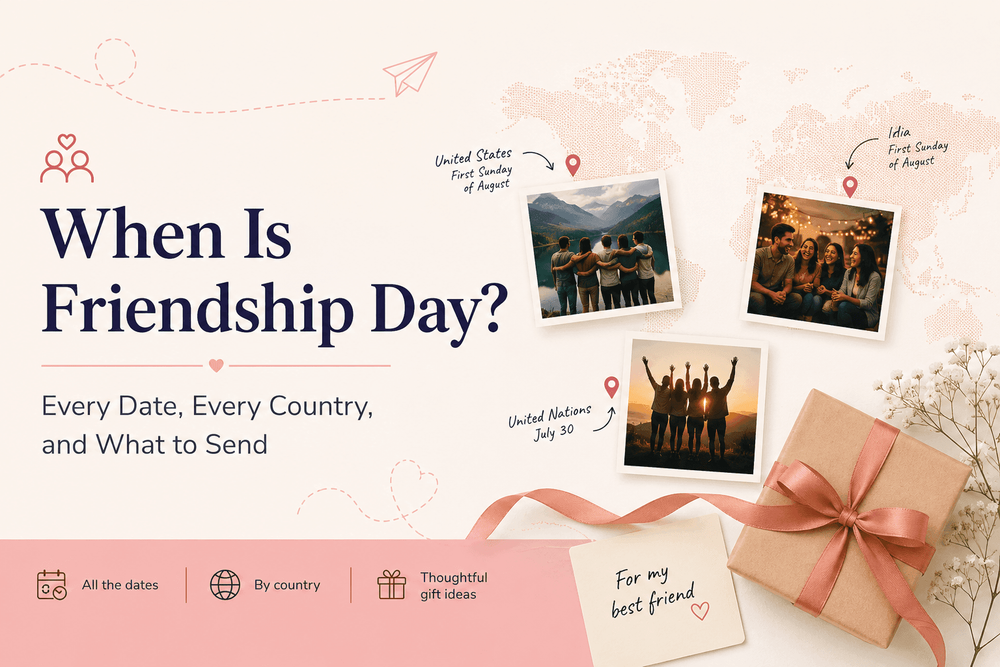
Ask three people when Friendship Day is and you'll get three answers, all of them correct.
The United Nations says 30 July. The United States says the first Sunday in August. Argentina, Brazil, Spain and Uruguay have celebrated on 20 July since a dentist in Buenos Aires was inspired by the Moon landing. Finland and Estonia skip the whole thing and turn Valentine's Day into a celebration of friends instead.
None of these are wrong. There is no single official Friendship Day, and there never has been. What exists instead is a scatter of separate holidays, invented in different decades on different continents for different reasons, that happen to share a name.
That's genuinely confusing if you're trying to work out whether you've missed it, whether it's tomorrow, or whether the friend you want to message is in a country that celebrates on a different day entirely.
So this guide does two things. First, it gives you the actual dates, all of them, by country, with the reasons they diverge. Second, it deals with the practical question that brought most people here: your friend is somewhere else, the day is close or already passing, and you want to send something that doesn't feel like a forwarded graphic.
Let's start with the dates.
When Is Friendship Day in 2026?
There are four Friendship Days in 2026 that matter to most people: 20 July (Argentina, Brazil, Spain, Uruguay), 30 July (the UN's International Day of Friendship), 2 August (the United States and much of South and Southeast Asia), and 14 February (Finland, Estonia, and several Latin American countries). Which one applies depends entirely on where you or your friend live.
Here are the 2026 dates in calendar order:
| Date in 2026 | Day | Observance | Where |
|---|---|---|---|
| 14 February | Saturday | Friend's Day / Día del Amigo | Finland, Estonia, Mexico, Ecuador, Guatemala, Venezuela, Peru, Dominican Republic |
| 16 April | Thursday | Friendship Day | South Africa |
| 9 June | Tuesday | Friendship Day | Ukraine |
| 4 July | Saturday | El Día del Amigo (first Saturday) | Peru |
| 14 July | Tuesday | Friendship Day | Ecuador, Venezuela |
| 19 July | Sunday | Friendship Day | Pakistan |
| 20 July | Monday | Día del Amigo / Dia do Amigo | Argentina, Brazil, Spain, Uruguay |
| 23 July | Thursday | Día del Amigo | Bolivia |
| 30 July | Thursday | International Day of Friendship | United Nations, Paraguay |
| 2 August | Sunday | National Friendship Day (first Sunday in August) | United States, Bangladesh, Nepal, Malaysia, UAE |
A few of these deserve a note before you scroll past them.
20 July has already passed in 2026. If you're reading this in late July and your friend is in Buenos Aires, São Paulo or Madrid, their Friendship Day was Monday the 20th. You're late, but a late message on this particular holiday is close to a tradition in itself.
30 July is the closest thing to a global date. It's the one the UN recognises, and it's the date most international organisations, schools and brands use when they want a Friendship Day that isn't tied to one country.
2 August is the biggest by participation. The first Sunday in August covers the United States and a large stretch of South and Southeast Asia, which between them account for most of the world's Friendship Day search traffic and most of the greeting-card volume.
If you want the short version: when someone says "Friendship Day" without qualifying it, they almost always mean either 30 July or the first Sunday in August. Everything else is regional.
Friendship Day dates for the next few years
The 20 July and 30 July dates are fixed. The first-Sunday-in-August date moves:
| Year | First Sunday in August | International Day of Friendship | Día del Amigo |
|---|---|---|---|
| 2026 | Sunday 2 August | Thursday 30 July | Monday 20 July |
| 2027 | Sunday 1 August | Friday 30 July | Tuesday 20 July |
| 2028 | Sunday 6 August | Sunday 30 July | Thursday 20 July |
| 2029 | Sunday 5 August | Monday 30 July | Friday 20 July |
| 2030 | Sunday 4 August | Tuesday 30 July | Saturday 20 July |
Worth noticing: in 2028 the UN date and a Sunday coincide, which is the sort of thing that tends to produce a bigger-than-usual year for the holiday.
Why Does Friendship Day Have So Many Different Dates?
Friendship Day has multiple dates because it was invented multiple times, independently, by people who didn't know about each other. A greeting-card executive in the United States proposed one version in 1930. A Paraguayan doctor proposed another in 1958. An Argentine dentist proposed a third in 1969. The UN eventually picked one of them, but by then the others were already local traditions.
This is unusual. Most international observances have a single origin that spreads outward. Friendship Day has at least three origin stories that grew in parallel and only partially merged.
Here's how each one started.
The commercial origin (United States, 1930)
The earliest documented proposal came from Joyce Hall, the founder of Hallmark Cards, in 1930. Hall's idea was a mid-summer occasion, set for 2 August, on which people would send cards to friends the way they already sent cards to mothers and fathers.
The reception was not warm. The greeting-card industry backed it, and the public read that backing as exactly what it looked like: an attempt to manufacture a card-buying occasion in a quiet part of the calendar. The idea faded in the United States for decades.
You'll frequently see the claim that the US Congress formally recognised the first Sunday in August as National Friendship Day in 1935. That claim is repeated across a lot of holiday sites, but it's poorly sourced, and I haven't been able to trace it to a congressional record. Treat it as folklore until someone produces the resolution.
You'll also see 1919 given as the founding year rather than 1930. Wikipedia and most reference sources use 1930 and credit Joyce Hall specifically. The 1919 date appears mostly on aggregator sites without citation.
The peace-movement origin (Paraguay, 1958)
The version that eventually reached the United Nations began at a dinner table.
On 20 July 1958, in Puerto Pinasco, a town on the River Paraguay roughly 320 kilometres north of Asunción, Dr. Ramón Artemio Bracho proposed to the friends he was eating with that there should be a World Friendship Day. Out of that conversation came the World Friendship Crusade, a foundation dedicated to promoting friendship between people regardless of race, colour or religion.
This was not a card-selling exercise. Bracho's framing was explicitly about peace between peoples, and the Crusade spent decades lobbying the United Nations to adopt 30 July as a recognised international day.
Paraguay has celebrated 30 July as Friendship Day ever since.
The Moon-landing origin (Argentina, 1969)
Eleven years later, and apparently without knowing about Bracho, an Argentine dentist and Rotarian named Enrique Ernesto Febbraro had a similar idea from a completely different direction.
Febbraro watched the Apollo 11 mission and took from it something other than national pride: if humanity could cooperate well enough to put a person on the Moon, it could manage friendship. While Apollo 11 was still in space, he wrote and posted roughly 1,000 letters to Rotary Club contacts around the world proposing that 20 July, the date Neil Armstrong stepped onto the lunar surface, be observed as a day of friendship.
He got about 700 replies.
That response was enough to seed the tradition across the Spanish- and Portuguese-speaking world. Argentina formally recognised the date by decree in 1979, and it spread to Uruguay, Brazil and Spain.
Paraguay and Argentina have been quietly disputing which country originated Friendship Day ever since, which is a fairly on-brand argument for a holiday about friendship.
The Nordic reframing (Finland, 1980s)
The fourth strand isn't an origin story so much as a substitution.
In Finland during the 1980s, Ystävänpäivä, literally "Friend's Day", emerged on 14 February as an alternative to the romantic framing of Valentine's Day. It started in schools, where children were encouraged to make cards and small gifts for classmates, and it spread outward from there. It reached Estonia, where it's called Sõbrapäev, by the end of that decade, and was formally added to Finnish calendars in 1996.
It caught on to a degree that surprises people. Friend's Day is now the second most popular card-giving occasion in Finland, with around three million cards sent in 2015 in a country of roughly five and a half million people.
Several Latin American countries, including Mexico, Ecuador, Guatemala, Venezuela, Peru and the Dominican Republic, use 14 February the same way, as Día del Amor y la Amistad, love and friendship, rather than romance alone.
And one purely commercial one (Peru, 2009)
Peru is worth a mention because it's the most honest about its origins.
Since 2009, Peru has observed El Día del Amigo on the first Saturday of July. The date was proposed by the beer brand Pilsen Callao, with the stated aim of carving out a celebration of platonic friendship distinct from Valentine's Day.
A beer company invented it, everyone knows a beer company invented it, and it's a real tradition anyway. Which is arguably the most useful thing to understand about all of these dates.
Friendship Day Around the World: The Complete Country-by-Country Calendar
Below is the fullest country-by-country list I can assemble from reliable sources. I've flagged where sources disagree rather than smoothing over the gaps, because on this topic the disagreements are frequent and most guides pretend they aren't.
| Country | Date | Local name | Notes |
|---|---|---|---|
| Argentina | 20 July | Día del Amigo | Recognised by decree, 1979. Enormous participation. |
| Bangladesh | First Sunday in August | Friendship Day | Follows the South Asian pattern. |
| Bolivia | 23 July | Día del Amigo | Own date, distinct from the 20 July bloc. |
| Brazil | 20 July | Dia do Amigo | Also has a separate National Friendship Day on 18 April. |
| Dominican Republic | 14 February | Día del Amor y la Amistad | Love and friendship combined. |
| Ecuador | 14 February and 14 July | Día del Amor y la Amistad | Sources list both dates. |
| Estonia | 14 February | Sõbrapäev | Adopted from Finland in the late 1980s. |
| Finland | 14 February | Ystävänpäivä | Official in calendars since 1996. |
| Guatemala | 14 February | Día del Cariño | Affection and friendship. |
| Malaysia | First Sunday in August | Friendship Day | — |
| Mexico | 14 February | Día del Amor y la Amistad | Widely observed. |
| Nepal | First Sunday in August | Friendship Day | — |
| Pakistan | 19 July | Friendship Day | Distinct from the 20 July bloc. |
| Paraguay | 30 July | Día de la Amistad | Origin of the UN date. Gift-giving often starts 29 July. |
| Peru | First Saturday in July, and 14 February | El Día del Amigo | July date introduced 2009. |
| Singapore | Third week of April | Friendship Day | Sources are vague on the exact day. |
| South Africa | 16 April | Friendship Day | — |
| Spain | 20 July | Día del Amigo | Adopted from Argentina. |
| Ukraine | 9 June | Friendship Day | The only June observance on this list. |
| United Arab Emirates | First Sunday in August | Friendship Day | — |
| United States | First Sunday in August | National Friendship Day | Some sources claim 7 August; see below. |
| Uruguay | 20 July | Día del Amigo | Adopted from Argentina. |
| Venezuela | 14 February and 14 July | Día del Amor y la Amistad | Sources list both. |
| Worldwide | 30 July | International Day of Friendship | United Nations. |
Where the sources genuinely disagree
Three specific conflicts are worth knowing about, because they'll change what you see depending on which site you land on.
The United States date. Most reference sources, including the National Day Calendar, put National Friendship Day on the first Sunday in August. Wikipedia's article carries a line saying the US date moved to 7 August, sourced to a holiday-listings site rather than anything official. The first-Sunday convention is far better attested, and it's what US organisations actually use. I'd go with the first Sunday.
Ecuador and Venezuela. Both appear under 14 February and 14 July in different reference lists. It's plausible both are observed for different reasons, one as the love-and-friendship pairing and one as a separate friendship date, but I haven't found a source that resolves it cleanly.
Singapore. Listed as "the third week" of a month without the month being consistently specified. Treat any precise Singapore date you see online with suspicion.
If a guide gives you all of this with total confidence and no caveats, it's guessing.
What Is the International Day of Friendship?
The International Day of Friendship is a United Nations observance held annually on 30 July. The General Assembly proclaimed it in resolution 65/275 on 27 April 2011, adopting it without a vote (United Nations). Its stated purpose is that friendship between peoples, countries and cultures can support peace efforts and build bridges between communities.
This is the closest thing to an official, global Friendship Day, and it's the date to use when you don't know where someone is or when you're organising something that spans countries.
A few details that most write-ups skip.
The resolution didn't appear from nowhere. It was the outcome of decades of lobbying by the World Friendship Crusade, the Paraguayan foundation Bracho started in 1958. The UN kept the Crusade's chosen date of 30 July rather than picking a neutral one, which means the official global Friendship Day traces directly back to a dinner conversation in a small river town in Paraguay.
The resolution is also grounded in earlier UN work, specifically the 1997 Declaration and Programme of Action on a Culture of Peace, and the International Decade for a Culture of Peace and Non-Violence for the Children of the World that ran from 2001 to 2010. Friendship, in the UN's framing, is infrastructure for peace rather than a sentiment.
And it places unusual emphasis on young people. The resolution specifically calls for involving youth in community activities that bring different cultures together, on the reasoning that people who form cross-cultural friendships early carry them into positions of influence later.
One more thing, because it's true and almost nobody mentions it: in 1998, Nane Annan named Winnie the Pooh the world's Ambassador of Friendship at the United Nations, at an event co-sponsored by the UN Department of Public Information and Disney. It remains one of the stranger entries in the UN's ceremonial record.
What Is National Friendship Day in the United States?
National Friendship Day in the United States falls on the first Sunday in August, which is 2 August in 2026. It descends from Joyce Hall's 1930 proposal, faded almost immediately under accusations of commercialism, and returned decades later largely through the same greeting-card and gifting industries that first proposed it.
It's a low-intensity holiday by American standards. There's no time off, no fixed ritual, and no widely observed convention about what you're supposed to do. Most participation is a message, a social post, or a small gift between close friends.
That looseness is the interesting part. Because there's no script, there's also no expectation to fail. Nobody is judging your Friendship Day gesture against a standard, the way they might judge a birthday or a wedding gift. A message that's clearly written by you, for one specific person, outperforms almost anything bought, because the bar for effort is so low that visible effort stands out.
Worth separating from two neighbouring US observances that get confused with it:
- National Best Friends Day, 8 June. A separate, unrelated observance.
- Galentine's Day, 13 February. Originated in the television series Parks and Recreation, now widely observed, specifically about friendships between women.
If someone in the US mentions "Friend's Day" in February, they probably mean Galentine's. In June, Best Friends Day. In August, National Friendship Day.
Día del Amigo: Why Argentina Celebrates the Moon Landing
In Argentina, Uruguay, Brazil and Spain, Friendship Day is 20 July, and it's tied to the day Neil Armstrong walked on the Moon.
Enrique Ernesto Febbraro's reasoning was that the Moon landing had been watched simultaneously by more of humanity than any previous event, and that the correct response to that shared moment was not competition but friendship. He mailed roughly a thousand letters to Rotary Club contacts internationally while Apollo 11 was still in transit, and roughly seven hundred people wrote back.
What makes this worth more than a paragraph is the scale it reached.
Día del Amigo in Argentina is not a quiet observance. Restaurants and bars in Buenos Aires are typically booked out a week ahead. And in the mid-2000s, the volume of Friendship Day messages and calls was enough to crash mobile phone networks in Buenos Aires, Mendoza, Córdoba and Rosario, an outage reported as comparable to what those networks saw on Christmas and New Year's Day.
A holiday invented by one dentist with a stack of envelopes now generates enough traffic to take down national telecoms infrastructure.
Paraguay has its own texture on the neighbouring date. Gift-giving to close friends and family traditionally begins on 29 July, and the country practises Amigo Invisible, or Invisible Friend, in which members of a group draw names in secret and reveal their gifts on 30 July. It works like a secret-gift exchange, but for friends rather than colleagues at a holiday party, and it runs in schools and workplaces across Asunción and other cities.
Brazil, meanwhile, has two. It observes 20 July alongside its neighbours, and separately has a National Friendship Day on 18 April, which was driven largely by retail interests looking to add a sales occasion to a slow month. The 20 July date is the one people actually use.
Where Friendship Day Replaces Valentine's Day
In Finland, Estonia, Mexico, Guatemala, Peru, Ecuador, Venezuela and the Dominican Republic, 14 February is about friendship as much as romance, and in Finland and Estonia it's about friendship instead of romance.
This is the most quietly radical version of the holiday, and the one worth borrowing from wherever you live.
Finland's Ystävänpäivä started in schools in the 1980s. Children made cards for classmates. The logic was that a February celebration organised entirely around couples excludes most of a classroom, and that a celebration organised around friends excludes nobody. It moved to Estonia as Sõbrapäev by the end of the decade and entered official Finnish calendars in 1996.
The adoption numbers are the part that surprises people. Around three million Friend's Day cards were sent in Finland in 2015, in a country of about five and a half million people, making it the second most popular card-giving occasion of the Finnish year. Families, couples and single people all participate. Shared meals, skating, sledding.
The Latin American version keeps romance in the frame but refuses to let it dominate. Día del Amor y la Amistad, the Day of Love and Friendship, is celebrated with partners, friends, siblings and parents alike. In Mexico it's entirely normal to give a friend a small gift on 14 February without anyone reading anything into it.
If you've ever found 14 February a bit narrow, these countries solved that decades ago. And if the person you want to reach on that date is someone you'd rather not stay platonic with, that's a different problem with its own kind of link.
There's a practical upshot here too. If you have a friend in Helsinki or Tallinn or Mexico City, February is when they're expecting to hear from you about friendship, not August. Sending a Friendship Day message to a Finnish friend on 2 August will land as a pleasant non-sequitur.
What Are Friendship Bands, and Where Did They Come From?
Friendship bands are woven or beaded bracelets exchanged between friends, traditionally tied on the wrist and worn until they fall off on their own. They're the single most recognisable Friendship Day object, and they went through an unexpected global revival in 2023 that had nothing to do with the holiday at all.
The form itself is old. Hand-knotted decorative cords appear across many cultures, and the modern macramé-style friendship bracelet spread widely through the United States and Europe from the 1970s onward, with the convention that the wearer keeps it on until it wears through. Cutting one off early was considered bad form. The rule made the bracelet a small commitment device: a physical object that logs how long you've kept faith with someone.
By the 2010s the tradition had gone fairly quiet outside of school playgrounds and summer camps.
Then Taylor Swift's Midnights arrived in 2022 with a line in "You're On Your Own, Kid" about making friendship bracelets, and when the Eras Tour opened in March 2023 fans began mass-producing beaded bracelets to trade with strangers in stadium queues. It became the defining fan behaviour of the tour. On TikTok, videos tagged #friendshipbracelet accumulated around 200 million views, with the tour-specific tag passing 30 million.
What's interesting about that revival is the mechanic. Fans weren't giving bracelets to existing friends. They were giving them to people they'd never met, as an opening move, which inverts the original meaning entirely. The bracelet stopped being a record of a friendship and became an invitation to start one.
What to do with this if you're not at a stadium
The band is a decent template even if you never make one.
The properties that make it work are that it's handmade, it's specific to one person, it costs almost nothing, and it persists. Most good Friendship Day gifts hit at least three of those. A forwarded graphic hits none.
If you want a digital equivalent, the closest analogue is something the other person has to actively engage with and can come back to later, rather than something they glance at once. A photo puzzle built around a picture only they would recognise does roughly what the bracelet did: it takes effort to make, it's specific, and the reveal is the same small ceremony as tying a knot on someone's wrist.
If you do want to make a physical one, the traditional rule still stands. You tie it on their wrist for them, they make a wish, and it stays on until it falls off.
Friendship Day vs Every Other Friendship Observance
Friendship Day is one of at least six separate occasions built around friendship, several of which get confused with each other. Here's what each one actually is.
| Occasion | Date | Origin | Focus |
|---|---|---|---|
| International Day of Friendship | 30 July | UN General Assembly, 2011 | Friendship between peoples and nations |
| National Friendship Day | First Sunday in August | Joyce Hall, Hallmark, 1930 | Friends generally |
| Día del Amigo | 20 July | Enrique Febbraro, Argentina, 1969 | Friends generally |
| National Best Friends Day | 8 June | United States, origin unclear | Closest friends specifically |
| Galentine's Day | 13 February | Parks and Recreation, 2010 | Friendships between women |
| Friend's Day (Ystävänpäivä) | 14 February | Finland, 1980s | Platonic love as a whole |
National Best Friends Day (8 June)
A US observance, distinct from National Friendship Day in August, focused on the one or two people you'd describe as your closest friends rather than your friendships in general. Its origins are murky in a way the others aren't. It circulates widely on social platforms every June without a clearly documented founding.
Useful mainly as a second prompt in the calendar, well away from the July and August cluster.
Galentine's Day (13 February)
The best-documented origin of any of them, because it was written for television.
Galentine's Day first appeared in Parks and Recreation, season two, episode sixteen, which aired on 11 February 2010. Showrunner Mike Schur has credited writer Aisha Muharrar with the original idea. In the episode, Leslie Knope gathers her closest female friends on 13 February for breakfast, mimosas and handmade gifts, on the explicit logic that a February celebration organised entirely around romance leaves most people out.
It escaped the show almost immediately. Galentine's Day is now widely observed as a real occasion, which makes it one of the very few holidays with a verifiable authorship and an air date.
The framing that made it stick is worth noting: Knope insists it's the main event rather than a consolation prize for a disappointing Valentine's Day. That distinction is why it reads as celebratory instead of sad.
"Palentine's Day" is the mixed-gender variant that grew out of the same idea, though it has no canonical origin.
Friendsgiving
Not a fixed date, and not a Friendship Day, but worth listing because it operates on the same principle: a meal with chosen family, typically held in the days around the American Thanksgiving holiday in late November. It's the largest friendship-centred gathering tradition in the US by participation, despite having no official status whatsoever.
Which one should you use?
If you're picking a single occasion to actually commit to, the honest recommendation is the one nearest to now. All of these exist because friendship has no natural milestone, and the specific date matters far less than having any date at all.
Friendship Day Traditions Worth Stealing
Most Friendship Day customs are local, small, and considerably better than the greeting-card version. A few are worth importing regardless of where you live.
Amigo Invisible (Paraguay). Members of a group draw names in secret, then reveal their gifts on 30 July. It's structurally the same as a secret-gift exchange at a workplace holiday party, but for friends, and it runs in schools and offices across Asunción. It solves the two hardest problems of group gifting at once: nobody buys eleven presents, and nobody gets left out.
Booking the table a week early (Argentina). In Buenos Aires, restaurants and bars on 20 July are typically full a week in advance. The custom isn't the meal, it's the fact that people plan for it. Friendship gatherings usually die because nobody schedules them, and a date that forces the scheduling is doing real work.
Handmade only (Finland). Ystävänpäivä began with schoolchildren making cards rather than buying them, and the handmade convention stuck to a degree that Finland now sends around three million Friend's Day cards a year. The constraint is the point. If nothing can be bought, effort becomes the only currency and everyone is on equal footing.
Tie it on, don't hand it over (friendship bands). The band is tied onto the other person's wrist rather than passed to them, and it stays until it falls apart. A small ceremony attached to an object makes the object stick in memory.
Give to strangers (Eras Tour, 2023). The stadium-queue bracelet exchange treated the gift as an opening rather than a record. If your friend group has gone quiet, using the occasion to contact someone you barely know yet is a more interesting use of it than another message to the same five people.
How Long Does It Actually Take to Make a Close Friend?
Roughly 200 hours, according to research by Jeffrey Hall at the University of Kansas, published in the Journal of Social and Personal Relationships. Hall found it takes about 50 hours together to move from acquaintance to casual friend, around 90 hours to become a friend, and more than 200 hours before someone counts as a close friend.
Hours spent working alongside someone counted for much less. What moved the needle was unstructured time: hanging around, joking, playing things, doing nothing in particular.
Sit with those numbers for a second, because they explain a great deal about adult friendship.
Two hundred hours is enormous. If you meet someone for coffee twice a month for ninety minutes, you'll reach close friendship in about five and a half years. Most adults do not have five and a half years of spare fortnightly coffees available, which is why so many people report that their closest friendships all date from school or university. Those environments supplied hundreds of unstructured hours by default, and almost nothing in adult life does.
It also reframes what a Friendship Day message is doing. It isn't building a friendship. Nothing you send in five minutes builds anything. What it does is protect an existing investment of hundreds of hours that would otherwise decay quietly through simple lack of contact.
That's a much better argument for the occasion than sentiment. If you've genuinely put two hundred hours into knowing someone, letting that lapse because neither of you had a reason to message first is a poor return on the time.
The practical implication
If you want more close friends, the mechanism isn't better conversation. It's more hours, and specifically more unstructured, low-purpose hours.
Which is why the shared-activity formats matter more than the message formats. A running weekly question exchange, a game you both dip into, a collaborative playlist that accumulates over months: these generate hours passively. A single well-written Friendship Day note does not.
Send the note. Then start something that runs.
What If You've Drifted From a Friend and It Feels Too Late?
Send something anyway, and don't explain the gap. The overwhelming majority of lapsed friendships lapsed through nothing but inertia, and both people are usually sitting on the same guilt and the same assumption that the other one stopped caring. Friendship Day is useful here precisely because it supplies a reason to make contact that isn't about the silence.
This is the situation most people are actually in when they search for Friendship Day ideas, and it's the one every gift guide ignores.
Here's what tends to go wrong. Someone decides to reach out, then decides the message has to account for two years of not speaking, then starts drafting an explanation, then realises the explanation sounds either defensive or falsely casual, then doesn't send anything. The gap grows, which makes the required explanation longer, which makes sending it harder. It compounds.
The way out is to refuse the premise that an explanation is owed.
Don't open with the gap. "I know it's been ages and I'm sorry" makes the silence the subject of the conversation and quietly asks the other person to absolve you. Most people will do it, and then the exchange is about the absolution rather than about them.
Lead with the specific thing. A photo, a memory, something you saw that reminded you of them. The message becomes about the thing rather than about the relationship's maintenance record.
Acknowledge it in one clause, at most. If it genuinely needs naming, a subordinate clause is enough. "Happy Friendship Day, terrible correspondent that I am."
Ask nothing. No "we should catch up soon." That converts a gift into a request and puts the burden of scheduling on someone who may not want it yet. If they want to reopen the conversation they will, and if they don't, you've still sent something kind that cost them nothing.
Send it and then genuinely let it go. The value of this message doesn't depend on the reply. Some percentage of these won't get answered, for reasons that usually have nothing to do with you.
Why the occasion helps
Unsolicited contact after a long silence carries an implicit question: why now, and what do you want? That question is what makes people hesitate.
A dated occasion answers it in advance. Why now is because it's Friendship Day. What you want is nothing. The holiday does the work of justifying the message, which is most of the obstacle, and it does it without either party having to name the awkwardness.
This is genuinely the best use of the whole thing. Not the friends you speak to weekly, who don't need a calendar prompt. The ones you haven't spoken to in eighteen months and think about more often than that would suggest.
If what's actually sitting between you is a specific unresolved thing rather than simple drift, that's a different conversation, and our guide on how to say sorry properly covers it in more depth.
Which Friendship Day Should You Actually Celebrate?
Use your friend's date, not yours. If you don't know theirs, use 30 July, the UN's International Day of Friendship, which is the only date with a claim to being global. If it's already passed and you want an excuse, the first Sunday in August is close behind and covers the largest number of people.
Here's the decision in practical form:
| Your situation | Date to use |
|---|---|
| You and your friend are in the same country | Whatever your country observes |
| Your friend is in Argentina, Brazil, Spain or Uruguay | 20 July |
| Your friend is in Finland or Estonia | 14 February |
| Your friend is in Mexico or most of Latin America | 14 February, or the local July date |
| Your friend is in the US, or in South or Southeast Asia | First Sunday in August |
| You genuinely don't know where they are | 30 July |
| You want to celebrate a friend group spread across countries | 30 July, the neutral choice |
| You've missed the date entirely | Send it late; see below |
On being late
Being late to Friendship Day carries close to zero social cost, and this is the one genuine advantage the holiday has over birthdays and anniversaries.
Nobody has an expectation attached to the date. There's no equivalent of the awkward "you forgot my birthday" conversation, because most people don't track when their own Friendship Day is. A message that arrives three days after the fact reads as thoughtful, not delinquent. A message that arrives four months late, framed as "I saw this and thought of you," reads as thoughtful too.
Which means the correct time to send something to a friend is whenever you happen to think of it. The date is a prompt, not a deadline.
What Do You Send on Friendship Day?
The honest answer is that almost anything works as long as it's specific to the person. The failure mode isn't sending the wrong gift. It's sending something so generic that it's obvious you sent the same thing to everyone. A forwarded graphic with someone else's watermark communicates that you thought about the occasion. Something built around one shared memory communicates that you thought about them.
Friendship Day has a structural problem that birthdays don't: it usually arrives without warning, it's often the same day across a whole friend group, and physical gifts require an address and a delivery window you don't have. Most people realise it's Friendship Day on the morning of Friendship Day.
So the options that actually work are the ones that don't need a courier.
Things that arrive instantly and don't feel lazy
A shared-memory photo challenge. Take a photo that only the two of you would recognise, whether a specific night out, a trip, or a room you both lived in, and turn it into something they have to work for before it reveals. A solve-to-reveal photo puzzle does this well: you upload the picture, add your own questions, and they have to answer before the image resolves. The sender gets a live dashboard showing their answers as they go, which is usually funnier than the reveal.
This works particularly well for Friendship Day specifically, because the entire premise of the holiday is shared history. A photo from six years ago that they have to earn their way back to is a better argument for a friendship than any message.
A "how well do you actually know me" set of questions. The competitive-friendship format. Everyone thinks they'd win. Almost nobody does. We've collected 50 questions built for this. They were written with couples in mind, but most of them transfer directly to close friends with no editing.
A voice note instead of a text. Underrated and free. Thirty seconds of your actual voice saying one specific thing you appreciate about someone lands harder than a paragraph, because almost nobody does it and it can't be mistaken for a forward.
A playlist with liner notes. Not the playlist alone. The playlist plus a line for each track explaining why it's there. The annotation is the gift.
A shared photo album they can add to. Most cloud photo services let you create a collaborative album. Seed it with twenty photos of the two of you and send the invite. It keeps generating for years, which very few gifts do.
A written list of specific memories. No format, no design, no app. Ten numbered things that happened, described precisely enough that they can picture each one. This costs nothing and is regularly the thing people keep.
If you want a broader run at this, we've written a full guide to free online gifts that don't feel cheap and a wider collection of personalized digital gift ideas that covers more occasions than this one.
What to avoid
Some categories reliably underperform, and it's worth naming them.
Forwarded graphics. The template images with generic text that circulate on messaging apps every Friendship Day. Everyone receives several. Nobody keeps one.
Group messages. A message addressed to eleven people communicates that no single one of them was worth a separate thought. If you're going to send the same thing to your whole friend group, at least send it separately with one line changed for each person.
Anything requiring shipping, decided on the day. If it's the morning of Friendship Day and you're browsing a gift site, the delivery estimate is going to be after the occasion. That's fine if you're comfortable being late, as covered above, but don't pay express shipping for a date nobody's tracking.
Generic "friendship" merchandise. Mugs, keychains and plaques with the word FRIENDS on them are gifts about the concept of friendship rather than about your friend. The concept doesn't need commemorating. The person does.
If it's their birthday around the same time
Friendship Day falls in a busy stretch of the calendar, and if a friend's birthday lands nearby you can reasonably combine the two. A personalised birthday celebration you send as a link, one they open to blow out candles and read a message you wrote, covers both occasions without either feeling like an afterthought. We've written more on digital birthday gift ideas if that's the situation you're in.
How to Send a Friendship Day Gift in Under Five Minutes
If Friendship Day is today and you have nothing prepared, this takes about five minutes start to finish and produces something specific to one person.
-
Pick one memory, not a general feeling. Not "you've always been there for me." A specific night, trip, argument, or in-joke. Specificity is the entire mechanism. Two minutes of thinking here is worth more than anything else in this list.
-
Find the photo that goes with it. Search your camera roll by rough date. It doesn't need to be a good photo. Badly lit, blurry photos from years ago consistently outperform well-composed recent ones, because they're evidence rather than content.
-
Choose the format. If you want them to do something rather than just look at something, build it into a photo puzzle they have to solve. If you want it simple, the photo plus a written paragraph is fine.
-
Write the questions or the note. For a puzzle, write three or four questions only the two of you could answer. The more obscure the better. For a note, write the memory in detail and then one sentence about what the friendship has actually meant. Resist the urge to make it eloquent.
-
Send it directly, one person at a time. Not to a group. Not as a story. A link or message in a one-to-one conversation, with their name in it. If you're sending to several friends, send several separate messages.
Total time is under five minutes if you don't overthink step one, and step one is the only part that matters.
If the technical side is what's putting you off, we've written a guide to digital gift ideas that require no technical skill at all.
What Do You Write? Messages That Don't Sound Forwarded
A good Friendship Day message names something specific that happened, says what it meant, and stops. Length isn't the variable. A two-line message with one real detail beats six lines of general warmth, every time, because the detail proves you were thinking about that person rather than about the occasion.
The reason most Friendship Day messages fail is that they're written about friendship rather than about a friend. "Friends are the family we choose" is a statement about a category. It contains no information about the recipient, which means it could have been sent to anyone, which is exactly how it reads.
The three-part structure that works
1. The specific detail. Something that happened. A date, a place, a thing they said.
2. What it meant. One sentence. Not a paragraph.
3. The present-tense line. Something about now, so it isn't purely nostalgic.
Worked example:
"I still think about you driving four hours to sit in a hospital car park with me in 2019 and not once making it a big deal. I don't think I ever properly said what that meant. Anyway, happy Friendship Day, and I'm glad you're still around."
That's three sentences. It couldn't have been sent to anyone else.
If you don't have a dramatic memory
Most friendships don't have a hospital-car-park story, and they don't need one. Small and specific beats big and vague.
"Happy Friendship Day. You're the only person I can send something completely unhinged at 1am and get an immediate reply. I don't take that for granted."
"Thinking about the fact that we've now been friends longer than we haven't. Genuinely one of the better things about my life. Happy Friendship Day."
"Happy Friendship Day to the person who has never once let me leave the house in something bad."
For a friend you've drifted from
This is the message most people want to send and don't, because the gap itself feels like the thing that has to be addressed first.
The move is to acknowledge it briefly and not make it the subject.
"I know we've been terrible at keeping in touch and I'm at least half of that problem. Happy Friendship Day anyway. I think about you more than the message frequency would suggest."
Almost nobody responds badly to this. The occasion gives you a reason to reach out that doesn't require an explanation, which is most of what people are stuck on.
For a long-distance friend
"Happy Friendship Day from the wrong time zone. Six years and four cities and you're still the first person I want to tell things to."
For a friend group
Send individually, but you can keep a shared spine and change one line each:
"Happy Friendship Day. Genuinely could not have got through the last few years without this group, and specifically without [one thing that person did]."
The bracket is the whole point. Fill it differently every time.
If you owe them an apology more than a greeting
Sometimes the honest Friendship Day message is not a celebration. If there's something unresolved, the occasion is a reasonable door to open. We've written a longer piece on how to actually say sorry to someone if that's closer to your situation.
How Do You Celebrate Friendship Day Long Distance?
Long-distance friendship is where Friendship Day is most useful, because it supplies a reason to make contact that doesn't require one. The practical constraints are time zones, the fact that physical gifts need an address you might not have, and the slow drift that happens when nobody has a specific reason to message.
Distance makes the date matter more, not less. Friends who see each other weekly don't need a prompt. Friends three time zones apart do.
Deal with the time zone deliberately
Work out their local time before you send anything. A Friendship Day message that arrives at 4am reads as automated even if you wrote it by hand.
If you want to be precise about it, aim for their early evening. That's when people have the attention to reply properly rather than acknowledging and forgetting.
Do something together, asynchronously
The failure mode of long-distance friendship is that all the interaction becomes updates. Status reports, in both directions, until neither person has anything to report and the thread goes quiet.
The fix is a shared activity that doesn't need you both online at once.
- A solve-to-reveal photo puzzle. Send it, go to sleep, wake up to their answers. The live sender dashboard means you see what they guessed even though you weren't there, which is a decent approximation of being in the room.
- A running question exchange. One question each, per week. Not "how are you." Things like "what's the last thing that genuinely surprised you." It keeps a thread alive without either person having to generate news.
- Watching the same thing separately and sending reactions as you go. Works better than synchronised viewing across time zones, and requires no coordination.
- A collaborative playlist that you both add to over months.
We've covered a lot more of this in our guide to online games and shared activities. It's written for couples, but nearly all of it works for friends without modification, and the long-distance mechanics are identical. Our piece on celebrating from a distance has more on the time-zone logistics.
Send something that arrives at their local midnight
If you know their time zone, scheduling a message or a link to land exactly at their midnight is a small trick with a disproportionate effect. It suggests you did arithmetic on their behalf, which is a form of attention people notice.
Most messaging apps support scheduled sends. Most people never use it.
How Do You Organise Friendship Day for a Group Spread Across Countries?
Pick 30 July as the neutral date, choose a single asynchronous activity rather than a live call, and accept in advance that not everyone will participate on the same day. Group celebrations across time zones fail almost entirely because someone tries to schedule a call that works for six people on four continents, discovers it doesn't, and abandons the whole thing.
Here's a format that survives contact with reality.
1. Declare the date rather than negotiating it. Announce that you're doing something on 30 July. Don't open a poll. Group scheduling polls across time zones produce no viable slot and a lot of dead conversation, and the negotiation itself is usually where the plan dies.
2. Pick something that works whenever someone opens it. The constraint is that every participant should be able to take part in their own waking hours without coordination. That rules out calls and rules in almost everything else.
3. Run an Invisible Friend draw. The Paraguayan format transfers cleanly to a distributed group. Everyone draws one name in secret, everyone sends one thing to one person, and it all gets revealed on the day. Nobody has to buy six gifts, nobody gets missed, and because it's one-to-one the gifts are more specific than they would be otherwise.
For a digital version, each person sends their assigned friend something built for them alone. A photo puzzle using a picture from a shared trip works particularly well here, because the sender sees the recipient's answers come in on a live dashboard and can watch the reveal happen even from another continent.
4. Set up one shared thread for the reveals. Not for planning. Purely a place where people post what they received on the day. The thread becomes the gathering, and it stays interesting for about 36 hours as different time zones wake up, which is roughly the natural life of a good group chat moment anyway.
5. Seed a collaborative album at the same time. While everyone's attention is on the group, start a shared photo album and ask each person to add three pictures. It costs nobody anything and produces an artefact that keeps accruing long after the day.
6. Don't chase the non-participants. Someone will miss it. Two people will post four days late. That's a normal outcome and not a failure of the plan, and reminding people repeatedly converts a nice thing into an obligation, which is the fastest way to ensure nobody wants to do it again next year.
The whole structure takes about fifteen minutes to set up and it works across any number of time zones, because at no point does it require two people to be awake simultaneously.
Does Any of This Actually Matter?
More than the greeting-card framing suggests. In 2025 the World Health Organization's Commission on Social Connection reported that loneliness and social isolation are linked to around 871,000 deaths a year worldwide, roughly a hundred every hour, and put social disconnection in the same tier of public-health risk as air pollution, tobacco and alcohol.
That's a heavy statistic to attach to a holiday about sending photos to your mates, and I want to be careful not to overstate the link. Nobody's claiming a Friendship Day message is a public-health intervention.
But the surrounding numbers are worth sitting with.
The WHO Commission, established in November 2023 and co-chaired by Vivek Murthy and Chido Mpemba, found that one in six people worldwide experience loneliness. It's most common among adolescents and young adults, at roughly one in five, and in lower-income countries, at close to one in four. About a third of adults over 60 are socially isolated.
In the United States, the Survey Center on American Life has tracked a sharp decline in close friendship over three decades. The share of Americans reporting no close friends rose from 3% in 1990 to 12% in 2021. Among men the shift is starker: from 3% to 15% over the same period, while the share of men with six or more close friends fell from 55% to 27%.
Time spent with friends followed. Americans spent roughly six and a half hours a week with friends for decades. Between 2014 and 2019, that fell to about four.
The pattern behind these numbers is not that people stopped valuing friendship. It's that adult friendship has no structural support. Romantic relationships have anniversaries, milestones and social expectation. Family has obligation. Friendship has none of that. It runs entirely on someone deciding, unprompted, to make contact.
That's the case for a date on the calendar, and it's a better one than the greeting-card industry ever made. Not because the date is meaningful in itself, but because friendship is the only significant relationship in most people's lives with no built-in reason to check in.
One deliberate message a year is a low bar. Most friendships that quietly ended would have survived clearing it.
Friendship Day FAQ
When is Friendship Day in 2026?
It depends on the country. The UN's International Day of Friendship is Thursday 30 July 2026. National Friendship Day in the United States and much of South Asia is Sunday 2 August 2026, the first Sunday in August. Argentina, Brazil, Spain and Uruguay observed Día del Amigo on Monday 20 July 2026.
Why are there so many Friendship Days?
Because it was invented separately at least three times. Joyce Hall of Hallmark Cards proposed a US version in 1930. Dr. Ramón Artemio Bracho proposed a global one in Paraguay in 1958. Enrique Febbraro proposed the Moon-landing date in Argentina in 1969. Each took hold regionally before any of them became international, and the UN's 2011 adoption of 30 July didn't displace the others.
Is Friendship Day 30 July or the first Sunday in August?
Both, in different places. 30 July is the official United Nations International Day of Friendship and the closest thing to a global date. The first Sunday in August is the national observance in the United States, Bangladesh, Nepal, Malaysia and the UAE. If you need one date for an international group, use 30 July.
Who invented Friendship Day?
There's no single inventor, and Paraguay and Argentina actively dispute the credit. The earliest documented commercial proposal was Joyce Hall's in 1930. The earliest proposal that led to UN recognition was Dr. Ramón Artemio Bracho's, on 20 July 1958 in Puerto Pinasco, Paraguay, which produced the World Friendship Crusade.
Is Friendship Day a public holiday anywhere?
No. It isn't an official day off in any country, including Paraguay and Argentina where participation is highest. It's an observance rather than a statutory holiday, which is part of why the dates were able to diverge so freely in the first place.
What is the difference between Friendship Day and International Day of Friendship?
The International Day of Friendship is the specific UN observance on 30 July, established by General Assembly resolution 65/275 in 2011. "Friendship Day" is the general term covering every national and regional version, of which the UN date is one. All International Days of Friendship are Friendship Days; not all Friendship Days are the UN one.
Why do Finland and Estonia celebrate Friendship Day on Valentine's Day?
Because they reframed the occasion rather than adding one. Ystävänpäivä began in Finnish schools in the 1980s as a version of 14 February that included everyone rather than just couples, spread to Estonia as Sõbrapäev by the end of the decade, and entered Finnish calendars officially in 1996. It's now the second most popular card-giving occasion in Finland.
What should I send a friend for Friendship Day?
Something specific to that person rather than to the occasion. A shared photo with a memory attached, a voice note naming one thing you appreciate, an annotated playlist, or a photo puzzle they have to solve to reveal an old picture. Anything that could have been sent to anyone else will read that way.
What if I've already missed Friendship Day?
Send it anyway. Friendship Day carries almost no expectation, which means it also carries almost no penalty for lateness, and very few people track when their own falls. A message a few days or even months later, framed as "I saw this and thought of you," lands as thoughtful rather than late.
Is there a Friendship Day for best friends specifically?
In the United States, National Best Friends Day is 8 June, separate from National Friendship Day in August. Galentine's Day on 13 February, which originated in the show Parks and Recreation, is specifically about friendships between women. Most other countries don't distinguish between friends and best friends by date.
Do people still send Friendship Day cards?
In some places, heavily. Finland sends roughly three million Friend's Day cards a year in a population of about five and a half million. In most other countries the volume has shifted to digital: messages, links and shareable pages rather than physical cards.
How do I celebrate Friendship Day with someone in another country?
Use their date rather than yours, check their local time before sending, and pick something that works asynchronously. A puzzle or challenge they can solve whenever they wake up works better across time zones than anything requiring you both to be online, and you still see their answers afterwards.
What is Día del Amigo?
The Spanish and Portuguese-speaking version, observed on 20 July in Argentina, Brazil, Spain and Uruguay. It commemorates the Apollo 11 Moon landing, following Enrique Febbraro's 1969 argument that a moment watched by all of humanity should be marked with friendship. It's one of the most heavily participated social occasions of the year in Argentina.
Does Brazil have two Friendship Days?
Yes. Brazil observes Dia do Amigo on 20 July with its neighbours, and separately has a National Friendship Day on 18 April that was driven largely by retail interests. The 20 July date is the one with real cultural traction.
How long does it take to become close friends with someone?
Research by Jeffrey Hall at the University of Kansas, published in the Journal of Social and Personal Relationships, found it takes roughly 50 hours together to move from acquaintance to casual friend, about 90 hours to become a friend, and over 200 hours to become close friends. Unstructured time counted for far more than time spent working together.
What are friendship bands and why do people wear them?
Friendship bands are woven or beaded bracelets exchanged between friends, traditionally tied onto the other person's wrist and worn until they fall off naturally rather than being removed. The custom spread widely from the 1970s onward and had a major global revival in 2023, when fans traded handmade beaded versions at Taylor Swift's Eras Tour.
What is Galentine's Day and how is it different?
Galentine's Day falls on 13 February and celebrates friendships between women. It originated in the sitcom Parks and Recreation, in an episode that aired on 11 February 2010, with showrunner Mike Schur crediting writer Aisha Muharrar for the idea. It's since become a genuinely observed occasion, distinct from both Valentine's Day and Friendship Day.
Should I message a friend I haven't spoken to in years?
Yes, and lead with something specific rather than with an apology for the silence. Most lapsed friendships lapsed through inertia rather than conflict, and both people usually assume the other stopped caring. A dated occasion like Friendship Day answers the awkward "why are you contacting me now" question in advance, which removes most of the obstacle.
What is Amigo Invisible?
A Paraguayan Friendship Day tradition in which members of a group draw names in secret and reveal their gifts on 30 July. It works like a secret-gift exchange but between friends, and it runs in schools and workplaces across Asunción and other cities. It's a practical solution for group gifting, since each person buys for one recipient rather than for everyone.
Is Friendship Day just a marketing invention?
Partly, and it depends which one. The US version was proposed by the founder of a greeting-card company, and Peru's July date was proposed by a beer brand. The UN date came out of a peace-movement foundation, and Finland's came out of schoolteachers. So: some of it was manufactured, some of it wasn't, and the manufactured ones became real traditions anyway.
The One Thing Worth Taking From This
If you remember nothing else: use your friend's date, and if you don't know it, use 30 July.
Everything else on this page is context. The dates diverge because the holiday was invented independently on three continents, and no amount of tidying will collapse them into one. That's genuinely interesting, but it isn't the reason most people arrived here.
The reason is usually a specific friend and a vague sense of having let something slide.
So the practical suggestion. Pick one person. Find one photo of something you both remember. Send it with two sentences about what actually happened, on whatever date is nearest. If you want them to work for it, turn it into a puzzle they have to solve before the picture appears. You'll get to watch their answers come in, which is usually the better half of the gift.
Then do it again next year, on whichever of the four dates you happen to notice first.
Nobody's checking. That's rather the point.