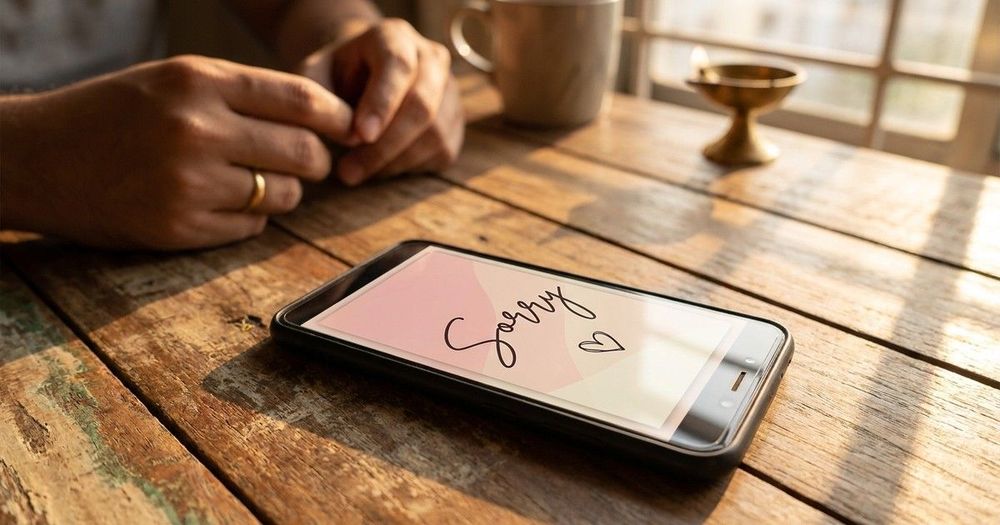
It's 2:14 AM. You sent the message you can't unsend. The blue ticks went grey. And now you're staring at the ceiling wondering how to fix it.
Or maybe it's a quieter version. Your mom called twice this week and you didn't pick up. Your best friend's birthday went by and you forgot. Your boss copied a senior on the email about your missed deadline. Your wife stopped asking how your day was three days ago.
Whatever brought you here, the question is the same: how do you say sorry to someone in a way that actually works? Not a "sorry babe" text that lands like a wet napkin. Not a corporate "I apologize for any inconvenience." A real apology. The kind that softens the other person's face when they read it, even if they don't reply right away.
This guide is built to be the only one you'll need. I cover every relationship in your life: girlfriend, boyfriend, wife, husband, best friend, mom, dad, sibling, kids, friend you ghosted, boss, colleague, customer. There are 200+ copy-paste-ready messages organized by situation and length. There's a full Hindi and Hinglish section because if your moment is in Hindi, your apology should be too. And there's a framework therapists actually use, with citations to the people who built it: Aaron Lazare, Gary Chapman, the researchers at Greater Good Berkeley, NPR's Life Kit team.
You'll also see one option a lot of these guides skip: when the moment is bigger than a text and you can't be there in person, a personalized Sorry Card from MyHeartCraft does what a one-line text can't. It costs ₹199, takes about 90 seconds to make, and turns your message into something they'll keep on their phone instead of swiping past. I'll come back to it where it actually fits, not on every other paragraph.
Pick the section you need from the table below and jump straight to it. If you want the framework first, start with the next two sections.
Table of Contents
- What does it actually mean to say sorry?
- The 6-part apology framework therapists use
- How to say sorry step by step
- What NOT to say when you apologize
- How to say sorry to your girlfriend (50+ messages)
- How to say sorry to your boyfriend (50+ messages)
- How to say sorry to your wife (30+ messages)
- How to say sorry to your husband (30+ messages)
- How to say sorry to your best friend (25+ messages)
- How to say sorry to your mom (20+ messages)
- How to say sorry to your dad (20+ messages)
- How to say sorry to your sibling (15+ messages)
- How to say sorry to your kids
- How to apologize to a friend you ghosted
- How to apologize professionally (boss, colleague, client)
- How to apologize to a customer
- How to say sorry in Hindi and Hinglish
- Apology channel decision matrix: text vs WhatsApp vs call vs in person
- Cute and creative ways to say sorry
- Sample long apology letters
- What to do if they don't accept your apology
- Frequently asked questions
What Does It Actually Mean to Say Sorry to Someone?
Saying sorry to someone means acknowledging a specific harm you caused, taking responsibility without excuses, expressing genuine regret for how it affected them, and committing to change. A real apology is about the other person's feelings, not your guilt.
That definition does a lot of work. Most people get apologies wrong because they reverse it. They make the apology about themselves: about how bad they feel, about what they meant, about why they did it. The person on the receiving end doesn't need any of that information. What they need is for you to demonstrate that you understand the impact, not the intent.
Aaron Lazare, the late psychiatrist and former dean of UMass Medical School, spent two decades studying public and private apologies and wrote the foundational book on the subject, On Apology (Oxford University Press, 2004). His core argument: an apology is a transaction. The wrongdoer trades shame for the restoration of dignity to the person they hurt. If the apology centers the wrongdoer's discomfort, the trade fails.
Marjorie Ingall, co-author of Sorry, Sorry, Sorry: The Case for Good Apologies, said it best on NPR's Life Kit in 2023: "Regret is about how I feel. Sorry is about how the other person feels." If you take only one sentence from this article, take that one.
The difference between a real apology and a fake one
Real apologies share four traits. They name a specific behavior. They acknowledge specific impact. They contain no hidden defense. They're followed by changed action, not just repeated words.
Fake apologies do the opposite. They hide behind generalities ("sorry for everything"). They sidestep the impact ("if I hurt you"). They smuggle in defenses ("but I didn't mean to"). And they're not backed up by anything different the next day.
Here's the cleanest test I know: if your apology would still be a "win" for you even if the other person didn't forgive you, it's not really an apology. It's a performance. A real apology accepts that the other person might still be angry tomorrow. You apologize anyway because they deserve to hear it, not because you need them to feel better about you.
Why "I'm sorry you feel that way" isn't an apology
This phrase, along with its cousins "I'm sorry if I hurt you" and "I'm sorry but you have to understand," is what therapists call a non-apology. It uses the grammar of an apology to do the opposite work. The word "sorry" appears, but the responsibility gets routed somewhere else, usually to the person who got hurt.
A real version of "I'm sorry you feel that way" would be: "I'm sorry I said that to you. I can see now it was hurtful, and I shouldn't have." The first version offloads the problem onto your reaction. The second one accepts the action as the problem.
Psychotherapist Esther Perel puts the broader stakes plainly: arguments don't break couples — the lack of repair does. The phrases above sound like contrition but function as deflection. They almost never work, and they often make the original wound worse because the other person now has two things to be angry about: the original act and the bad apology that followed it.
The psychology of why apologies work (when they do)
When apologies work, they work because they meet a specific psychological need: the need for the wronged person's reality to be confirmed. Dr. Karina Schumann, a psychology researcher at the University of Pittsburgh who studies forgiveness, found in a series of studies that the apology elements that move the needle most are explicit acknowledgement of harm, accepting responsibility, and offering to repair the damage. The mere word "sorry" did almost no work on its own.
This matches what relationship researcher John Gottman has been saying for decades. Gottman's "repair attempts" research found that successful long-term couples weren't the ones who avoided fights. They were the ones who got good at the repair after a fight. And the repair attempts that worked were the ones that named the specific thing.
What apologizing does for you
Most apology guides skip this part because it sounds selfish. But it matters: apologizing well also helps the person doing the apologizing. As Karina Schumann argues in her 2018 review in Current Directions in Psychological Science, high-quality apologies — ones that include responsibility, remorse, and an offer to repair — are far more effective than perfunctory or defensive apologies at restoring relationships and easing the transgressor's own guilt and rumination. The act of naming the wrong externally seems to release something internally.
So if you're staring at your phone wondering whether to send the apology, send it. Even if they don't reply. Even if it doesn't fix anything. You will feel better having said it. And one of the dirty little secrets of apology research is that the people who think the most about whether an apology will be received well are usually the ones whose apologies will be received well. Defensive people don't agonize.
Now, with the why out of the way, let's get into the how.
The 6-Part Apology Framework Therapists Actually Use
A complete apology has six parts: name what you did, take full responsibility, acknowledge how it hurt them, skip the excuses, make amends or restitution, and commit to specific changed behavior. This combines Aaron Lazare's 4 R's framework — Recognition, Responsibility, Remorse, Reparation — with Gary Chapman's Five Languages of Apology, plus the repair element that John Gottman's research highlights.
If you remember nothing else from this guide, remember the order. Most failed apologies fail because they jump straight to step five or six, the "I'll make it up to you" promise, before doing the work in steps one through four. The promise lands hollow because the person hasn't yet felt heard.
Lazare's 4 R's: Recognition, Responsibility, Remorse, Reparation
In On Apology, Aaron Lazare boils a real apology down to four movements:
Recognition. Name what you did. Specifically. "I left the dishes in the sink for the third night in a row" beats "I was being inconsiderate." Specifics signal that you actually understand what the problem was. Vagueness signals that you're guessing.
Responsibility. Own it without conditions. "I did it" beats "it happened." Skip the passive voice ("mistakes were made"). Skip the cause-and-effect ("I was tired so I didn't think"). Just take it.
Remorse. Express genuine regret for the impact. Not stage-play remorse. Just an honest "I feel bad about how this landed for you, and I wish I'd done differently." This is what separates an apology from a confession.
Reparation. Offer to fix what's fixable and change what isn't. The reparation can be small (do the dishes tonight) or symbolic (a sincere "I'll be more careful from now on, here's how I'll remember"). What it can't be is absent.
The 4 R's are intentionally compact. They're a floor, not a ceiling. Most short apologies that work hit all four.
The 5 Apology Languages (Gary Chapman)
Gary Chapman, the family counselor who wrote The Five Love Languages, also wrote The Five Languages of Apology with psychologist Jennifer Thomas. Their core insight: different people need different elements to feel apologized to.
Expressing regret: saying the actual words "I'm sorry," with feeling. Some people need to hear the word.
Accepting responsibility: saying "I was wrong." For some people, hearing the wrongdoer admit they were wrong is the linchpin.
Making restitution: asking "How can I make it right?" Action-oriented people need this question.
Genuinely repenting: explicitly committing to change. "I won't do this again, and here's what I'll do differently."
Requesting forgiveness: asking "Will you forgive me?" Some people, especially in faith-influenced traditions, need the explicit ask.
Chapman's research, summarized in his book and on his website, found that most people have a primary apology language, just like most people have a primary love language. If you're apologizing to a long-term partner, it's worth thinking about which one of these your partner most needs, because giving them the wrong one feels like missing the point.
A quick way to figure out their apology language: think about what your partner says when they're upset with someone else. Do they say "they didn't even say sorry?" (Expressing Regret.) Do they say "they didn't take responsibility?" (Accepting Responsibility.) Do they say "they didn't try to fix it?" (Making Restitution.) That language tells you what they're listening for.
The 6-Part Framework I Recommend (Synthesis)
Combining all of the above, here's the full version:
- Name the specific thing you did. "I yelled at you in front of your sister last night."
- Take full responsibility, no excuses. "That was on me. I was frustrated about something else and I took it out on you, but that doesn't make it okay."
- Acknowledge the impact on them. "I know it embarrassed you, and it probably made you feel like I don't respect you, which is the opposite of what I want you to feel."
- Express genuine regret. "I'm really sorry. I wish I could take it back."
- Offer a remedy. "If there's something I can do to repair the moment, I want to. And I'd like to apologize to your sister too."
- Commit to specific changed behavior. "Next time I'm frustrated, I'll step away for ten minutes before I open my mouth. That's what I'll do differently."
Notice what's not in there. There's no "but." There's no "I didn't mean to." There's no "I was just." There's no "you also." There's also no demand for forgiveness, no timeline, no asking them to feel a specific way.
You can do this in a long letter or in three sentences. The format doesn't matter. The order does.
Why naming the specific behavior matters
A 2016 study by Roy Lewicki at Ohio State tested which elements of an apology actually moved the dial on whether people accepted it. The single most powerful element was acknowledgement of responsibility. The second was an offer to repair. The least effective element, ranked last of the six, was the request for forgiveness — Lewicki himself said it's "the one you can leave out if you have to." If you have to choose what to put your weight behind, put it on owning the mistake and offering to fix it, not on asking the other person to absolve you.
So if you have to choose between "I'm so sorry, I'm so sorry, I'm so sorry" and "I forgot your birthday and I know how much that day matters to you. I should have set a reminder weeks ago. That was my responsibility, and I dropped it. I want to do something to make it up to you, on a day that works for you," choose the second one every time.
The "no but, no if, no maybe" rule
The three smallest words that ruin apologies are but, if, and maybe. They each do a different kind of damage.
But attaches a defense. "I'm sorry I yelled, but you were also being unreasonable." Everything before the "but" is now invalid. The other person heard the defense, not the apology.
If introduces conditional uncertainty about whether you actually did anything wrong. "I'm sorry if I hurt you" suggests you're not sure you did. The implicit message: "I'm only conceding the possibility, not the fact."
Maybe puts you halfway in and halfway out. "Maybe I was a little harsh." A real apology doesn't dodge. It says "I was harsh."
When you write your apology, do a pass and delete every but, if, and maybe that softens the responsibility. If the sentence still works without them, it was a defense in disguise.
Restitution: real vs symbolic
Restitution doesn't have to be material. Healthline's guide on apology makes a useful distinction between real restitution (giving back what was taken, fixing what was broken) and symbolic restitution (a gesture that demonstrates the seriousness of your regret).
Real restitution: you broke their phone, you replace their phone. You missed picking up the kids, you do school pickup for the next two weeks.
Symbolic restitution: you forgot their birthday, you can't unforget it, but you can make a gesture that shows you understand what was lost. A handwritten note. A planned dinner. A personalized apology card with their name and a photo of the two of you. Symbolic restitution doesn't undo the harm, but it does signal that you're taking the harm seriously.
Skipping restitution is one of the most common apology mistakes. People say sorry, then nothing else changes, and a week later the same fight happens again. The remedy is the proof that the apology was real.
How to Say Sorry to Someone: Step by Step
To say sorry to someone, follow these seven steps in order: cool off if you're heated, choose your medium, name the specific behavior, take responsibility, acknowledge the impact, offer a remedy, and then give them space to respond. The order is what makes the difference between an apology that lands and one that explodes into a second fight.
Step 1: Cool down before you apologize (timing matters)
If your hands are shaking and your mouth is dry, your apology is going to come out wrong. Wait. Even if you feel an urgent need to fix it right now.
The neuroscience here is real. When you're activated, the prefrontal cortex (the part of your brain that handles nuance, empathy, and self-monitoring) is partly offline. The amygdala is in charge. Apologies written from the amygdala tend to be either over-defensive or over-apologetic. Both miss the mark.
The rule of thumb: if you can't read the apology aloud without your voice cracking or speeding up, give it more time. Mark Merrill, the family advocate, writes that you should apologize "quickly", but quickly here means "before days have passed," not "before your heart rate has come down." Twenty minutes of breathing usually does it. For a serious apology, an hour or even overnight is fine. What's not fine is letting it stretch into days of silence while you wait for the right moment that never comes.
Step 2: Choose the right channel
Match the channel to the size of the mistake. I cover the full decision matrix in section 18, but the short version is: small apologies fit in a text, medium ones deserve a voice note or call, and big ones need to happen in person if at all possible. If distance prevents in-person, layer your apology across two channels (a phone call plus a personalized sorry card, for example).
Never apologize for a serious thing over a one-line text. It reads as dismissive even if it isn't.
Step 3: Lead with what you did, not how you feel
Open with the action, not your emotion. "I lied to you about where I was on Saturday" beats "I feel terrible." Your emotion is your problem. The action is what they need acknowledged.
This single move separates apologies that work from apologies that don't. When you lead with your feelings, the other person has to manage your emotions before they can process yours about theirs. They become responsible for comforting the person who hurt them. That's an unfair load to drop on someone, and a lot of failed apologies fail because the wronged person ends up doing emotional labor for the wrongdoer.
Step 4: Take responsibility without "but"
This is where most apologies break. The instinct, especially when you don't think you were entirely in the wrong, is to qualify. Don't.
Even if you have a real defense, a real explanation, a real point about what they did too, save it for a separate conversation. The apology is not the conversation where you defend yourself. It's the conversation where you own your part.
If they did something wrong too, that conversation can happen tomorrow, or in two days, when the apology has had time to land. Mixing the two conversations turns an apology into a fight.
Step 5: Acknowledge what it cost them
This is the step almost everyone skips. After you've named the action and taken responsibility, name the impact. Specifically.
"I know that when I ignored your text for two days, you probably spent the whole weekend wondering what you'd done wrong. That wasn't fair, and I'm sorry I put you in that position."
The power of this step is that it shows you've actually thought about their experience. You haven't just confessed your sin. You've imagined what your sin felt like from inside their body. That's the part that does the heavy lifting on whether they feel safe forgiving you.
Step 6: Offer a real remedy or amends
What can you do? Not "I'll be better," which is vague. Something concrete. "I'm setting a reminder on my phone to text you back within an hour during the weekday." "I'll do school pickup for the next two weeks while you catch up on sleep." "I'm making a personalized apology card with photos from our trip last year because I want you to remember what we are at our best."
The remedy doesn't have to be huge. It does have to be specific.
Step 7: Give them the response timeline they need
End by handing the next move to them. Something like: "I don't expect you to forgive me right now. Take whatever time you need. I'm here when you're ready."
This step is about not collecting on the apology. You don't get to send a four-paragraph apology and then send "did you read it?" two hours later. That collapses the whole apology back into being about you. Once you've sent it, your job is to wait without checking in, without rephrasing, without escalating.
If they need a day, give them a day. If they need a week, give them a week. The only follow-up that's allowed is one short message after a few days saying "I just want you to know I'm still here, no pressure to reply." After that, your job is silence and changed behavior.
If your moment calls for something more than a text, you can build a personalized apology card in about 90 seconds at sorry.myheartcraft.com. I cover this in detail in section 19, with how it works, why it lands harder than a text, and which moments it's worth using for.
What NOT to Say When You Apologize: 9 Mistakes That Make It Worse
Avoid nine common apology mistakes: "I'm sorry but…" (excuses), "I'm sorry if…" (conditional), "I'm sorry you feel that way" (deflection), centering your guilt over their hurt, over-apologizing, vague apologies, the "sorry, not sorry" tone, asking for forgiveness too fast, and explaining instead of acknowledging. Each one feels like an apology while doing the opposite.
I've watched friends end relationships over apologies that were technically "I'm sorry" but functionally insulting. The wording matters more than the word count. Below are the nine traps in order of how often I see them ruin otherwise-fixable situations.
1. The "sorry but…" trap
You say "I'm sorry I snapped at you, but you've been on edge all week." You think you've apologized. They heard a defense.
Anything that comes after "but" cancels what came before it. The fix: split the apology and the discussion of their behavior into two separate conversations, on two separate days if needed. Apologize first, fully, with no qualifier. Then, after they've had time to receive that apology, you can talk about what you'd like to see change in their behavior too.
If you can't get yourself to apologize without a "but," you're not ready to apologize yet. Wait.
2. The "sorry if…" deflection
"I'm sorry if I hurt you" leaves room for the possibility that you didn't actually hurt them. The if signals doubt about whether the harm even occurred. To the person on the receiving end, it reads as "I'm only conceding the possibility, not the fact."
Replace every "if" with "that": "I'm sorry that I hurt you." Notice the difference. The first says "maybe." The second says "you did, and I know it."
3. The "sorry you feel that way" gaslight
This one is a classic non-apology. The grammar is right, the substance is wrong. You're not actually apologizing for anything you did. You're apologizing for their reaction.
If you find yourself wanting to use this phrase, sit with the question of why. Usually the honest answer is: you don't think you did anything wrong, and you want the conflict to end. Those are real feelings, but they don't deserve the camouflage of a fake apology. Either say "I disagree that this is on me, and I want to talk about it," or actually find the part you can take responsibility for and apologize for that part.
4. Making your apology about your guilt
"I feel so terrible about this. I haven't been able to sleep. I've been thinking about it all day."
The person you hurt is now responsible for managing your feelings about hurting them. You've made yourself the patient in the room when they should be.
Mention your feelings briefly, if at all. Spend most of the apology talking about them. The ratio I aim for is roughly 80/20: 80% about the impact on them, 20% about your regret.
5. Over-apologizing (it cheapens the next one)
Saying "sorry" thirty times in one paragraph doesn't make the apology thirty times stronger. It makes it weaker, because the word loses meaning. It also can make the recipient feel like they need to comfort you out of your spiral.
Say "I'm sorry" once or twice in a serious apology. Spend the rest of the words on specifics, on impact, and on what you'll do differently. The depth of the apology comes from the depth of the acknowledgement, not from the repetition of the word.
6. Vague apologies ("for everything")
"Sorry for everything" is a confession of laziness. It tells the other person you haven't done the work of identifying what specifically you did. It also opens the door for them to mentally add things to your apology that you never meant to include.
Be specific. "I'm sorry I forgot your birthday" is a real apology. "Sorry for everything that's been off lately" is a hand-wave. If you have multiple things to apologize for, name each one.
7. The performative "sorry, not sorry" tone
This is the social-media-influenced version of an apology. You write the words but your tone, body language, or punctuation broadcasts that you don't really mean it. The eye-roll apology. The "fine, I'm sorry, can we move on now" apology.
The other person can almost always tell. If you can't apologize sincerely, don't apologize at all yet. A grudging apology often does more damage than no apology, because it tells the other person you don't think their hurt is legitimate.
8. Demanding forgiveness on your timeline
"I said I was sorry, what more do you want?"
You don't get to set the clock on someone else's processing. The person you hurt gets to decide when, and whether, they forgive you. Your job is to apologize and then go quiet.
Berlitz puts this well in their guide on apologizing in English: "An apology is not a transaction where forgiveness is the receipt." If you treated their forgiveness as something you earned by saying the right words, you weren't really apologizing. You were paying the toll to skip past the conflict.
9. Explaining instead of acknowledging
"I shouldn't have raised my voice, but here's what was going on for me…"
Explanations and apologies do different work. Explanations help the other person understand your context. Apologies acknowledge their experience. If you mix them, the apology dilutes.
If they want the explanation, they'll ask. Until they ask, just apologize. The explanation can come in a separate conversation, after the apology has had time to settle. A lot of the time, they'll never ask. The apology was enough.
How to Say Sorry to Your Girlfriend: 50+ Messages and a Real Strategy
To say sorry to your girlfriend, lead with the specific thing you did, take responsibility without explaining yourself, acknowledge how it hurt her, and offer a real change. Don't just send words. Send the message in the channel that matches the size of the mistake: text for small, voice note or call for medium, in-person or a personalized sorry card for big.
The mistake most guys make when apologizing to their girlfriends is treating the apology like a problem to close out. Send sorry, get reply, move on. That approach is why so many "sorry babe" texts get a one-word reply, or worse, no reply at all. She's not looking for the conflict to end. She's looking to feel like you actually understand why you hurt her. Those are different goals.
A real apology to your girlfriend has three layers: the message itself, the acknowledgement of impact, and a follow-up gesture that proves the message wasn't just words. The 50+ messages below cover the message layer. Pair them with a follow-up gesture, and you're operating at a much higher level than the average apology text.
Short sorry messages for your girlfriend (10 messages)
Use these for small offenses or as the first text after you've cooled down, before a longer apology in person.
- "I was wrong. I shouldn't have said that. I'm sorry, and I'll do better."
- "I'm sorry. I hate that I made you feel like this. Can I call you tonight?"
- "I was being defensive when I should have just listened. I'm sorry."
- "You deserved better from me today. I'm sorry."
- "I know an apology doesn't undo it. I'm still going to say it: I'm sorry."
- "I messed up. I knew I was wrong even while I was doing it. I'm sorry."
- "I'm sorry for what I said. I didn't mean it, and I shouldn't have used those words even in anger."
- "I love you. I'm sorry. I want to fix this, on whatever timeline works for you."
- "Sorry doesn't cover it, but I want you to hear it: I was wrong."
- "I'm thinking about you. I'm sorry. I'm not going anywhere."
Long heartfelt apology messages for your girlfriend (10 messages)
Use these when the offense is bigger and a one-line text feels inadequate. Each is meant to be sent as a single message, not split into pieces.
-
"I've been sitting with this all afternoon and I just want to say: you were right. I was being dismissive of something that mattered to you, and I made you feel small in the process. That's not who I want to be with you. I'm sorry. If there's something I can do to repair this, I want to do it."
-
"I'm not going to defend myself. What I did hurt you, and that's the only thing that matters right now. I should have known better, and honestly I did know better, which makes it worse. I'm sorry. I'll give you whatever space you need, and I'll be here when you're ready."
-
"When I think about how I spoke to you last night, I feel sick. You didn't deserve any of it. The version of me that said those things isn't the version of me I want to be in this relationship, and I'm sorry I let her come out around you. I'm working on it. Until I can show you that, I just want you to know that I'm sorry."
-
"I know I can't fix this with a text. I'm writing it anyway because I want you to know I haven't moved on, I'm not pretending it didn't happen, and I'm not going to wait for you to bring it up. What I did was wrong. I'm sorry."
-
"I keep replaying the conversation in my head and I can see exactly where I should have stopped, and exactly where I should have listened instead of arguing. I didn't, and I hurt you, and I'm sorry. The next time we're in that conversation, I'll do it differently."
-
"I'm sorry for not being there when you needed me. You told me what you needed, and I didn't show up. There's no excuse for that. I'm not going to make one. I just want you to know that I see what I did, and I'm sorry."
-
"I love you. That's not in question. What is in question is whether I've been showing up for you the way I claim to. The honest answer is no, not lately, and I'm sorry. I want to do better, and I want to talk about how, when you're ready."
-
"What I said about your family was out of line. I had no right to say any of it, and I knew it would hurt you, and I said it anyway because I was angry. I'm not asking you to forgive me right now. I'm asking you to know that I know I was wrong."
-
"I'm sorry I lied. I know it's worse than what I lied about, and I know it changes how you feel about whether you can trust me. I'm not going to ask you to trust me again right away. I'm going to show you, slowly, that you can. I'm sorry."
-
"I keep wanting to write 'I'm sorry but' and then I realize the 'but' is exactly the problem. There's no but. I was wrong. You weren't the reason. I'm sorry."
Sorry messages after a fight with your girlfriend (10 messages)
These are for the morning-after, when the heat has died down and one of you needs to break the silence.
- "I hated falling asleep angry. I'm sorry for my part in last night. Can we talk when you're ready?"
- "I've been thinking about what I said. You were right and I was being defensive. I'm sorry."
- "Last night was bad. I want to apologize properly, not over text. Coffee tonight?"
- "I'm sorry for how I handled that. I know I escalated when I should have paused."
- "I love you. We're going to be okay. I'm sorry for last night."
- "I should have walked away instead of digging in. I'm sorry I didn't."
- "I know you're still upset. That's fair. I'm sorry for the way I spoke to you."
- "Whatever else happened last night, I'm sorry I made you feel unheard. That's on me."
- "I'm sorry for being stubborn. You were trying to tell me something important and I shut it down."
- "I want to be the partner you can fight with safely. Last night I wasn't. I'm sorry."
Sorry messages after you hurt her feelings (10 messages)
These are for the situations where you said or did something that wounded her, even if you didn't realize it at the time.
- "I didn't realize how much that joke would hurt until I saw your face. I'm sorry. I shouldn't have said it."
- "What I said about your work was wrong, and I know it touched a sore spot. I'm sorry I went there."
- "You told me how that comment landed, and I want to acknowledge it: it landed exactly the way you said. I'm sorry."
- "I've been dismissing your feelings about this and I didn't see it until you said it out loud. I'm sorry."
- "I'm sorry I made you feel like you were too much. You're not. That was me having a bad day, not you being too much."
- "I'm sorry for using your insecurities against you in an argument. That was below the belt and I know it."
- "I shouldn't have compared you to anyone else. I'm sorry. There is no comparison and I know that."
- "I'm sorry for laughing when you were being serious. I read the room wrong, and I made you feel unimportant. I'm sorry."
- "I'm sorry I forgot. I know it didn't seem like a big deal to me, but I should have realized it was a big deal to you, and I should have remembered."
- "I'm sorry for how I reacted. You were being vulnerable and I was being closed off. You deserved a better partner in that moment."
Sorry messages when you don't know what to say (10 messages)
When the situation is so big that no message feels right, sometimes the most honest thing is to say that.
- "I don't know how to apologize for what I did. I'm sorry. I'm willing to learn how to do this better if you'll let me."
- "I keep starting messages and deleting them because none of them feel like enough. So this is what I have: I'm sorry. I love you."
- "There's no version of this message that fixes anything. I'm sending it because I want you to know I'm not moving on. I'm sorry."
- "I don't have the right words. I have only the truth: I was wrong, I hurt you, and I am so sorry."
- "I've been sitting with this for two hours trying to write the perfect apology. There isn't one. Just: I'm sorry."
- "I know you might not want to hear from me. I'm sending this anyway because I owe you the words: I'm sorry."
- "If I could go back, I would. I can't. So I'm here, with this message, telling you I'm sorry, hoping you'll let me try again."
- "I'm sorry. I'm sorry I haven't said it sooner. I'm sorry I needed you to ask."
- "There is nothing about what I did that I can defend. I'm not going to try. I'm just going to say it: I'm sorry."
- "I love you. I hurt you. Both are true. I'm sorry."
Hinglish sorry messages for your girlfriend (5 messages, preview of section 17)
For when English alone doesn't carry the warmth.
- "Sorry baby, mera dimaag kahin aur tha. Tum sahi thi, main galat. Pyaar karta hoon, hamesha karta rahunga."
- "Yaar, sorry. Maine cross kar di line. Mujhe pata hai. Maaf kar do."
- "I'm so sorry jaan. I shouldn't have said it. Tumhari feelings hurt karne ka koi reason nahi tha."
- "Galti meri thi pura. Sorry. Ek mauka aur do please."
- "Sorry meri jaan. Tumse zyada important kuch nahi hai mere liye. I'll do better."
For the full Hindi section, including Devanagari script and shayari, jump to section 17.
Send any of these as a personalized Sorry Card
If your girlfriend deserves more than a plain text, here's the move: pick the message you want, then send it inside a personalized Sorry Card from MyHeartCraft. The card has her name, your photo, your message, and a small animated "sorry" reveal that turns the apology from a swipe-past notification into something she'll actually open and remember. Costs ₹199, takes about 90 seconds to make. The shareable link goes straight to her WhatsApp.
The reason this works better than a plain text: you've added an effort signal. The card shows you spent time on this, not just thumbs. For an apology of any real weight, that signal is a meaningful part of the apology itself.
How to Say Sorry to Your Boyfriend: 50+ Messages That Won't Sound Forced
To apologize to your boyfriend, drop the over-explaining and skip the dramatic phrasing. Most boyfriends respond better to a short, clear apology that names the behavior, owns the impact, and asks one direct question, "Can we talk?" or "What can I do to fix this?", instead of a 200-word emotional essay. Send the message, then back it up with action and a personalized sorry card if the moment is bigger than a text.
A small caveat: men aren't a monolith. Some boyfriends do want the long, emotionally rich apology. The way to know which kind your boyfriend is: ask yourself how he himself apologizes when he's wrong. People tend to want the kind of apology they give. If he sends paragraph-long apologies, he wants paragraph-long ones back. If his apologies are short and direct, match that.
What's universally true: men, like women, want specifics. They want to feel heard. They don't want to be lectured. The messages below are written to hit those marks.
Short sorry messages for your boyfriend (10 messages)
- "I was wrong. I'm sorry. Can I call you tonight?"
- "I shouldn't have said that. Sorry. I love you."
- "I'm sorry. You deserved a better version of me today."
- "That was on me. I'm sorry. I'll do better."
- "I've been thinking about it and I owe you an apology. I'm sorry."
- "I was being unfair. I know it. I'm sorry."
- "Sorry for snapping. You didn't deserve it."
- "I'm sorry I didn't listen. I'm listening now."
- "I love you. I'm sorry. I want to fix this."
- "I was wrong, you were right, I'm sorry, I miss you."
Long apology messages that don't feel performative (10 messages)
-
"I've been replaying our conversation and I keep landing in the same spot: I was being defensive when I should have been listening. You weren't attacking me, you were telling me how you felt. I made it about my ego instead. I'm sorry. I want to talk again, this time without me jumping to defend myself."
-
"I don't want to write a long apology because I know you don't love long messages. But I do want you to know that I see what I did. I dismissed your feelings, and I made you feel like they were inconvenient. They weren't. They were you trying to tell me something important. I'm sorry."
-
"I lied to you and you caught me, and the worst part is that I tried to make it your problem instead of mine. I'm sorry. The lie was bad enough on its own. The way I handled getting caught was worse. Both were on me. I'll earn the trust back if you're willing to let me try."
-
"I've been distant and I know you've felt it. I'm sorry. The distance wasn't about you. I should have told you what was actually going on instead of letting you fill in the blanks. From here on, I'm going to be better about saying when I'm in my own head."
-
"I shouldn't have brought up your ex. That was a low blow and I knew it when I said it. I'm sorry. I was looking for a way to win the argument and I reached for the thing that would hurt the most. That was wrong, and I won't do it again."
-
"I love you. I'm not always good at showing it, especially when we're fighting, and that's a thing I want to be better at. I'm sorry for the way I withdrew last night. I should have stayed in the conversation even when it got hard."
-
"I missed your call three times yesterday and I didn't have a real reason. I just didn't want to deal with the conversation I knew we were going to have. That was avoidant of me, and it was unfair to you. I'm sorry. I'm calling tonight."
-
"I'm sorry I made fun of something that mattered to you. I thought I was being playful. I see now that I was being dismissive, and there's a difference. I'll watch for it."
-
"I'm sorry for assuming the worst about you. You've never given me a reason to doubt you, and I let one weird night turn into me imagining things that weren't there. That's my work to do, not yours. I'm sorry I made it yours."
-
"I want to apologize without making this about me. Here's what I did: I cancelled on you for the third time this month. Here's the impact: you've been making space for me and I haven't been showing up. Here's what I'll do: I'm not cancelling again unless someone is in the hospital. I love you. I'm sorry."
Sorry messages after a fight with your boyfriend (10 messages)
- "Last night was a mess. I don't want to leave it sitting. I'm sorry for my part."
- "I hate when we fight. I hate even more that I made it worse. Sorry."
- "I shouldn't have walked out mid-conversation. I'm sorry. Can we talk tonight?"
- "I was wrong about how I came at you. Even if my point was right, the delivery wasn't. Sorry."
- "I owe you an apology for last night. Properly, not over text. Tonight?"
- "I'm sorry. I let it spiral. I'll do better at catching myself before it gets there."
- "Whatever you're feeling about last night, I want you to know I'm sorry."
- "I shouldn't have said the thing about your job. That was personal and unfair. Sorry."
- "I'm not going to disappear after a fight. I'm here. I'm sorry. I love you."
- "I want to be a good partner to you. Last night I wasn't. I'm sorry."
Sorry messages when he's giving you the silent treatment (10 messages)
When he goes quiet, the wrong move is to flood him with messages. The right move is one well-crafted message and then space.
- "I can tell you need time. I just want you to know I'm here when you're ready. I'm sorry."
- "I'm not going to keep messaging. One last thing: I was wrong, I'm sorry, and I'm not going anywhere."
- "I know you're processing. I'm not pushing. I just want you to hear that I'm sorry, in case you needed to know that before deciding what comes next."
- "Whenever you're ready, I'd like to talk. No rush. I'm sorry."
- "I'm giving you space. I'm also telling you I love you, and I'm sorry."
- "I won't keep writing. I just want this on the record: I see what I did, and I'm sorry."
- "Take all the time you need. I'm here. I'm sorry."
- "I'm not going to ask you to talk before you're ready. I am going to ask you to know that I love you and I'm sorry."
- "Sending this with no expectation of a reply. I just want you to feel my apology even from over here. I'm sorry."
- "I'll stop messaging now. Just know I'm not going anywhere. Sorry, and I love you."
Cute and slightly playful sorry messages (10 messages)
For low-stakes situations where you can lean into the lightness.
- "Petition to officially declare me an idiot. Also: sorry."
- "If sorry was a currency, I'd be broke. Take this one anyway. I love you."
- "Update: I was wrong. Updated my position. Sorry."
- "Hi. I'm the worst. I'm also sorry. Forgive me?"
- "I made you a sorry-themed Spotify playlist and I'm not even joking. I'm so sorry."
- "I've been informed by myself that I owe you an apology. Here it is. I'm sorry."
- "Can I get a do-over on this morning? Please? I'm sorry."
- "Knock knock. Who's there. Me, with an apology. I'm sorry."
- "Sorry I'm bad at this. Working on it. Patience requested. Love offered."
- "Imagine someone you love, but slightly less annoying than me. That's who I'm trying to become. Sorry, and I love you."
Hinglish sorry messages for boyfriend (5 messages)
- "Sorry jaan, galti meri thi. Tumhari baat sahi thi. Mujhe maaf kar do."
- "Yaar I'm sorry. Itna react nahi karna chahiye tha. Pyaar karti hoon."
- "Sorry babu, you were right. Mera mood off tha aur maine tumpe nikaal diya. Sorry."
- "Maaf kar do na please. Galti maan rahi hoon. I love you."
- "Sorry. Sach mein sorry. Kal raat ka sab kuch wapas le sakti to le leti. Pyaar."
Send any of these inside a Sorry Card
If a text isn't enough, build a personalized Sorry Card with his name and a photo of the two of you. Drop in any of the messages above. Send him the link. The card opens in his browser, plays a small animation, then shows the message. ₹199. The point isn't the gimmick. The point is that the card forces him to slow down and actually receive the apology, instead of swiping past it on a busy WhatsApp screen.
How to Say Sorry to Your Wife: 30+ Messages and the 7 Things She Deserves
A real apology to your wife has seven elements: speed, specific recognition, full responsibility, expressed regret, an explicit ask for forgiveness, repair of the damage, and patience for her timeline. The order matters less than not skipping any of them. Write the message, send it, then back it up with action. For an apology with weight, pair it with a personalized sorry card that she can keep on her phone.
Marriage adds a layer that dating doesn't have: history. Every apology to your wife is being received not just on its own terms, but in the context of every previous apology you've given her. If you've been patchy, this one has to be better than the last one. If you've been good, this one has to clear a higher bar to count.
The good news: long marriages are built on the apologies that worked. Couples therapist John Gottman, whose Sound Relationship House research has shaped most of modern marriage counseling, found that the difference between marriages that lasted and ones that didn't wasn't whether they fought, but whether they could repair after a fight. Your apology is the repair. It matters more than you think.
The 7 Things Your Wife Deserves in Your Apology
Mark Merrill, the family advocate, lays this out in a way that has stuck with me. I've adapted his framework slightly:
1. Speed. Don't let it sit for days while you "think about how to phrase it." Days of silence after a hurt feel to her like you don't care enough to do the work. Apologize within 24 hours when you can.
2. Specific recognition. Name the thing. "I'm sorry I dismissed what you said about your mom" beats "sorry for tonight."
3. Full responsibility. No "but," no "if," no "I was just." Take it cleanly.
4. Expressed regret. Use the actual word. "I'm sorry" or "I regret" must appear. Some wives need to hear it explicitly.
5. The explicit ask. "Will you forgive me?" Asking the question, even if the answer is "not yet," signals that you understand forgiveness isn't automatic.
6. Repair. Offer to do something. Real or symbolic. The repair is what makes the apology more than a transaction of words.
7. Patience for her timeline. She gets to decide when, and whether, she's ready. Your job is to apologize and then wait without collecting on it.
If your apology hits all seven, you're operating at a level most husbands never reach.
Short sorry messages for your wife (10 messages)
- "I was wrong. I'm sorry. I love you."
- "I shouldn't have spoken to you that way. I'm sorry. Please forgive me."
- "I'm sorry, my love. I want to make it right. Tell me how."
- "I let you down today. I see it. I'm sorry."
- "I'm sorry. You deserved better, and I'll do better."
- "I love you. I was wrong. Will you forgive me?"
- "I'm sorry for snapping. You didn't deserve it. I love you."
- "I'm sorry. I'm here. I'm not going anywhere. I love you."
- "I owe you an apology, properly. Tonight, after the kids are down?"
- "Sorry doesn't undo it. I'm saying it anyway: I was wrong, and I love you."
Long apology messages for your wife (10 messages)
-
"I've been thinking about what you said this morning, and you're right. I've been checked out at home for the last few weeks, and I've been pretending it wasn't noticeable. It was noticeable, and it was hurtful, and I'm sorry. You shouldn't have to ask your husband to be present in his own marriage. I'm going to fix this, starting tonight."
-
"I owe you a real apology, not the half-apology I gave you yesterday. The truth is I knew I was being dismissive of your feelings about your sister, and I did it anyway because I didn't want to deal with the conversation. That was cowardly of me. You deserved a husband who showed up to that conversation. I'm sorry. Will you forgive me, and will you let me try again tonight?"
-
"I'm sorry I lost my temper. There's no excuse. I had a hard day, and I came home and I unloaded it on you. You shouldn't have to absorb my bad days like that. I'm going to find a better way to come down off work before I walk in the door. In the meantime, I'm sorry."
-
"I haven't been listening to you the way you deserve. I've been in my own head, and you've been telling me things, and I've been responding without really hearing. I'm sorry. I see how that's worn you down over the last few months. I'm going to put my phone away during dinner, starting tonight. That's the smallest thing I can do, and it's overdue."
-
"I forgot our anniversary, and there is no version of this apology that fully fixes that. What I can do is acknowledge it: I forgot, and forgetting wasn't an accident, it was me not prioritizing you. That's worse than the forgetting itself. I'm sorry. I'm planning something for next weekend that will not undo this, but will at least show you I'm trying. I love you."
-
"I'm sorry for the way I spoke to you in front of the kids. They saw it, and they shouldn't have, and you definitely shouldn't have. I'm going to apologize to them too. And I'm going to work on not letting frustration come out of my mouth as contempt. I love you, and I'm sorry."
-
"You told me you felt unseen, and instead of asking what you needed, I got defensive. I see now that the defensiveness was the proof of your point. You weren't seeing me see you. I'm sorry. I want to try again. I'd love to know what makes you feel seen, in your own words, so I can actually do those things instead of guessing."
-
"I lied about something small and you found out and you're hurt, not because the thing was big, but because I lied. I'm sorry. The lie tells you something true about how I think about us, and what it tells you isn't good. I'm going to stop doing that. I want to be a husband you can trust completely, and I haven't been. I'm sorry."
-
"I've been irritable for weeks, and I've been taking it out on you because you're the closest target. That's not fair. You're not the cause of my stress, and you don't deserve to be the outlet for it. I'm sorry. I'm going to figure out where the stress is actually coming from and deal with it there, not at home with you."
-
"I love you, and I'm sorry. Those two sentences, in that order. I love you. I'm sorry. I want to be married to you for fifty more years, and the way I've been acting lately doesn't match that. I'm fixing it."
Sorry messages after a big fight with your wife (10 messages)
- "Last night went somewhere neither of us wanted it to go. I'm sorry for my part."
- "I shouldn't have raised my voice. I shouldn't have brought up things from years ago. I'm sorry."
- "I'm sorry. I'll be home tonight at the regular time. I want to talk, when you're ready."
- "I love you. I'm sorry. I don't want to be the husband I was last night."
- "I'm sorry I went to bed without resolving it. That was wrong. Coffee tonight, after the kids are asleep?"
- "What I said about your family was unfair. I'm sorry. I take it back."
- "I was being defensive when I should have been listening. Sorry. Love you."
- "I'm sorry for the way I left things last night. I'll be better tonight."
- "I want to be a husband you feel safe fighting with. Last night I wasn't. I'm sorry."
- "I love you. We'll get through this. I'm sorry for my part in last night."
Anniversary apology messages (5 messages)
For when you've forgotten or under-celebrated an anniversary.
-
"I forgot. There's no version of this where I'm not in the wrong. I'm so sorry. I'm planning a do-over for next weekend, but for tonight, I just want to say: I love you, you deserved better, and I'm sorry."
-
"Happy belated anniversary. I'm so sorry I didn't make today what it deserved to be. You always remember everything, and I dropped it. I'm going to make it up to you, properly. Starting with: I love you, and I'm sorry."
-
"I know today wasn't what you'd hoped it would be. That's on me. I'm sorry. Let me plan something for this weekend. Whatever you want, dinner, a day trip, something quiet at home. Tell me, and I'll make it happen."
-
"I marked the anniversary, but I didn't honour it. There's a difference, and I see it now. I'm sorry. Let me try again on Saturday."
-
"I'm sorry for forgetting. I'm sorry for not making it right at the time. I'm sorry for the apology being two days late. I love you. I want to do better, and I'm going to."
Hindi sorry messages for wife (5 messages, preview of section 17)
- "Mujhe maaf kar do meri jaan. Tumhari kadar nahi ki maine. Galat tha main. Pyaar karta hoon, hamesha karta rahunga."
- "Sorry meri pyaari. Aaj raat baat karte hain, jab tum ready ho."
- "Pati hone ki responsibility nahi nibhayi maine. Mujhe sharm hai. I'm so sorry."
- "Tumse better deserve karti ho. Sorry. Promise karta hoon, behtar banunga."
- "Maaf kar do please. Pyaar mera tumse kabhi kam nahi hua. Galti meri thi."
Send the apology as a Sorry Card
For an apology with marriage-level weight, a plain text often doesn't cut it. Build a personalized Sorry Card from MyHeartCraft, upload a photo of the two of you (your wedding day works well, or a recent trip), drop in your message, and send her the link. ₹199. The card stays in her camera roll. A text scrolls past. That difference matters more than you'd think.
For apologies that double as a romantic gesture, build a Surprise Photo Puzzle of a moment you both treasure. She solves the puzzle to reveal the photo, answers a few questions you've written for her, and you watch her progress in real time on the sender dashboard. It works especially well for anniversary apologies or when the apology is part of a larger 'I want to start over' gesture.
How to Say Sorry to Your Husband: 30+ Messages That Repair, Not Patch
Apologizing to your husband works best when you skip the over-emotional language and lead with what you'd do differently. Most husbands report wanting an apology that's short, specific, and followed by changed behavior, not repeated reassurance. Show, don't just tell. For the apologies that need more weight than a text, send a personalized sorry card with a photo and your message.
Same caveat as the boyfriend section: husbands aren't a monolith. Some want long, emotionally rich apologies. Most don't. The way to know which kind your husband is: notice how he himself apologizes. Match that.
The thing many wives get wrong when apologizing to their husbands: they over-explain. They want their husband to understand the full context, the why, the backstory of what they were going through. The husband, often, just wants to know: did she own it, what's she going to do differently, are we okay. Less story, more substance.
Short sorry messages for your husband (10 messages)
- "I was wrong. I'm sorry. I love you."
- "Sorry. I shouldn't have said it. Forgive me."
- "I owe you an apology. Tonight, properly. Coffee after the kids?"
- "I'm sorry for snapping. You didn't deserve it."
- "I love you. I was being unreasonable. I'm sorry."
- "Sorry, jaan. I was wrong. I'll make it right."
- "I'm sorry. I see what I did. I won't do it again."
- "I love you. I'm sorry. I want to fix this."
- "Sorry for last night. I'll be better tonight."
- "I was the problem yesterday. I see it. I'm sorry."
Long apology messages for your husband (10 messages)
-
"I've been short with you for the last week and you didn't do anything to deserve it. I've been carrying stress from work and I've been letting it spill into how I talk to you. That's not fair. I'm sorry. I'm going to find a better outlet for the work stuff so I'm not bringing it home and dropping it on you."
-
"I shouldn't have made that comment in front of your friends. I knew it would land badly even as I was saying it, and I said it anyway. I'm sorry. I'm going to apologize to them too if you want me to. The bigger thing is that I owe you an apology for embarrassing you. I won't do it again."
-
"I love you. I haven't been showing it lately, and I want you to know I see that. I've been distracted, I've been on my phone too much, I've been treating our time together as the leftover space after everything else. That's the wrong order. I'm flipping it. I'm sorry."
-
"I dismissed what you said about your dad, and I shouldn't have. I was tired and I didn't have the energy to engage with something hard. That's not an excuse, that's just the honest reason. I should have said 'I'm too tired to do this justice tonight, can we talk tomorrow?' instead of waving it off. I'm sorry. Tomorrow I want to actually listen."
-
"I shouldn't have brought up your spending. The way I brought it up was wrong, even if there's a real conversation to have about money. I attacked instead of asking. I'm sorry. I'd like to have the actual conversation, calmly, when you're ready."
-
"I went behind your back on the decision about the kids' school, and I shouldn't have. I told myself it was easier than discussing it, but the easier version came at your expense. That's not a partnership. I'm sorry. I'll bring it back to the table and we can decide together."
-
"I lied about how much I spent on the trip. It was small, and I knew it was small, and I lied anyway because I didn't want the conversation. The lie is bigger than the spending. I'm sorry. I'm going to be more honest about money, and about everything, going forward."
-
"I've been treating you like a roommate, not a husband. I see it. I'm sorry. I want to fix it. Can we plan something for this weekend, just us, without the kids, where we can actually talk?"
-
"I'm sorry I didn't ask you about your day yesterday. I was in my own head and I didn't even notice that you'd come home until you'd been there for an hour. That's not the kind of wife I want to be. I'm working on it."
-
"I love you. I was wrong about the thing yesterday. I'm sorry. I'm not going to make a long thing about it. Just: I see what I did, I own it, and I'm not going to do it again."
Sorry messages after a big fight with your husband (10 messages)
- "Last night was awful. I'm sorry for my part. Can we restart?"
- "I shouldn't have escalated. I knew I was doing it. Sorry."
- "I love you. I'm sorry. I'll be home at six. Want to talk then?"
- "What I said about your family was below the belt. I'm sorry. I take it back."
- "I'm sorry. I let it spiral. I'll catch it earlier next time."
- "I'm sorry for going silent on you. That wasn't fair. I love you."
- "I shouldn't have brought up old stuff. Last night was about last night. Sorry."
- "I want to be your safe place to fight. Last night I wasn't. I'm sorry."
- "I love you. We're okay. I'm sorry for my part."
- "Sorry for going to bed angry. That was a rule we used to keep. Let's keep it again."
When you said something hurtful (5 messages)
- "I shouldn't have said it. I knew it would hurt you and I said it anyway. I'm sorry. I won't reach for that again."
- "What I said about your weight wasn't a joke and I shouldn't have framed it as one. I'm sorry. That's a sore spot for you and I knew it."
- "I made a comment about your job that I have no business making. I'm sorry. You're working hard and I should be on your side, not adding pressure."
- "I'm sorry for comparing you to my ex. There's no comparison. I love you. I shouldn't have said any of that."
- "I went there. I shouldn't have. I'm sorry. Forgive me when you're ready."
Hindi sorry messages for husband (5 messages, preview)
- "Mujhe maaf kar do please. Galti meri thi pura. Pyaar karti hoon, hamesha karti rahungi."
- "Sorry jaan. Tumhari baat sun-ni chahiye thi. Maine nahi suni. Ab sun rahi hoon."
- "Pati ho mere. Aapko aisa nahi bolna chahiye tha maine. Sharm aati hai apne aap par. Sorry."
- "I'm so sorry. Tumse pyaar karti hoon. Aaj raat baat karte hain, jab tum ready ho."
- "Galti maan rahi hoon. Maaf kar do. Aage se aisa nahi hoga, promise."
Send the apology with a Sorry Card
If your apology to your husband needs to land harder than a text, build a personalized Sorry Card with a photo from your wedding day, your honeymoon, or any moment where the two of you were obviously happy. Add your message. Send him the link. The card opens, animates, shows the photo, then your apology. ₹199 and 90 seconds. Husbands often won't admit it, but the gesture lands. Especially if you've been the one who's usually too busy for the small thoughtful things.
For apologies that need to lead into a 'fresh start' moment, when the fight was bigger than just one incident, pair the Sorry Card with a Perfect Proposal-style link from MyHeartCraft that asks him a question. 'Will you give us another chance?' or 'Date night, Saturday — yes?' The interactive No-button-that-runs-away mechanic adds a moment of lightness to a heavy apology, which sometimes is exactly what's needed to break the tension.
How to Say Sorry to Your Best Friend: 25+ Messages That Don't Feel Awkward
Apologizing to a best friend is harder than apologizing to a partner because you can't lean on the romance. The fix: name the specific moment, admit you knew better, ask if there's something they need from you, and follow up. Twice if needed. For a serious friend-fight, a personalized sorry card hits harder than a text because it shows you actually thought about it.
Friend apologies are weird because the language of apology in friendships is less practiced. With a partner, you've probably had dozens of these conversations and you have shared rhythms. With a best friend, especially one you've known forever, the apology can feel like a script you're not used to reading. That awkwardness is often the reason apologies between friends get put off until they ferment into something worse.
The simplest cure: don't try to be eloquent. Just be honest. The friend who matters will recognize the honesty and meet you halfway.
Short sorry messages for your best friend (10 messages)
- "I was a bad friend last week. I know it. I'm sorry."
- "I owe you an apology. Properly. Coffee this weekend?"
- "I'm sorry. I should have shown up for you and I didn't."
- "I was being judgmental and you didn't deserve it. Sorry."
- "I'm sorry for what I said. It was uncalled for."
- "I miss you. I'm sorry. Can we fix this?"
- "I shouldn't have ghosted you. I'm sorry. I'm here now."
- "I was wrong. You were right. I'm sorry."
- "Sorry for being weird about it. Truth is I was jealous. I see it now."
- "I love you. I'm sorry. Don't let me lose this friendship over this."
Long apology messages for your best friend (10 messages)
-
"I've been a bad friend for the last few months. You needed me when [thing] happened, and I wasn't there in the way I should have been. There's no real excuse. I let my own stuff take over and I forgot that being a friend means showing up even when you're tired. I'm sorry. I'd like to start showing up again, properly, if you'll let me."
-
"I should have called you back. I kept putting it off because I didn't know what to say, and the longer I put it off the worse it got, and now I'm two weeks late on a five-minute call. I'm sorry. I'm calling tomorrow, however awkward it'll be."
-
"I made a comment about your relationship that wasn't my place to make. I'm sorry. You came to me to vent, not to be judged, and I judged you anyway. That's not what a best friend does. I'm sorry, and I won't do it again."
-
"I was jealous of you and I let it leak into how I treated you. You did something cool and instead of being happy for you, I was small about it. I'm sorry. That was on me, not on you. You deserve a friend who celebrates you. I'm trying to be that friend."
-
"I forgot your birthday. I know that sounds small, and you might even let it slide, but I want to acknowledge it instead of letting it be small. You're one of the most important people in my life and I forgot the day you were born. I'm sorry. Let me take you out, properly, this weekend."
-
"I shared something you told me in confidence. I shouldn't have. I knew it as soon as it came out of my mouth and I've been sick about it ever since. I'm sorry. There's no version of this where I'm not in the wrong, and I'm not going to ask you to trust me with anything again until I've earned it back."
-
"I know I've been distant since [thing] happened with [name]. The honest truth is I felt weird around you and I didn't know how to say it, so I just disappeared. That wasn't fair to you. I'm sorry. I'd like to talk about it, awkwardly if needed, instead of just letting the friendship die quietly."
-
"I'm sorry for what I said at the party. I was drunk, which isn't an excuse, just an explanation. The thing I said was real, in the sense that I'd been thinking it, and I'm even more sorry that I'd been thinking it. I want to talk about it sober, when you're ready."
-
"I've been a bad listener lately. Every time you've tried to tell me something, I've turned it into a story about myself. I'm sorry. That's a thing I want to fix, in our friendship and in other places too. Thank you for putting up with me. I'd like to do better."
-
"I love you. I miss you. I was wrong. I'm sorry. Whenever you're ready to talk, I'm here. No pressure, no timeline."
Sorry messages after a fight or falling out (5 messages)
- "I've been thinking about our last conversation for two weeks. You were right and I was being defensive. I'm sorry."
- "I don't want this to be the thing that ends our friendship. I'm sorry. Can we try again?"
- "I'm sorry for what I said. I've been carrying it. I want to apologize properly when you're ready."
- "I miss having you in my life. I'm sorry for my part in why we're not talking."
- "I was wrong. The friendship is more important than being right. I'm sorry."
"I miss you" messages when you've been distant
For when you haven't fought, but you've drifted, and you want to acknowledge it without being weird.
- "I've been a bad friend in the 'just being absent' way. I miss you. Sorry. Can we hang out soon?"
- "It's been too long. I'm sorry I let it drift this far. Free Saturday?"
- "I was thinking about [shared memory] and I realized how much I miss you. Sorry I've been MIA."
- "I'm not sure when we last talked properly. Too long. I'm sorry. Coffee?"
Hinglish sorry messages for friends (3 messages)
- "Yaar maaf kar de. Galti meri thi. Bahut zyada miss kar raha hoon tujhe."
- "Sorry yaar. Bekaar friend rahi hoon main last few weeks mein. Milte hain Saturday ko?"
- "Bro, sorry. Maine line cross ki, mujhe pata hai. Maaf kar de please."
Send your friend a Sorry Card
For a serious friend apology, especially when you've been distant and a text alone feels inadequate, send a personalized Sorry Card with a photo of the two of you from your favorite trip or hangout. Drop your message in. ₹199. The card lands in their WhatsApp, opens with a small animation, then shows the photo and your apology. The image of the two of you doing the friend version of being happy together is, in itself, a piece of the apology.
If you missed their birthday, double up. A Virtual Birthday Bash acknowledges the day you forgot, and a Surprise Photo Puzzle of a shared memory gives them something to do that's about the friendship instead of about the apology. Both run on the same shareable-link model, no app install, works on any phone.
How to Say Sorry to Your Mom: 20+ Messages That Land
To say sorry to your mom, acknowledge the specific thing you did, recognize what she gave up to raise you, and offer to do something concrete: call more often, visit, take over a chore, fix what you broke. Indian moms in particular value follow-through over flowers. A personalized apology card maker with a photo from your childhood lands harder than a generic message.
Apologies to mothers are a category unto themselves. The dynamic isn't peer-to-peer like a friend or partner. There's the parent-child layer, which never fully goes away. There's also, for many of us, a layer of guilt that has been quietly accumulating: the calls we didn't make, the visits we kept postponing, the help we didn't offer when we should have. A real apology to your mom often has to acknowledge that backdrop, even when it's about a single recent thing.
The thing not to do: a casual "sorry mom" that treats her like a friend you'll text again next week. Mothers, especially Indian mothers, often want to know that the apology is being said with the weight that the relationship carries.
Short sorry messages for mom (10 messages)
- "I'm sorry, Ma. I shouldn't have spoken to you like that."
- "Sorry, Mom. I was wrong. I love you."
- "I owe you an apology. Calling you tonight."
- "I'm sorry I haven't called more. I miss you."
- "Sorry for being short with you on the phone yesterday. I love you."
- "I'm sorry I forgot. It won't happen again."
- "Maaf kar do, Mummy. Galti meri thi."
- "Sorry, Mom. You deserved better from me today."
- "I'm sorry for my behaviour at dinner. I'll do better."
- "I love you. I was wrong. I'm sorry."
Long apology messages for mom (5 messages)
-
"Mom, I've been thinking about how I spoke to you on Sunday and I owe you a real apology. You were right to bring up what you brought up. I was being defensive because I didn't want to hear it. I'm sorry. I love you, and you deserve a son/daughter who listens to you instead of getting irritated."
-
"I haven't called as much as I should have. I see it. I'm sorry. I know my life feels very busy to me, but it can't be too busy to talk to my mom. I'm setting a reminder to call you twice a week from now on. Not because I have to, but because I want to."
-
"I'm sorry for what I said about Dad. That was between you two and I had no business jumping in like that. I'm sorry. I love you both, and I shouldn't have made things harder."
-
"Mom, I know I've been distant since I moved out, and I know it's hurt you even though you'd never say so. I'm sorry. I'm coming home this weekend. Not for any reason except that I want to spend time with you. Will that work?"
-
"I'm sorry for the way I dismissed your advice. The truth is you were right and I knew it even as I was arguing. I have a hard time admitting when you're right because part of me still wants to feel like I have my own life figured out. That's silly. You're my mom. You can be right and I can still be my own person. I'm sorry."
After being disrespectful or rude (5 messages)
- "I shouldn't have raised my voice at you. There's no version of that where it's okay. I'm so sorry."
- "What I said earlier was disrespectful. I know how I was raised, and I know better. I'm sorry, Ma."
- "I'm sorry for my tone. You don't deserve to be spoken to like that, especially by your own child. I love you."
- "Sorry for storming out. That was childish. Coming back home tonight, and I'd like to talk."
- "I'm sorry for what I said in front of [other family member]. I'll apologize to them too."
Hindi sorry messages for mom, माँ के लिए माफी (5 messages, preview)
- "Mummy, mujhe maaf kar do. Galti meri thi. Aapse aise baat karne ka mujhe koi haq nahi tha."
- "Maa, sorry. Aapki baat sahi thi. Main galat tha. Pyaar karta hoon aapse."
- "Mummy, maaf kar dijiye please. Phir kabhi aisa nahi hoga."
- "Maa, sorry for being dur lately. I'm coming home this weekend. Promise."
- "Mom, aapne mere liye sab kuch sacrifice kiya. Aur main aapse aise baat karoon? Sharm aati hai. Sorry, Maa."
Send your mom a Sorry Card
For an apology to your mom that feels right-sized to the relationship, build a personalized Sorry Card with a childhood photo of the two of you. Add a message in Hindi, English, or your mother tongue. Send her the link via WhatsApp. ₹199. Mothers tend to keep these. The photo plus the apology often does more than a phone call where you stumble over your words.
If your apology overlaps with a missed birthday, layer it with a Virtual Birthday Bash from MyHeartCraft, a personalized 3D birthday celebration she opens in her browser with cake, candles, and your message. The combination of the apology and the celebration she should have had often does more emotional work than either gesture alone.
How to Say Sorry to Your Dad: 20+ Messages
Apologies to dads tend to be harder for a different reason than apologies to moms. With dads, especially Indian dads, the apology often has to navigate a wall of silence rather than a sea of feelings. Many dads aren't going to say "let's talk about it." They're going to nod, change the subject, and act like it's fine. Your apology has to land even when there's no obvious feedback that it landed.
The technique that tends to work: short, direct, no flourish. Then a follow-up gesture, like a phone call about something else two days later, that signals continuity. Dads often process apologies between the lines.
Short sorry messages for dad (10 messages)
- "Sorry, Dad. I was out of line."
- "I owe you an apology. Calling you tonight."
- "I shouldn't have said it. I'm sorry, Papa."
- "Sorry for my tone yesterday. You didn't deserve it."
- "I was wrong. I'm sorry. I love you."
- "Maaf kar do, Papa. Galti meri thi."
- "I'm sorry for not calling back. I'll be better."
- "Sorry, Dad. I let you down. I'll fix it."
- "I shouldn't have argued with you in front of Mom. Sorry."
- "Sorry, Papa. Coming over this weekend."
Long apology messages for dad (5 messages)
-
"Dad, I owe you an apology for the conversation last weekend. You were trying to give me advice and I treated it like an attack. That wasn't fair. You've spent forty years giving me good advice, and I should have at least listened. I'm sorry. Let's try again on Sunday."
-
"Papa, I haven't been a great son/daughter lately. You don't say anything because you wouldn't, but I see it. I'm sorry. I'm going to start calling you on Sundays from now on. Not for anything in particular, just to talk."
-
"Dad, I'm sorry for what I said about your work. I had no right. You worked thirty years to give me the life I have, and I made a flippant comment about it. That was disrespectful. I'm sorry."
-
"Papa, I forgot Father's Day. There's no good excuse. I'm sorry. I'll make it up to you when I'm home next month, but I wanted to say it now: I love you, you've been a good dad, and I shouldn't have forgotten."
-
"Dad, I lied to you about [thing]. I was scared of what you'd say. The lie was worse than what I did, and I see that now. I'm sorry. From now on, I'll just tell you the truth and deal with whatever comes."
After disappointing him (3 messages)
- "I know I let you down with the [decision/situation]. I'm sorry. I'm working on making it right."
- "Sorry, Dad. I know I'm not living up to what you'd hoped. I'm trying. Bear with me."
- "I'm sorry, Papa. I made a mistake. I'm going to fix it. I'm telling you because I want you to know I'm not hiding it."
Hindi sorry messages for dad, पापा के लिए माफी (3 messages, preview)
- "Papa, mujhe maaf kar do. Aapki izzat karna chahiye tha maine. Galat tha main."
- "Sorry Papa. Aap ka credit hai mere zindagi mein. Aaj main aapse aise baat karoon, ye galat hai. Sorry."
- "Maaf kijiye Papa. Galti maan raha hoon. Aage se aisa nahi hoga."
Send your dad a Sorry Card
For an apology to your dad that needs a softer landing than a direct conversation, send him a personalized Sorry Card with an old photo of the two of you. ₹199. The card gives the apology somewhere to live without forcing him into the awkwardness of a face-to-face moment, which a lot of dads find easier to receive.
How to Say Sorry to Your Sibling: 15+ Messages Including Raksha Bandhan Apologies
Sibling apologies have a unique flavor: there's a lifetime of context, both good and bad, and any apology you send is being received against the backdrop of every sibling fight you've ever had. The good news is that siblings who are still talking are siblings who want to be talking. Most sibling apologies are received generously if they're sincere.
The thing not to do: pretend the fight didn't happen. Brothers and sisters often skip the apology and just resume normal conversation a few days later, but that pattern accumulates. The unaddressed fights become a quiet wall.
Short sorry messages for brother (5 messages)
- "Bro, I was wrong. Sorry."
- "Sorry for what I said. I shouldn't have."
- "I owe you an apology. I'll call you tonight."
- "Maaf kar de yaar. Galti meri thi."
- "I'm sorry, bhai. Let's talk."
Short sorry messages for sister (5 messages)
- "Di/Behen, I'm sorry. I shouldn't have."
- "Sorry for last weekend. I was being a brat."
- "I owe you an apology. Properly. Calling tonight."
- "I love you. I'm sorry. I was wrong."
- "Maaf kar de. I crossed a line."
After a serious fight (3 messages)
- "We've been not talking for two weeks. I hate it. I'm sorry for my part. Can we restart?"
- "I'm sorry for what I said about [thing]. That was a low blow and I knew it. Forgive me."
- "I love you. I was wrong. The fight isn't worth this much silence. I'm sorry."
Raksha Bandhan / festival apology angle (2 messages)
For when an apology overlaps with a festival or family occasion.
-
"Bhai/Behen, I know we haven't been good lately, but I want this Raksha Bandhan to be a fresh start. I'm sorry for my part in why things have been weird. I love you. Let's not let it stay this way."
-
"I'm sorry for missing Diwali at home. I should have been there. I let work win when family should have. I'm coming for the next one, no matter what. Sorry."
Send your sibling a Sorry Card
For a serious sibling apology, build a custom Sorry Card with a childhood photo of the two of you. ₹199. The photo of the two of you as kids, plus the apology, often softens the edge in a way that words alone can't. Especially good for Raksha Bandhan or a sibling's birthday if the timing is right.
How to Say Sorry to Your Kids: Why Modeling Apology Matters
Apologizing to your children is one of the most underrated parenting moves there is. When parents apologize, they teach kids three things: that adults make mistakes, that admitting mistakes is a sign of strength, and that the kid's feelings are real and worth acknowledging. Skipping these apologies sends the opposite message: that authority is more important than honesty, and that being a parent means never having to say you're wrong.
Greater Good Magazine at UC Berkeley has a body of work on the developmental importance of parents apologizing well. The short version: kids whose parents apologize sincerely (not performatively) develop better emotional regulation, better conflict skills, and a healthier relationship to their own mistakes.
The trap to avoid: the "sorry but you also" apology. "I'm sorry I yelled, but you weren't listening." This teaches the kid that apologies come with strings attached, and they'll do the same thing back to you when they're sixteen.
Age-appropriate scripts
For toddlers (2-4): Keep it short and physical. Get on their level. Say it slowly. "I'm sorry I yelled. That was Mommy/Daddy being too loud. I'll use my calm voice. Hug?"
For school-age kids (5-10): Add the "what I'll do differently" part. "I'm sorry I said you weren't trying hard enough. That wasn't true. I was frustrated about something else and I took it out on you. Next time I'm having a hard day, I'll tell you instead of being grumpy."
For teens (11-17): Treat them more like a peer. Be specific about what you did, what they felt, and what you'll change. Don't expect immediate forgiveness. "I'm sorry I went through your phone. That was a violation of your privacy. I was scared, but that doesn't make it okay. I won't do it again. I know it'll take time for you to trust me with that, and I'm okay with earning it back."
10 sample apologies for kids
- "I'm sorry I yelled. I should have used my calm voice."
- "I'm sorry I broke my promise about the park. I know I let you down. We're going Saturday. I promise, and this time I'll keep it."
- "I shouldn't have compared you to your brother/sister. That wasn't fair. I'm sorry."
- "I'm sorry I was on my phone when you were trying to tell me something. You're more important than my phone. I'll do better."
- "I'm sorry I said you were being dramatic. Your feelings are real. I shouldn't have brushed them off."
- "I'm sorry I lost my temper. That wasn't about you. I'll work on it."
- "I'm sorry I said no without listening to your reason. Tell me again. I'll listen this time."
- "I'm sorry I forgot to pick you up on time. That was scary for you. I won't let it happen again."
- "I'm sorry I read your messages. That was wrong of me. I'm not going to do it again."
- "I'm sorry I made you feel like you couldn't tell me. You can tell me anything. I'll work on being someone you feel safe telling things to."
The one thing NEVER to do
Don't apologize and then guilt them. "I'm sorry I yelled, but I work so hard for this family and you have no idea what I go through." That teaches them that apologies are bargaining chips. It also teaches them that their hurt is small compared to your stress. Both of those lessons will haunt your relationship with them for a long time.
If you can't apologize without guilting, you're not ready to apologize yet. Wait. Cool down. Come back when you can apologize cleanly.
How to Apologize to a Friend You Ghosted or Lost Touch With
Apologizing to a ghosted friend is its own genre. The ghost can be intentional (you actively pulled away) or accidental (life got loud and you dropped the ball), but from the friend's side, the experience is the same: they reached out, you didn't reply, and over months that hardened into a state of not-talking.
The re-entry rule: lead with accountability, not catching up. If you open with "OMG hi, what's been going on with you?" you've skipped the part where you acknowledge that you went silent. That skip is what made the original silence sting. Doing it twice is worse than not reaching out at all.
What to do instead: name the silence, take responsibility for it, and ask if they're open to reconnecting. Then, if they are, do the catch-up.
10 sample re-entry messages
-
"Hi. I know it's been a while. I should have reached out long before now, and I'm sorry I didn't. I miss you. Are you open to catching up?"
-
"I've been a bad friend. I went quiet and I'm not even sure why, except that the longer it went on, the more awkward it felt to break it. I'm breaking it now. I'm sorry. I miss you."
-
"I owe you an apology for ghosting. There's no real reason. I just got bad at staying in touch and you got the worst of it. I'm sorry. Coffee soon if you're up for it?"
-
"I keep thinking about you and feeling guilty for not reaching out. I'm reaching out now. I'm sorry I let it get this bad. Are you free this weekend?"
-
"I know I haven't been a friend to you in a while. I'm sorry. I'd like to be one again, if you're open to it. No pressure either way."
-
"Hi. I'm sorry for the silence. I have no good excuse. I miss you, and I'd love to grab dinner if you're free."
-
"I should have called when [thing] happened. I didn't, and I've been carrying that guilt. I'm sorry. I'm here now if you want to talk."
-
"I don't expect you to drop everything because I finally got my act together to message you. I just want you to know I see what I did, I'm sorry, and I'm here when you're ready."
-
"I'm sorry I disappeared. I went through some stuff and I handled it by isolating, and you were one of the people who got cut off. That wasn't fair. I'd like to fix it."
-
"I miss you. I'm sorry I haven't said it sooner. Whenever you're ready, I'd love to catch up."
What to expect
Some friends will reply warmly within an hour. Some will take days or weeks. Some won't reply at all, and that's a real outcome you have to be prepared for. If they don't reply, that's their answer, and it's fair, and pushing harder will not help.
If you do hear back, the first conversation is going to be a little awkward. That's okay. The awkwardness is the cost of the silence. Push through it instead of pretending it isn't there.
Hinglish "yaar maaf kar de" variants (3 messages)
-
"Yaar maaf kar de. Bahut time ho gaya, mujhe pata hai. Galti meri thi. Mil sakte hain weekend pe?"
-
"Bro/yaar, sorry. Bekaar dost rahi/raha hoon main. Wapas connect karna chahta/i hoon. Kya chal raha hai tere life mein?"
-
"Sorry for being MIA yaar. Pata nahi kya hua. Bas chala gaya/gayi tha apni duniya mein. Tujhe miss karta/ti hoon. Kab milte hain?"
How to Apologize Professionally: Boss, Colleague, Client (Email Templates)
To apologize professionally in an email, use four parts: a clear subject line that names the issue, a one-sentence direct apology, a specific acknowledgment of impact, and a concrete next step. Avoid "I apologize for any inconvenience this may have caused." It's the corporate version of "sorry not sorry."
Professional apologies are different from personal ones in one key way: the recipient doesn't need your emotional landscape. They need to know that you understand what went wrong, what the impact was, and what's going to happen next. The shorter the apology, the better, as long as it covers those three things.
Mindtools and Berlitz both have good frameworks here. The synthesis: skip the throat-clearing. Skip the corporate filler. Be specific. Offer the remedy.
Apology email template: missed deadline
Subject: Apology — Q3 report deadline missed
Hi [Name],
I missed the deadline on the Q3 report yesterday. I'm sorry. The delay is on me, and I should have flagged it earlier in the week instead of letting the day arrive without it.
Here's where I am: I'll have the full draft to you by EOD tomorrow, with a complete review pass by Friday morning. I've already let [stakeholders] know about the new timeline.
Going forward, I'm building in earlier checkpoints on long deliverables so this doesn't happen again. Happy to walk through what I'm changing if that's useful.
Thanks for your patience.
[Name]
Apology email template: late reply
Subject: Apology for the late reply
Hi [Name],
Apologies for the delay in getting back to you. Your email deserved a faster response, and I should have managed my inbox better last week.
To your question: [direct answer / next step].
Let me know if you need anything else from me, and again, sorry for the wait.
Best, [Name]
Apology email template: mistake at work
Subject: Apology — error in [project / report / data]
Hi [Name],
I made a mistake in [specific deliverable]. The [specific error] is mine, and I want to take responsibility for it before it ripples further.
Here's the impact as I see it: [one sentence on what went wrong downstream]. Here's what I've done to fix it: [one sentence]. Here's what I'd suggest for next steps: [one sentence].
If there's anything else you'd like me to do or anyone you'd like me to loop in, let me know.
Sorry for the friction this caused.
[Name]
Apology email template: to your manager after a screw-up
Subject: Apology and next steps — [topic]
Hi [Manager],
I want to take responsibility for what happened with [situation]. The decision was mine, and I should have looped you in before going ahead. I'm sorry.
Here's what I've learned and what I'm going to do differently: [one or two specific changes].
I'd like to talk through it briefly when you have ten minutes, so you can tell me what you would have done in my place. That's the part I most want to learn from.
Thanks for the patience.
[Name]
Apology email template: to a colleague after an outburst
Subject: I owe you an apology
Hi [Name],
I wanted to apologize for how I spoke to you in [meeting / on the call / in Slack] yesterday. I was frustrated about [thing], but that's not your problem and I shouldn't have let it land on you.
I'm sorry. You handled it more gracefully than I deserved.
Want to grab a coffee later this week so I can apologize properly?
[Name]
Apology email template: to a client after a service failure
Subject: Apology — [issue] and what we're doing about it
Hi [Client Name],
I want to personally apologize for [specific issue]. You hired us to [deliver X], and we fell short of that.
Here's what happened: [one or two sentences, no excuses, just what happened]. Here's what we're doing to make it right: [specific remedy or refund]. Here's what we're changing internally so it doesn't happen again: [one sentence].
I'd value the chance to talk this through with you on a call. Does Tuesday or Wednesday work?
Sincerely, [Name and title]
Phrases to use instead of "sorry for any inconvenience"
The phrase "sorry for any inconvenience" has been overused into meaninglessness. It also frames the harm as an "inconvenience," which is dismissive when the actual impact was bigger. Replace it with:
- "I'm sorry this caused [specific impact]."
- "I know this set you back. I appreciate your patience while we fix it."
- "Sorry for the friction. Here's how we're going to make it right."
- "Apologies for the delay. Here's the answer/next step."
The pattern: replace "any inconvenience" with the actual specific thing. Replace "may have caused" with the actual impact.
<a id="toc-customer"></a>
How to Apologize to a Customer: Service Recovery Templates
Customer apologies sit at the intersection of personal apology craft and business risk. A bad apology can lose you a customer for life. A great apology, counterintuitively, can turn a complaint into stronger loyalty than if nothing had gone wrong in the first place. Researchers call this the service recovery paradox.
The structure that works: acknowledge the failure specifically, take responsibility on behalf of the company, offer a concrete remedy (often financial), and explain what you're changing so it won't happen again. Skip the corporate non-apology language. Customers can smell it.
5 customer apology email templates
1. Defective product or service
Hi [Customer Name],
I'm sorry the [product] arrived defective. That shouldn't have happened, and I'm sorry it did. I've shipped a replacement, expedited, with tracking [link]. I've also added a [credit / discount] to your account as an apology for the trouble.
If anything's still off when the replacement arrives, reply to this email and it'll come straight to me.
Sorry again, [Name]
2. Late delivery
Hi [Customer Name],
Your order is running [X days] late. That's our fault, and I'm sorry. The current status: [tracking update]. Expected arrival: [date].
As an apology, I've issued a full refund of the shipping cost. The product itself is still on its way, no return needed.
Sorry for the wait.
[Name]
3. Billing error
Hi [Customer Name],
You were billed [incorrect amount] this month. That was our error. I've reversed the charge, refunded the difference [or applied credit], and you'll see it on your statement within [X business days].
I'm sorry for the confusion. If you'd like a written summary of the correction for your records, just reply and I'll send one.
[Name]
4. Service outage
Hi [Customer Name],
[Service] was down on [date] for [duration]. I'm sorry. I know you rely on us being available, and we let you down.
Here's what happened: [one or two sentence cause]. Here's what we're doing to prevent it: [one sentence on the fix].
I've credited [amount or service days] to your account. If your business was affected in a way that needs additional discussion, please reply and we'll figure something out.
Sincerely, [Name]
5. Bad customer service experience
Hi [Customer Name],
I just read your conversation with our team and I want to personally apologize. The way [specific issue] was handled wasn't up to our standards. I'm sorry.
[Specific remedy: refund, replacement, free month, etc.] is on the way. I've also walked the team through what should have happened differently, so this doesn't get repeated.
If you'd like to talk to me directly about anything else, I'm at [email/phone].
[Name]
Refund/redress language
When you're offering a refund or other financial remedy, lead with the offer, not the conditions. "I've refunded $X to your card. It will appear in 3-5 business days" beats "If you would like a refund, please follow these steps."
The cleaner the offer, the more credible the apology.
What never to write
- "Per our terms and conditions…", defensive, legalistic.
- "Our policy is…", implies the policy matters more than the customer.
- "We apologize for any inconvenience this may have caused", empty.
- "Thank you for your understanding" before the customer has expressed any understanding, presumptuous.
- "We hope you'll continue to do business with us", too soon, and not the time.
How to Say Sorry in Hindi and Hinglish
To say sorry in Hindi, use "मुझे माफ़ कर दो" (mujhe maaf kar do, please forgive me) for serious apologies, "माफ़ी चाहता हूँ / चाहती हूँ" (formal regret), or "सॉरी यार" (sorry yaar, informal). For Hinglish, mix English with regional warmth: "Sorry baby, mera dimaag kahin aur tha," or "Yaar, galti meri thi." This section covers all of these with copy-paste-ready messages, shayari, and cultural notes on when to use which.
The reason this matters: most apology guides on the internet skip Hindi and Hinglish entirely. If your relationship is in Hindi, your apology being in English can feel emotionally cold even if the words are perfect. The opposite is also true. Sometimes a single line of Hindi inside an otherwise-English apology is what makes it feel real.
Common Hindi sorry phrases with English meanings
| Hindi (Devanagari) | Roman | English meaning | When to use |
|---|---|---|---|
| मुझे माफ़ कर दो | Mujhe maaf kar do | Please forgive me | Serious apology, family or partner |
| माफ़ी चाहता हूँ | Maafi chahta hoon (m) | I seek forgiveness (formal) | Formal, professional, elders |
| माफ़ी चाहती हूँ | Maafi chahti hoon (f) | I seek forgiveness (formal, female) | Same as above, female speaker |
| मेरी गलती थी | Meri galti thi | It was my mistake | Personal, taking responsibility |
| मुझसे गलती हो गई | Mujhse galti ho gayi | A mistake happened from me | Slightly softer admission |
| माफ़ कीजिए | Maaf kijiye | Excuse me / forgive me (formal) | Strangers, formal contexts |
| माफ़ कर दीजिए ना | Maaf kar dijiye na | Please forgive me (warm formal) | Older relatives, in-laws |
| सॉरी यार | Sorry yaar | Sorry, friend | Casual, friends |
| बहुत सॉरी | Bahut sorry | So sorry | Casual emphasis |
| दिल से माफ़ी | Dil se maafi | Apology from the heart | Heartfelt, romantic |
Sorry shayari for girlfriend in Hindi (10 shayari)
-
"हर ग़लती मेरी थी, हर इल्ज़ाम मेरा, तुम चुप रही, और मैं ज़िद पर अड़ा रहा। माफ़ कर दो जान, अब और कुछ नहीं चाहिए, बस तुम्हारी हँसी, बाक़ी सब छोड़ा रहा।"
-
"तुम्हें रुलाना नहीं था, फिर भी रुला दिया, दिल मेरा खुद ही टुकड़ों में बँट गया। माफ़ कर दो प्लीज़, बस इतनी सी अर्ज़ है, तुम बिन ये दिल कहाँ कहाँ भटक गया।"
-
"गलती मेरी थी, मानता हूँ खुले दिल से, तुम्हारी आँखों में आँसू देख न सका। एक मौक़ा और दो, मेरी जान, क़सम तुम्हारी, ऐसा फिर कभी नहीं होगा, मैं वादा करता।"
-
"रूठ गई हो तुम और दुनिया रुठी सी लगती है, तुम्हारे बिना हर खुशी अधूरी सी लगती है। माफ़ कर दो ना मेरी जान, मेरी ग़लती मानता हूँ, तुम्हारी मुस्कान बिना ज़िंदगी सूनी सी लगती है।"
-
"मैंने तुम्हें रुलाया, ये सच मानता हूँ, तुम्हारी जगह कोई और नहीं, ये जानता हूँ। माफ़ी माँगना भी सीख रहा हूँ धीरे धीरे, बस इतना कह दो, कि तुम मुझे अपना मानती हो।"
-
"ज़बान फिसली, और दिल टूट गया तुम्हारा, मेरा कोई हक़ नहीं था, फिर भी कह बैठा। सॉरी जान, सच में सॉरी, माफ़ कर दो ना, मैं अपनी ग़लती दिल से क़ुबूल कर बैठा।"
-
"तुम्हारी ख़ामोशी मुझे चुभ रही है हर पल, तुम्हारे बिना ये दिन भी एक सदी सा। माफ़ कर दो प्लीज़, मेरी जान, मेरी ग़लती, तुम्हारी एक मुस्कान, और सब ठीक हो जाए सा।"
-
"मैं ग़लत था, तुम सही, अब क्या और कहूँ? दिल से माफ़ी, मेरी जान, और क्या दे सकूँ? तुम्हारी एक हाँ का इंतज़ार है, और कुछ नहीं, तुम्हारे बिना अब कोई पल जी नहीं सकूँ।"
-
"ग़लती हो गई जान, कुछ कहते कहते, तुम्हारा दिल दुखाया, बिना सोचे समझे। माफ़ कर दो ना, बस इतनी सी गुज़ारिश है, मैं भी इंसान हूँ, गलती कर बैठा अनजाने में।"
-
"तुम्हारे आँसू देखे, और दिल बैठ गया, मेरी ग़लती थी, मानता हूँ बिना किसी शर्त के। माफ़ कर दो जान, बस इतनी सी फ़रियाद है, तुम बिन ज़िंदगी का कोई मतलब नहीं रहता।"
Sorry shayari for boyfriend (5 shayari)
-
"ग़लती मेरी थी, मानती हूँ दिल से, तुम्हें ठेस पहुँचाई, बिना सोचे बिना समझे। माफ़ कर दो जान, एक मौक़ा और दो, मैं तुम्हारी, बस तुम्हारी, हर हालत में।"
-
"तुम्हारी चुप्पी मुझे रात भर सोने नहीं देती, तुम्हारे बिना ये दिल कहीं चैन नहीं पाता। सॉरी बाबू, मेरी ग़लती थी पूरी, तुम्हारी एक हाँ का इंतज़ार करती हूँ अब तक।"
-
"मैंने झगड़ा शुरू किया, ये मानती हूँ, तुम्हें बेवजह सुनाया, ये जानती हूँ। माफ़ कर दो ना, प्लीज़, मेरी जान, तुम्हारे बिना मेरा हर पल अधूरा सा लगता है।"
-
"तुम्हें खोना नहीं चाहती, ये एक सच है, मेरी ग़लती के लिए माफ़ी, ये भी एक सच है। दिल से सॉरी जान, अब और क्या कहूँ, तुम्हारी मुस्कान के बिना ज़िंदगी अधूरी है, बस यही सच है।"
-
"ग़ुस्से में बहुत कुछ कह दिया, जो नहीं कहना था, तुम्हारी इज़्ज़त के लायक़ बात नहीं की मैंने। माफ़ कर दो ना, बाबू, मेरी जान, मैं अपनी ग़लती को दिल से क़ुबूल करती हूँ।"
Hindi sorry message for wife, पत्नी के लिए (8 messages)
- "मेरी जान, मुझे माफ़ कर दो। ग़लती मेरी थी पूरी। तुम्हारी जगह कोई नहीं ले सकता मेरी ज़िंदगी में।"
- "तुम्हारे बिना ये घर अधूरा है। मेरी ग़लती के लिए दिल से माफ़ी। मैं बेहतर पति बनूँगा, वादा।"
- "सॉरी मेरी पत्नी, मेरी जान। तुम्हें ऐसे बात नहीं करनी चाहिए थी मुझे। माफ़ कर दो प्लीज़।"
- "तुम्हारी आँखों में आँसू देखकर मेरी जान निकल जाती है। मुझे माफ़ कर दो। मैं अब और सावधान रहूँगा।"
- "हमारी शादी मेरे लिए सब कुछ है। मेरी एक ग़लती से वो खराब हो, ये मैं नहीं चाहता। माफ़ कर दो जान।"
- "बहुत कुछ बोल दिया गुस्से में जो नहीं बोलना चाहिए था। माफ़ी चाहता हूँ दिल से। तुम्हारी क़ीमत मुझे पता है।"
- "मैं वादा करता हूँ, अगली बार ऐसा नहीं होगा। पहले रुक कर सोचूँगा, फिर बोलूँगा। माफ़ कर दो प्लीज़।"
- "तुम मेरी ज़िंदगी हो। मेरी ग़लती को नज़रअंदाज़ कर दो, मेरी जान। मैं तुम्हारे साथ ज़िंदगी भर रहना चाहता हूँ।"
Hindi sorry message for husband, पति के लिए (5 messages)
- "मुझे माफ़ कर दो जी। मेरी ग़लती थी। आपकी इज़्ज़त मेरे लिए सबसे ऊपर है, फिर भी मैंने आपसे ऐसे बात की। सॉरी।"
- "आप मेरे जीवनसाथी हो। आपको दुख पहुँचाने का कोई हक़ नहीं था मुझे। दिल से माफ़ी।"
- "गुस्से में बहुत कुछ बोल दिया जो नहीं कहना था। माफ़ कर दीजिए ना। प्लीज़।"
- "मैं वादा करती हूँ, अब ध्यान रखूँगी। आपको दुख नहीं दूँगी। माफ़ कर दीजिए, जी।"
- "हमारी शादी इतने साल से चल रही है। मेरी एक नादानी से सब खराब न हो। मुझे माफ़ कर दीजिए, प्लीज़।"
Hinglish sorry messages for everyday fights (10 messages)
- "Sorry yaar, mera mood off tha. Tujhpe nikal diya, that's not fair. Maaf kar de."
- "Baby I'm so sorry. Tumhari baat sahi thi, mujhe sun-ni chahiye thi. Promise, ab better karoongi."
- "Yaar, galti meri hai pura. Tu kuchh nahi galat. Sorry, sach mein sorry."
- "Sorry jaan, dimaag kahin aur tha. Tumhare saath aisa nahi karna chahiye tha. Maaf kar do please."
- "Mujhe pata hai galti meri hai. Defend nahi kar rahi. Bas itna kehna chahti hoon: sorry, aur main tumse pyaar karti hoon."
- "Sorry babu. Bekaar react kiya. Aaj raat baat karte hain properly, jab tum ready ho."
- "Yaar maaf kar de, sach mein. Itni si baat thi, maine bada bana diya. Galti meri thi pura."
- "Sorry meri jaan. Aaj se dhyaan rakhungi. Tum important ho mere liye, sabse zyada."
- "Pagal hoon main jo aise react kar deti hoon. Sorry. Tu meri patience deserve karta hai."
- "Sorry baby. I love you. Galti maan rahi hoon. Ab smile kar do na."
माँ-पापा के लिए माफी (Parents apology in Hindi, 5 messages)
- "Mummy, mujhe maaf kar do. Aapse aise baat karne ka mujhe haq nahi tha. Galti meri thi pura."
- "Papa, sorry. Aapki advice sahi thi, maine nahi suni. Aage se dhyaan rakhunga."
- "Maa, aap mere liye sab kuch ho. Mere ek ghante ki nadani se aapko dukh ho, ye main bardasht nahi kar sakta. Maaf kar do."
- "Mummy-Papa, sorry for not calling more. Mujhe pata hai aapko galat lagta hai. Ab se hafte mein do baar zaroor call karoonga, promise."
- "Maa, aapne mere liye kya kya kiya, mujhe yaad hai. Aaj agar maine aapse galat baat ki, to uske liye bahut sharm aati hai. Maaf kar do please."
Sorry status for WhatsApp in Hindi (5 messages)
For when you want to put it on your status to make a quiet apology visible to one specific person.
- "मेरी ग़लती थी। माफ़ी चाहता हूँ।"
- "Sorry. Sach mein sorry. ❤️"
- "ग़लती मानता हूँ। तुम्हारी एक हाँ का इंतज़ार है।"
- "Maaf kar do na please. 🥺"
- "तुम सही थी। मैं ग़लत था। माफ़ कर दो।"
Cultural notes: when to use formal vs informal माफी
A few things to keep in mind, especially if you're navigating apologies across generations or formality levels:
-
Use आप (aap) form with elders, in-laws, and bosses, even when apologizing. Switching to तू (tu) in an apology to an elder will undercut the apology. "मुझे माफ़ कर दीजिए" beats "माफ़ कर दो" with people who deserve formal address.
-
"माफ़ी" reads more serious than "सॉरी." If the apology is significant, leaning on Hindi or Urdu-rooted vocabulary (माफ़ी, क्षमा) signals weight. "Sorry" works for casual apologies but can feel light for big ones.
-
Avoid mixing too much English in apologies to elders. "Sorry uncle, my fault" can read flippant. "Maaf kijiye uncle, galti meri thi" lands better.
-
Shayari is for romance, not for serious moral apologies. Don't send shayari to a parent you've genuinely upset. Save it for partners and lovers, where the lyrical form fits.
Send a Sorry Card with Hindi text
You can write your message in Devanagari, Roman Hindi, or Hinglish inside the Sorry Card builder. The card supports it. Pair it with a photo of the two of you for full effect. ₹199. Especially good for messages to wives, husbands, parents, and grandparents who'd appreciate the apology in their own language.
Should You Apologize Over Text, WhatsApp, Call, or In Person? Decision Matrix
Match the channel to the size of the mistake. Small offenses: a text. Medium: a voice note or call. Big: in person if possible, or a personalized apology card with photos and message if distance prevents it. Never apologize for something serious over a one-line text. It reads as dismissive.
The reason channel matters is that the medium itself sends a meta-message about how seriously you're taking the apology. A one-line "sorry" over WhatsApp says "I want this to be over." A handwritten note says "I sat with this for a while." Both are technically apologies. They land differently.
The size-of-mistake to channel matrix
| Mistake size | Best channel | Why | Alternative if distance |
|---|---|---|---|
| Forgot to reply | Text | Light, low-stakes, fits the offense | — |
| Said something mildly hurtful | Voice note or call | Tone conveys what text can't | Voice note |
| Stood them up | Call + in-person follow-up | Show urgency, then show up | Call + Sorry Card |
| Big fight | In person | Body language conveys regret | Sorry Card + voice note + planned visit |
| Cheating or betrayal | In person, no exceptions | Requires presence | Plan a visit; do not text |
| Missed birthday or anniversary | Combo: call + Sorry Card | Acknowledgement + gesture | Sorry Card with photos |
| Workplace mistake | Email + verbal | Email = paper trail; verbal = sincerity | — |
| Customer complaint | Email + (if serious) phone call | Document the apology, then humanize it | — |
Why a voice note often beats a text
Voice notes have one thing texts don't: tone. The same words said differently land differently. When the apology is medium-stakes, a 30-second voice note where they can hear the actual emotion in your voice is almost always stronger than a paragraph of typed words.
The bonus: voice notes are harder to misinterpret. "Fine" in a text could mean ten things. "Fine" in a voice note that sounds soft is unambiguously soft. "Fine" in a voice note that sounds clipped is unambiguously not fine. The clarity helps both of you.
When to use a personalized apology card
Use a personalized Sorry Card when:
- The apology needs more weight than a text but you can't be there in person
- You've already apologized once and want to follow up with something more substantial
- You want to send the apology in a way they'll actually keep, not swipe past
- The relationship is significant (partner, spouse, parent, sibling, close friend)
- You want to include a photo as part of the apology
The card costs ₹199, takes about 90 seconds to build, and sends as a shareable link via WhatsApp or any messaging platform. The recipient opens the link, sees a small animated reveal, then your photo and message. The format itself signals effort.
The 24-hour rule for in-person apologies
If you're going to apologize in person, do it within 24 hours of the offense if possible. The longer you wait, the more the wound calcifies into resentment, and the harder the apology has to work to undo what time has compounded.
If you genuinely can't apologize in person within 24 hours (you're traveling, they're traveling, schedules don't allow it), send an interim acknowledgement: "I want to apologize properly when we can sit down together. Can we plan for [specific time]? In the meantime, I want you to know I see what I did and I'm sorry." That holds the space without skipping the in-person version.
WhatsApp double-tick anxiety: what to do
You sent the apology. Two grey ticks. They're online. The grey ticks turn blue. They've read it. No reply.
The wrong move: send a follow-up "did you read it?" or "you there?" That collapses the apology back into being about you and your need for reassurance.
The right move: nothing. Their silence is their first response. If you've apologized well, they're processing. They might reply in twenty minutes or twenty days. Either way, your job after sending the apology is to not collect on it.
If after a week there's still no reply, one short follow-up is okay: "I wanted to make sure my message reached you. No pressure to reply, just checking in." After that, you wait. Their silence may continue indefinitely, and if it does, that's information about where the relationship is. Pushing harder won't move it.
Cute and Creative Ways to Say Sorry (When Words Aren't Enough)
When a text won't carry the weight, layer your apology with a gesture: a personalized apology card with their name and your photo, a hand-delivered note, a voice memo of the actual apology, a playlist, a small thoughtful gift, or showing up with breakfast. The gesture is the proof your words are real.
The principle behind every option below: an apology with effort attached lands harder than an apology without. The size of the gesture should roughly match the size of the offense. A small thoughtful playlist for a small fight. A planned weekend for a big one. A handwritten note plus a personalized Sorry Card for the medium-to-big in between.
Send a personalized Sorry Card
This is the option the rest of the article keeps mentioning. Here's how it actually works.
You go to sorry.myheartcraft.com on your phone or laptop. The builder asks you who the card is for and gives you a few card designs to pick from. You upload a photo (a couple selfie, a wedding photo, a childhood photo if it's for a parent or sibling). You write your apology message in the text box. You preview the card. You pay ₹199. You get a unique link.
You send the link to them via WhatsApp, Instagram, iMessage, anywhere. They click it. The card opens with a small animated reveal, plays a soft "sorry" moment, then shows the photo and your message. They can save the link, screenshot the card, or just keep coming back to it.
Why this works better than a plain text:
- Effort is visible. They can see you spent real time on this, not thumbs.
- The photo grounds the apology. It pulls the moment out of the abstract and back into the relationship's actual history.
- It's keepable. A text scrolls away. A link they can return to stays in the relationship.
- It bridges the distance. For long-distance relationships, especially Indian couples and families across cities or continents, the card does what showing up in person can't.
- It signals you understand the size of the moment. Choosing to send a card instead of just a text is, itself, a piece of the apology.
Cost: ₹199 per card. Time: about 90 seconds to build. Works on every device, no app install needed.
Record a voice note apology
For medium-stakes situations, a voice note is one of the most underused tools. The technical part is trivial: hold down the mic icon in WhatsApp, speak the apology, release. The hard part is what to say.
A few rules:
- Keep it under 60 seconds. Anything longer feels like a monologue.
- Open with the apology, not "Hi, hope you're doing well." Get straight into it.
- Don't rehearse it ten times. The slight imperfection is the point.
- End with handing the next move to them: "I'm here when you're ready."
Make a "sorry" playlist
Sounds gimmicky. Often works. The reason: a playlist is one of the few apology gestures that requires sustained thought over time. You're not just sending a song. You're picking eight or ten songs that say the things you can't say yourself, in an order that means something. The recipient can listen alone, on their own timeline, and feel the apology in a way that doesn't put them on the spot.
Pair the playlist with a short text: "I made you something. Listen when you have a minute. I'm sorry. ❤️" Then send the link.
Show up with breakfast or chai
When you can be there in person, sometimes the apology is the showing up. You don't even need to lead with words. You bring breakfast (or chai, or whatever the equivalent comfort is in your relationship), you sit down, you say "I'm sorry. I want to make today easier for you, not harder." Then you let them set the agenda.
This works especially well for spouses, parents, and roommates. It doesn't replace the verbal apology, but it sets the conditions for the verbal apology to land.
Write a real handwritten note (and photograph it for distance)
Handwritten notes are rare enough now that they automatically read as effort. Even three sentences in your actual handwriting hits harder than a paragraph of typed text. If you're far away, take a photo of the note and send the photo. The recipient gets the visual signal of your handwriting alongside the words.
Send a photo puzzle of your favorite memory together
For couples and close friends, a Surprise Photo Puzzle from MyHeartCraft is a less-obvious apology format. You upload a photo of the two of you, write a few questions, send them the link. They solve the puzzle to reveal the photo. The act of solving forces them to engage with the memory, which softens the moment of receiving the apology.
Best for: making up after a fight where you want to remind them of who you are at your best, not just apologize for who you were at your worst. It's one of several personalized digital gifts that work as a peace offering when words alone feel too small.
Plan a "make it up to you" date
If you have an apology to make, plan a date that's about them, not about you. Don't ask "where do you want to go?" Decide. Pick the place they like, the time that works for them, the activity they'd choose. Tell them: "Saturday, 7 PM, I've taken care of it. Just show up." The planning is the apology.
For long-distance couples or for proposing a fresh start, a personalized proposal-style link via MyHeartCraft's Perfect Proposal is a way to mark the moment digitally if you can't do it in person. For softer, everyday reconnection, our roundup of cute links to send at night has gentler options.
For missed birthdays: a virtual birthday celebration
If your apology is specifically about forgetting their birthday or under-celebrating it, the cleanest fix is to make the celebration up to them at scale. A Virtual Birthday Bash from MyHeartCraft lets you build a personalized 3D birthday celebration (cake, candles, confetti, your message) and send the link. ₹199. The recipient blows out the candles in their browser, reads your apology-meets-celebration message, and gets the actual birthday moment they should have had on the day.
This is one of the few apology formats that doubles as the missed gesture itself. The apology is the gift. (If that's your situation, our birthday surprise websites guide has more ways to make up a missed birthday.)
Sample Long Apology Letters: 5 Templates Across Relationships
Sometimes the moment calls for more than a few sentences. Here are five complete templates you can adapt. Each one is meant to be sent as a single message, letter, or Sorry Card text.
Long apology letter to a girlfriend (after a serious fight)
Hey,
I've been sitting with what happened on Tuesday and I want to write this properly instead of letting another day pass with us not really talking.
You were right. About all of it. I was being defensive when you were trying to tell me something real, and I made it a fight when it didn't need to be one. I knew, even while I was doing it, that I was doing it. I did it anyway because admitting you were right felt harder than pretending you weren't.
I'm sorry. Not just for what I said, but for the way I dug in. You deserved a partner who could hear hard things without making them about him, and I wasn't that partner on Tuesday.
I know this doesn't fix anything by itself. I'm going to do the work to be different next time. Specifically, I'm going to pause for ten seconds before responding when something you say lands hard. I'm going to ask "what do you need from me right now" instead of jumping to defend myself. I'm going to remember that being right about a small thing is not worth being wrong about us.
Take whatever time you need. I'm here when you're ready. I love you.
Long apology letter to a boyfriend
Hi,
I owe you a real apology, not the half-apology I sent yesterday over text.
What I did was wrong. I knew it was wrong. I let my own bad mood become your problem, and you didn't deserve that. You were the closest target and I made you the easiest one. That's not a partnership. That's not the kind of girlfriend I want to be.
I'm sorry. I'm not going to ask you to forgive me on any timeline. I'd just like you to know that I see what I did, and I'm working on the part of me that defaults to lashing out when I'm overwhelmed. That's my work, not yours.
When you're ready, I'd love to do something quiet. Dinner, a walk, just sitting somewhere together. No big plans, just us, because I miss you. I love you. I'm sorry.
Long apology letter to a spouse
[Name],
I haven't been the husband/wife you deserve for the last few weeks, and I want to acknowledge it before we drift any further.
I've been distracted, irritable, and short. You've absorbed it, mostly without complaint, and that itself is unfair to you. You shouldn't have to manage my moods on top of everything else you carry.
I'm sorry. I love you. I want to be a better partner, and the first step is owning that I haven't been one lately.
Here's what I'm going to do differently. I'm going to leave work at work. I'm going to put my phone down at dinner. I'm going to ask about your day and actually listen to the answer. I'm going to remember that this marriage is the most important thing in my life, and I'm going to act like it.
Will you forgive me? Not now if you're not ready. Just at some point. I'll wait.
Long apology letter to a parent
Mom/Dad,
I owe you an apology for the way I spoke to you last weekend. You were trying to give me your honest perspective, and I treated it like you were attacking me. You weren't. You were doing what you've always done, which is care about how my life is going.
I'm sorry. I should have listened. I'm going to listen next time, even when what you're saying is hard for me to hear. Especially when it's hard for me to hear, because that's usually when you're saying something I most need to hear.
I love you. Coming home next weekend. We'll have chai together and I'll tell you about everything that's going on. The good and the hard parts.
Long apology letter to a friend you hurt
Hi,
I've been thinking about our last conversation for the better part of two weeks, and I owe you a real apology.
What I said was wrong. I don't have a justification, and I'm not going to try to construct one. I should have kept my opinion to myself, or framed it more carefully, or just been a friend instead of a critic. Any of those would have been better than what I did.
I'm sorry. I miss you, and I value this friendship, and I don't want one bad conversation to be the thing that ends it.
When you're ready, I'd love to grab coffee. No agenda except to apologize properly in person and to listen to whatever you want to say back. I'll wait as long as it takes.
What to Do If They Don't Accept Your Apology
If they don't accept your apology, give them space without disappearing. Acknowledge in one short message that you'll wait, then back off. Don't repeat the apology, don't ask why, don't make it about you. Most people who refuse an apology aren't refusing forever. They're refusing right now.
This is the section that most apology guides skip, and it's the one I get the most questions about. Because here's the truth: a lot of apologies, even good ones, don't get the response we want. The other person stays angry. Or they stay quiet. Or they say "I hear you" but their behaviour stays cold. Now what?
Why people refuse an apology (it's usually not about you)
People refuse apologies for reasons that have nothing to do with the quality of your apology:
- They're not done being angry yet (most common reason)
- They don't yet trust that the change will stick
- The apology stirred up older wounds you didn't know about
- They need to see the changed behaviour first, then forgive after
- They're processing what the relationship looks like going forward
- They're protecting themselves from being hurt again
None of those are about your apology being insufficient. Most of them are about timing. The right move when timing is the issue is to wait, not to keep apologizing.
The "give space without disappearing" message
After your initial apology, if you don't get the response you wanted (or any response), one short follow-up is okay after a few days. Something like:
"I'm not going to keep writing. I just want you to know I'm still here, I haven't forgotten what I owe you, and I'm not putting any timeline on this. Take whatever time you need."
That's it. Then you go quiet and you wait. Don't follow up the follow-up. Don't drop in two weeks later "checking on you." The space you gave only counts as space if you actually stay out of it.
The second apology rule: only if something has changed
A second apology is justified if something genuinely new has happened: a deeper realization on your part, a specific changed behavior you can now point to, an external event that affects them.
A second apology is not justified if it's just a re-statement of the first apology with more emphasis. That's not a second apology, that's pestering.
When to stop trying
Sometimes the answer is that the relationship is over, and the lack of acceptance is the way they're telling you. The signs:
- Months have passed with no movement
- Mutual friends have indirectly relayed that they're done
- You've apologized twice in genuinely different ways and gotten nothing back
- They've explicitly said "please don't contact me again"
If you're at that point, the most respectful thing you can do is honour their answer. Stop reaching out. Let them have the version of life that doesn't include you. That hurts. It's also, sometimes, the right ending.
Letting go: when an apology isn't enough to save the relationship
Not every apology saves a relationship. Some relationships were already over by the time the apology became necessary. The apology was the final acknowledgement, not a doorway back in.
If that's where you are, the apology was still worth giving. Apologies aren't only for relationships you keep. They're also for the closure of relationships that end. Saying "I'm sorry" cleanly, even if they never reply, lets you walk away with one less thing to carry.
Frequently Asked Questions About Apologizing
How do you say sorry to someone you hurt deeply?
To say sorry to someone you hurt deeply, name the specific harm, take full responsibility without excuses, acknowledge the impact on them, and offer a real change in behavior. Don't ask for forgiveness right away. Give them space. The depth of the apology is in the specificity and in the changed behavior that follows, not in the strength of the language. Send the apology, then prove it with action over time.
What is the most powerful word to say sorry?
"Sorry" itself is the most powerful word, but only when it's paired with specifics. The mere word, on its own, has been used so often that it can land as filler. "I'm sorry I lied to you" is more powerful than "I'm so so sorry for everything." The power isn't in the volume of apology language. It's in the precision of what you're owning.
How do you apologize without saying "sorry"?
You can apologize without using the word "sorry" by using equivalents that convey the same meaning: "I was wrong," "I owe you an apology," "I shouldn't have done that," "That was on me," "I take responsibility for it," "I regret what I did." For some people, hearing "I was wrong" lands harder than hearing "I'm sorry," because it concedes the substantive point without leaning on the social formula.
What are the 4 R's of apology?
The 4 R's of apology, framed by Aaron Lazare in his book On Apology (Oxford University Press, 2004), are: Recognition (name what you did), Responsibility (own it without conditions), Remorse (express genuine regret for the impact), and Reparation (offer to fix or make amends). It's the minimum viable apology framework. Most short, effective apologies hit all four Rs. Apologies that miss one of them tend to feel incomplete to the person on the receiving end.
What are the 5 apology languages?
The 5 apology languages, from Gary Chapman and Jennifer Thomas, are: Expressing Regret (saying "I'm sorry"), Accepting Responsibility (saying "I was wrong"), Making Restitution (asking "How can I make it right?"), Genuinely Repenting (committing to change), and Requesting Forgiveness (asking "Will you forgive me?"). Most people have a primary apology language, similar to a love language. Identifying your partner's apology language helps you give them the kind of apology that actually lands for them.
How long should you wait to apologize after a fight?
Wait long enough to apologize calmly, but not so long that the silence becomes its own injury. The general rule: apologize within 24 hours when possible. If you're still activated, take a few hours. If it's been days and you still haven't apologized, you've waited too long, and the apology now needs to acknowledge both the original offense and the delayed response. The best time is "as soon as you can do it well."
Should you apologize over text or in person?
Match the channel to the size of the mistake. Small offenses (forgetting to reply, being mildly rude) fit in a text. Medium offenses deserve a voice note or call. Big offenses need to happen in person if at all possible. For long-distance relationships where in-person isn't an option, layer the apology across channels: a phone call plus a Sorry Card with their photo and your message plus a planned visit. Never apologize for something serious over a single one-line text.
How do you write a heartfelt apology?
A heartfelt apology has four parts: name the specific thing you did, take full responsibility, acknowledge the impact on them, and commit to specific changed behavior. Write in your own voice, not in formal language you'd never normally use. Keep it specific and short rather than vague and long. Don't perform emotion. Just be honest. End by handing the next move to them, not asking for forgiveness on your timeline.
What should you NOT say when you apologize?
Avoid "sorry but…" (excuses), "sorry if…" (conditional), "sorry you feel that way" (deflection), "I didn't mean to" (intent over impact), and "let's just move on" (demanding closure). Also avoid making the apology about your guilt, over-apologizing repeatedly, comparing yourself to others ("at least I'm not as bad as…"), and using forgiveness as a transaction you've earned.
How do you apologize to someone who is still angry?
When the other person is still angry, your apology has to do less work, not more. Lead with acknowledgement of their anger ("I see that you're still upset, and that makes sense"). Don't ask them to feel different. Apologize cleanly, then back off. Trying to talk them out of being angry will make them angrier. The right posture: "I'm sorry. You don't have to be ready. I'll be here whenever you are."
How do you apologize to your girlfriend after a big fight?
After a big fight with your girlfriend, send a clean apology via text or voice note within 24 hours. Name what you did, take responsibility without "but," acknowledge how it hurt her, offer a remedy, and ask when she'd like to talk in person. For an apology with weight, follow up with a personalized Sorry Card that includes a photo of the two of you. Don't ask for forgiveness on her timeline. Let her decide when she's ready.
How do you apologize professionally in an email?
To apologize professionally in an email, use four parts: a clear subject line that names the issue, a one-sentence direct apology, a specific acknowledgment of impact, and a concrete next step. Avoid "I apologize for any inconvenience this may have caused." Replace it with the actual specific impact ("I'm sorry this delayed your launch"). Keep the email short. Lead with the apology, then explain the remedy.
How do you say sorry in Hindi?
To say sorry in Hindi, the most common phrases are: "मुझे माफ़ कर दो" (mujhe maaf kar do, please forgive me) for personal apologies, "माफ़ी चाहता हूँ / चाहती हूँ" (maafi chahta/chahti hoon, I seek forgiveness) for formal apologies, and "सॉरी यार" (sorry yaar) for casual apologies between friends. For more romantic contexts, shayari and Hinglish work well. The full Hindi section of this guide is in section 17.
What do you do when someone won't accept your apology?
When someone won't accept your apology, give them space without disappearing. Send one short follow-up acknowledging that you'll wait on their timeline, then back off completely. Don't repeat the apology with more emphasis. Don't ask why they won't accept it. Don't make it about your need for closure. Most people who refuse an apology in the moment will eventually come around if you give them room. Some won't, and that's information you'll have to accept.
Is it ever too late to apologize?
It is rarely too late to apologize, but the apology has to acknowledge the time. A late apology that pretends time hasn't passed lands worse than no apology at all. A late apology that opens with "I should have said this years ago, and I'm sorry both for what I did and for waiting this long to acknowledge it" can land powerfully, even decades later. The two things that determine whether a late apology works: whether it's specific, and whether it accepts that the person owes you nothing back, including a reply.
More from MyHeartCraft
If the personalized apology card resonated with you, MyHeartCraft has a small family of related products. All of them work the same way: customize, get a shareable link, send via WhatsApp or any messaging app. No app install needed, works on every device, ₹199 each.
- Sorry Card is the personalized digital apology card with photo and message. The product this article keeps coming back to.
- Virtual Birthday Bash is a personalized 3D birthday celebration with cake, candles, and confetti. For making up missed birthdays or sending a long-distance birthday surprise.
- The Perfect Proposal is the interactive love confession link with the runaway 'No' button. For asking the big questions: 'Will you be mine?' or 'Will you give us another chance?'
- Surprise Photo Puzzle is a solve-to-reveal photo puzzle with a live sender dashboard. For anniversary moments, 'how well do you know me' challenges, and re-engagement after a fight.
All four products are made by the same team, run on the same secure shareable-link model, and are designed for moments that matter more than a generic text or stock greeting card.
Final Words
Most apologies fail because they're about the person apologizing, not the person they hurt. Get that one thing right and the rest follows. Name the specific thing. Take responsibility cleanly. Acknowledge the impact. Offer a real change. Wait without collecting on it.
Whatever message you choose from this guide, send it inside something that matches the weight of the moment. For small things, a text. For medium, a call or voice note. For the apologies that matter most, when distance or timing keeps you from being there in person, build a personalized Sorry Card at MyHeartCraft in about 90 seconds. Your message, their name, your photo, ₹199. The link goes to their phone. The card opens, animates, and shows them an apology they'll keep.
Or just send the words. The point is sending them at all.