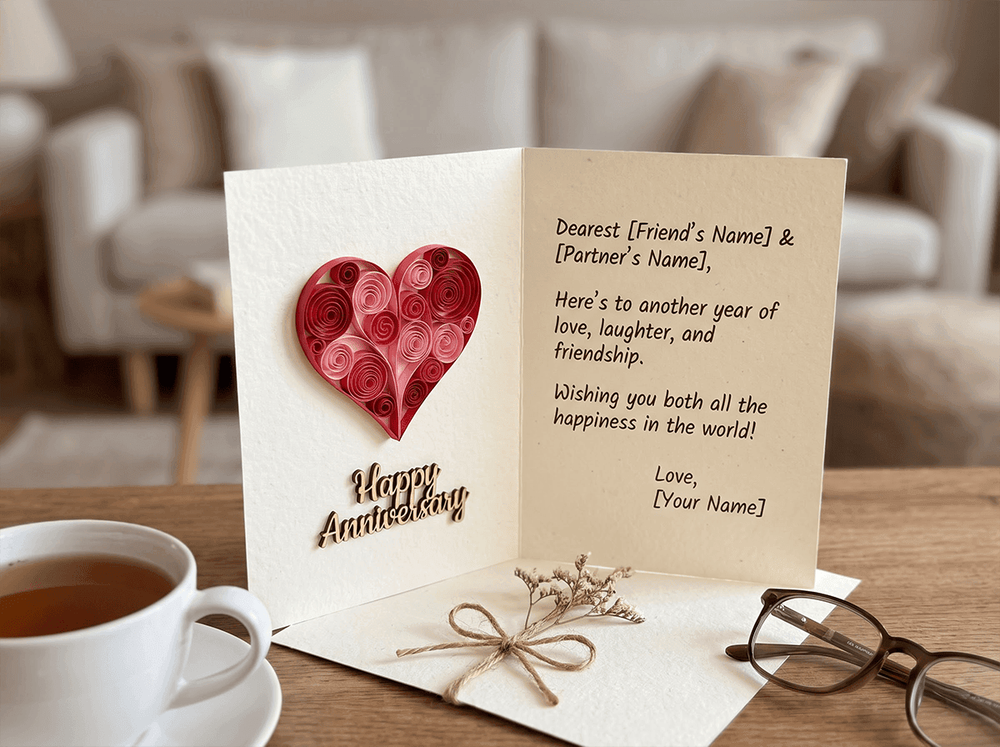
The fastest way to know what to write in a love letter is to stop trying to sound like a writer and start answering one question honestly: what do you notice about this person that you've never said out loud? A love letter that works is built from specific memories, specific traits, and a specific future you want with them, not from generic phrases borrowed from a card aisle. Everything below, including 15 prompts, full example letters, and a line-by-line structure, exists to get you from a blank page to something true in under an hour.
Why a Love Letter Still Lands Harder Than a Text
Most people underestimate how rare a written letter has become, which is exactly what makes it valuable. A message can be typed, sent, and forgotten in the time it takes to read it. A letter has to be planned, drafted, and often rewritten, and the recipient knows that. The effort itself is the message before a single word is read.
There's research behind that intuition. A U.S. gifting survey reported by GiftAFeeling found that two out of three American adults still prefer receiving physical cards over digital ones, including 62% of Millennials and 59% of Gen Z, the two generations assumed to be the most digitally native. The same body of consumer research found that 70% of recipients see personalized gifts, letters included, as a reflection of a deeper bond, and 66% of people say they remember personalized gifts far longer than anything bought off a shelf. A love letter is personalization in its purest form: words that could not have been written by anyone else, about anyone else.
The psychological case is just as strong as the consumer data. Psychologist James Pennebaker spent decades studying what he called expressive writing, the practice of putting emotion and experience into words rather than holding them in. In his original 1986 study with Sandra Beall, college students who wrote about their most emotionally significant experiences for 20 minutes over four days showed measurable improvements in both physical and psychological health months later, compared with a control group who wrote about neutral topics. Follow-up research summarized in Pennebaker's 2018 review in Psychological Science found the same pattern held across dozens of studies and populations: naming an emotion in writing changes how the brain processes it. A love letter isn't therapy, but it borrows the same mechanism. Writing down why someone matters to you forces you to metabolize the feeling instead of just carrying it around.
There's a second, more targeted line of research worth knowing. Martin Seligman's landmark positive psychology studies tested a range of interventions meant to increase happiness, from gratitude journaling to identifying personal strengths. The single most powerful intervention, producing the largest and most durable boost in happiness of anything tested, was writing and personally delivering a letter of gratitude to someone who had never been properly thanked. A love letter is a gratitude letter with the volume turned up. It works on the writer nearly as much as it works on the reader.
Handwriting adds a third layer that typing doesn't replicate. Cognitive research on handwriting versus typing has repeatedly found that the physical act of forming letters by hand engages motor, visual, and language regions of the brain simultaneously in a way that tapping a keyboard does not, which is part of why handwritten notes tend to feel more "present" to both the writer and the reader. A note that took visible time and physical effort to produce reads as sincere in a way that a perfectly formatted paragraph, typed and printed, sometimes doesn't. None of this means a typed or digital letter is wrong; it means you should understand why the handwritten version has an edge when you have the option, and lean into that edge deliberately rather than by accident.
A Brief History of Love Letters
Love letters are not a modern invention dressed up in old paper. Historians tracing the practice of letter writing have found romantic correspondence dating back more than 5,000 years, roughly as old as writing itself. The form we'd recognize today, personal, tender, and specific to one relationship, took shape more gradually. Chroniclers of the genre point to the early Renaissance, around the start of the 14th century, as the period when love letters began separating from formal correspondence, though those early examples were still bound by the conventions of courtly love: chaste compliments, elaborate praise, and a fair amount of performance for an audience beyond the recipient. It wasn't until the 18th century that letters loosened up and became genuinely personal, full of the specific tenderness and small jokes that define the best examples today.
Some of history's most quoted love letters are useful case studies in exactly the principle this guide keeps returning to: specificity over grandeur. Ludwig van Beethoven's unsent "Immortal Beloved" letter, discovered in his estate after his death, is remembered not for its polish but for its raw, unfiltered urgency. Napoleon Bonaparte's letters to Josephine, written from military campaigns, are full of small, specific longing rather than generic devotion. John Adams and Abigail Adams exchanged letters across years of political upheaval that mixed serious debate about the future of a country with affectionate, sometimes silly, private language, proof that a love letter doesn't have to be separated from ordinary life to be meaningful. Centuries earlier, the correspondence between Pierre Abelard and Héloïse, one of the most studied love letter collections in Western literature, endured for nearly 900 years precisely because of its emotional specificity and honesty, not its formality. And in a distinctly modern example, Ronald Reagan wrote to Nancy Reagan after more than three decades of marriage, "I more than love you, I'm not whole without you. You are life itself to me," a line that works for the same reason all the others do: it's plain, direct, and clearly could only have been written by someone who knew exactly what he meant.
The through-line across five millennia of romantic correspondence is remarkably consistent. The letters people kept, framed, published, and quoted for generations are rarely the most elaborately worded ones. They're the ones that got specific.
Why More People Are Choosing to Write Letters Again
Letter writing dipped sharply as texting and messaging apps took over daily communication, but the data on gift-giving and personalization suggests a real reversal in how much people value the written, personal version of a message. Market research on the U.S. personalized gifting sector put its 2024 value at roughly $9.69 billion, projected to grow to $14.56 billion by 2030, a 7.02% annual growth rate that outpaces most categories of general retail. Within that broader personalization trend, traditional cards still dominate consumer preference, accounting for an estimated 76.3% of the sentimental-message market, ahead of digital alternatives, largely because of their emotional appeal and physical presence in someone's hands.
The preference isn't just about nostalgia. Consumer surveys on gift-giving found that 80% of people believe personalized gifts are more thoughtful than generic ones, and 65% of consumers reported purchasing at least one personalized gift in the past year. Among people who send cards specifically, personalization is consistently ranked as a top priority, ahead of price or design, with photos and specific shared memories cited as the most requested form of customization. A love letter fits neatly inside that trend: it's the most personalized message format that exists, since by definition it can't be mass-produced or repurposed for anyone else.
The Anatomy of a Love Letter That Doesn't Sound Like a Card
Every love letter that actually moves someone follows a loose structure, even when it doesn't feel like a formula while you're writing it. Understanding the shape ahead of time makes the blank page much less intimidating.
1. The opening line
Skip "Dear [Name], I hope this letter finds you well." That's an email opener, not a love letter opener. Start in the middle of a thought, a memory, or an honest confession about why you're writing at all. The first line sets the emotional register for everything after it.
2. The anchor memory or observation
Ground the letter in something real: a specific moment, a specific habit, a specific thing they said once that you never forgot. This is what separates a love letter from a greeting card. Specificity is what makes someone believe you mean it.
3. The expansion
From that anchor, widen out into what it reveals about who they are and what they mean to you. This is usually the longest section of the letter, and it's where most of the 15 prompts below will do their work.
4. The vulnerability
Say the thing you don't normally say out loud. This might be "I was scared to fall for you," or "I don't tell you enough that I notice how hard you work," or "I still can't believe you chose me." A letter without a moment of vulnerability reads as polished but hollow.
5. The forward-looking close
End by pointing toward the future, even briefly: a hope, a promise, a plan, or simply a statement of intention to keep showing up. Letters that only look backward can feel like elegies. A single forward-facing sentence keeps it feeling alive.
6. The sign-off
Simple is almost always better than clever here. "Yours," "Always," "All my love," or just a first name can carry more weight than an elaborate closing line, because by this point the letter has already done its work.
These six pieces don't need to appear in strict order, and a strong letter can compress several of them into a single paragraph. What matters is that all six show up somewhere: an entry point, a grounding detail, room to expand on it, a moment of honesty, a look forward, and a close that doesn't overstay its welcome. Skip more than one or two of these and the letter tends to feel either rushed or unfinished, even if the writer can't quite articulate why.
Why Written Words Matter More to Some People Than Others
Not everyone experiences a love letter the same way, and understanding why can help you calibrate how much weight to put on the words themselves versus the format or delivery. Gary Chapman's 1992 book "The Five Love Languages" proposed that people tend to feel most loved through one of five channels: words of affirmation, quality time, acts of service, physical touch, or gifts. Chapman's framework grew out of his own counseling practice rather than a controlled research study, and psychologists have since pointed out that the empirical evidence for it is mixed. Still, more recent academic work has tried to test the underlying idea directly. A 2020 study by researchers Hughes and Camden found that couples who actively used a partner's preferred love language reported higher relationship satisfaction, and a 2022 study offered further partial support for the framework. Words of affirmation, the category a love letter falls squarely into, is consistently identified in this research as one of the most commonly reported primary love languages, particularly in Western cultures.
What this means practically: for a specific and fairly large slice of people, a letter is not simply a nice gesture among several equally effective options. It's the gesture that lands hardest, harder than a gift, harder than a planned evening out, harder than anything else you could do. You likely already have a sense of whether the person you're writing for is one of these people, based on how they react to compliments, notes, or verbal appreciation compared to gifts or shared activities. If you're not sure, the letter itself is a reasonably safe bet either way. Even people whose primary love language sits elsewhere still tend to keep a well-written letter for years, because rarity and effort carry weight regardless of someone's default preference.
It's also worth separating the love language framework, which is a popular but scientifically contested model, from the underlying research on expressive and gratitude writing, which rests on a much firmer evidence base. You don't need to believe in five fixed categories of love to accept that naming specific appreciation in writing produces a measurable emotional effect on both the writer and the reader. The love languages idea is a useful lens for calibrating tone and expectations. The Pennebaker and Seligman research cited earlier is the part actually backed by controlled studies, and it applies regardless of which category someone would place themselves in.
Before You Write: Five Questions to Ask Yourself
Sitting down to write a love letter without any preparation is what causes writer's block. Spend five minutes answering these questions on scratch paper first, and the letter will write itself faster than you expect.
- What is the actual occasion? An anniversary letter, an apology letter, a long-distance letter, and a first-love-confession letter all carry a different emotional job. Knowing which one you're writing prevents the letter from wandering.
- What's one memory I keep coming back to? Not the "biggest" memory, necessarily, just the one that resurfaces unprompted. That instinct is usually right.
- What do I notice about them that I've never told them directly? Everyone has at least one thing they've thought and never said. That's often the emotional core of the letter.
- What do I want them to feel while reading this, not just understand? Understanding is for a text message. A letter should produce a feeling: reassured, seen, missed, chosen.
- How will this be delivered? A letter tucked into a suitcase, mailed across a distance, read aloud, or opened alongside a small gift will be paced and written differently than one handed over directly. Decide this before you write the closing lines, since the ending often references the delivery moment.
Answering these five questions doesn't need to take long, and it doesn't need to happen in writing if you'd rather think it through in your head on a walk or a commute. What matters is doing it before you sit down to write the actual letter, rather than trying to figure out the occasion, the memory, and the delivery plan all while also trying to find the right words. Separating the thinking from the writing is what makes the writing itself go faster.
15 Prompts for What to Write in a Love Letter
These prompts are grouped into five categories, three prompts each, moving from memory to character to future to the senses to vulnerability. You don't need to use all 15. Read through once, notice which two or three prompts produce an immediate, specific memory or sentence in your head, and build the letter around those.
Memory-Based Prompts
1. The first time you knew
Write about the exact moment, however small, when you realized you cared about this person differently than you expected to. It doesn't have to be dramatic. "You knew" moments are often mundane: they laughed at something no one else found funny, they were patient with a stranger, they texted back something ordinary and you smiled at your phone for no reason. Naming that moment tells the reader that your feelings have a specific origin, not just a vague accumulation.
Example line: "I knew somewhere around the third time you offered me half your fries without me asking. It wasn't the fries. It was that you noticed I wanted them before I said anything."
2. A memory only the two of you would understand
Every relationship collects private references: an inside joke, a disaster of a first date, a trip that went wrong in a way that became funny later. Pick one and describe it in enough detail that the reader is transported back into it. Shared memory is one of the strongest bonding mechanisms a relationship has, and naming it in writing reinforces that you were both there, together, building something.
Example line: "Nobody else will ever understand why the word 'flamingo' makes us both laugh in the middle of serious conversations, and honestly, I hope it never stops working."
3. A moment they probably don't know you noticed
Describe something they did when they thought no one was watching, or something small they likely forgot: the way they hummed while cooking, how they double-checked the door was locked before bed, how they always let you have the last bite. These details prove observation, and observation is one of the clearest evidence of love that exists. Anyone can say "I love you." Fewer people can say exactly what they've noticed.
Example line: "You don't know I saw you check twice that the porch light was on before we left, just in case I forgot my keys. You think I don't notice the small maintenance you do on us. I notice every time."
Character-Based Prompts
4. The quality you'd want your kids, friends, or future self to inherit from them
This prompt forces you to articulate what you actually admire, not just what you're attracted to. Maybe it's how they handle conflict without raising their voice, how they treat service workers, how they keep promises even small ones. Naming a specific virtue and explaining why it matters to you is one of the most sincere things you can put on paper.
Example line: "You've never once raised your voice at me, even when I would have understood if you did. I hope that's the thing I remember most, years from now, about how you handled the hard weeks."
5. How they've changed you
Write about a way you think or act differently because of them. This could be as concrete as "you taught me to actually rest instead of always doing something," or as abstract as "you made me less afraid of being wrong out loud." People rarely get to hear how they've shaped someone else. It's one of the more powerful things a letter can say.
Example line: "Before you, I didn't think I was allowed to change my mind about things out loud. You made disagreeing with myself feel less like failure and more like thinking."
6. What they do that makes hard days easier
This is a chance to be specific about support, not just affection. A phone call at the right moment, a habit of checking in without being asked, the way they handle you when you're not at your best. Naming the specific behavior, rather than a vague "you're always there for me," makes the gratitude land as observed rather than assumed.
Example line: "You never ask what's wrong right away. You just sit next to me until I'm ready to say it, and somehow that's exactly what I need every single time."
Future-Facing Prompts
7. A small future you want with them
Skip the grand "I want to grow old with you" language unless it's genuinely how you'd phrase it out loud. Instead, describe something small and specific: a Sunday morning you want to keep having, a trip you haven't taken yet, an ordinary future evening you can picture clearly. Small, concrete futures feel more real than sweeping ones, and they're easier to write honestly.
Example line: "I want a hundred more mornings exactly like this one: bad coffee, worse hair, you reading the parts of the news out loud that annoy you. I'm not asking for anything bigger than more of the same."
8. What you're looking forward to that involves them
This works well for a couple already building a life together: a wedding, a move, a milestone, or simply the next several months. Naming a specific thing you're excited about, and that they're part of, signals commitment without needing the word itself.
Example line: "I keep catching myself daydreaming about the apartment we haven't found yet, and in every version, you're already there."
9. A promise you can actually keep
Avoid the temptation to promise perfection. A more honest and more meaningful promise sounds like: "I'll keep choosing to talk instead of shutting down," or "I'll keep showing up even on the days it's inconvenient." Promises that acknowledge effort read as more trustworthy than promises that claim you'll never struggle.
Example line: "I can't promise I'll never get it wrong again. I can promise I'll keep coming back to fix it instead of walking away from it."
Sensory and Detail Prompts
10. A physical detail that isn't generic
Skip "beautiful eyes" and "amazing smile," which could describe almost anyone. Instead, name something specific: the way their hands look when they're concentrating, a particular laugh that only shows up in certain moods, a scar or habit that's uniquely theirs. Specificity here does more emotional work than any superlative.
Example line: "You bite the inside of your cheek when you're concentrating, and I've caught myself staring at you doing it more times than I'll ever admit."
11. A sound, smell, or small sensory memory tied to them
Scent and sound are strongly linked to memory. Describe a smell that reminds you of them (their car, their kitchen, a specific soap or coffee) or a sound (their laugh through a wall, the particular way they say your name). This kind of detail makes a letter feel lived-in rather than composed.
Example line: "Cedar and coffee, that's what your side of the closet smells like, and I will never be able to walk past a hardware store without thinking of you."
12. A place that means something because of them
Write about how a location changed meaning once they were part of it. This could be your apartment, a specific restaurant, a city, or even a mundane place like a grocery store that became meaningful because of a shared errand. Attaching emotion to place is a classic literary device for a reason: it works.
Example line: "That gas station on the highway used to just be a gas station. Now it's the place we pulled over at 2 a.m. and talked for an hour instead of driving, and I can't pass it without smiling."
Vulnerability Prompts
13. What you were afraid of before them, or with them
This might be a fear of commitment, a fear of being fully known, a fear specific to a past relationship, or simply the fear of caring this much about someone. Naming the fear and then explaining what changed, or what you're still working through, is one of the more disarming things a letter can contain.
Example line: "I spent the first few months waiting for the version of you that would eventually let me down, because that's what I was used to. You never showed up. I'm still getting used to that."
14. Something you don't say enough out loud
This is the most literal version of the vulnerability category, and it works precisely because it names its own rarity. "I don't tell you enough that..." is a sentence starter that almost always produces something true, because it forces you to notice the gap between what you feel and what you actually say day to day.
Example line: "I don't tell you enough that I'm proud of you, not just for the big things, but for the quiet, unglamorous effort you put into the days nobody's watching."
15. Why them, specifically
Close with the hardest and most valuable prompt: not why you love being in a relationship, but why this particular person. What is it about them, specifically, that no one else could replace? This prompt resists generic answers by design. If your first draft answer sounds like it could apply to anyone, keep pushing until it doesn't.
Example line: "It's not that you're the easiest person I've ever loved. It's that you're the only person who's ever made the hard parts feel worth staying for."
How to Start a Love Letter (Without Sounding Like a Card)
The opening line matters more than any other sentence in the letter, because it decides whether the reader settles in or skims. A few approaches that consistently work better than "I hope you're doing well" or "I've been meaning to write this for a while":
- Start mid-thought. "I keep thinking about the drive home from your parents' house last month" drops the reader straight into intimacy, no throat-clearing required.
- Start with a confession. "I've rewritten this line four times because I don't know how to say this without it sounding smaller than it is" is honest and disarming, and it's true for almost everyone writing a letter like this.
- Start with a question you're answering. "You asked me once what made me fall for you, and I never gave you a real answer. Here it is." This structure gives the whole letter a built-in purpose.
- Start with the anchor memory itself. Skip the preamble entirely and open directly with the scene: "It was raining, you'd forgotten your umbrella again, and I remember thinking I didn't mind being late because of it."
Whatever you choose, avoid opening with an apology for your handwriting, your writing skills, or how "cheesy" the letter might be. Undercutting the letter before it's read teaches the reader to take it less seriously. Trust the content.
How to End a Love Letter
The closing line should feel like it belongs to the specific letter you just wrote, not like a stock sign-off pasted onto the bottom. A few structures that hold up:
- Return to the opening image. If you opened with rain and an umbrella, close by referencing it again: "I'd stand in that rain again, every time." Circular structure makes a letter feel deliberate rather than rambling.
- State the plain truth simply. After pages of detail, a short, direct final line can land harder than an elaborate one: "I love you. That's the whole letter, really. Everything else was just explaining why."
- Close with a small, concrete promise or plan. "I'll see you Friday, and I'll bring the umbrella this time" ties the letter back to real life and gives it a sense of continuation rather than finality.
For the sign-off itself, resist the urge to get elaborate. "Yours," "Always yours," "With everything I have," or simply your name, handwritten, tends to outperform anything more ornate. By the final line, the letter has already made its case.
A Bank of Opening and Closing Lines to Adapt
If you're still staring at a blank page after working through the prompts, these starter lines can break the freeze. Treat every one of them as a rough draft to be rewritten in your own words and filled in with your own specific details. None of these should end up in the final letter unchanged; they're scaffolding, not sentences.
Openers to adapt
- "I keep thinking about the time you ___, and I never told you what it meant to me."
- "I'm writing this because I said something today and it wasn't the thing I actually meant."
- "You asked me once why I ___. Here's the real answer."
- "It's been a while since I told you this, so I'm putting it in writing so it counts."
- "I don't know how to start this except to just say the thing I've been meaning to say."
- "There's a version of this that I've said in my head a hundred times, and this is finally it on paper."
- "I noticed something about you today that I don't think I've ever told you."
- "This isn't for any particular occasion. I just wanted you to have it."
Closers to adapt
- "That's the whole letter, really. Everything else was just explaining why."
- "I'll say the rest out loud, but I wanted this part written down."
- "I'd choose this, all of it, again."
- "More than I say. Always more than I say."
- "This is me, trying to catch up on all the things I don't say enough."
- "Keep this, if you want. I meant every word of it, today and every day after."
Seven Full Example Letters
Below are seven complete example letters written for different situations, from short notes to one longer letter that shows how several prompts can combine into a single piece. Use them as models for tone and structure, not as scripts to copy word for word. The details that make them work are the specific ones, and specificity has to come from your own memory, not someone else's example.
Example 1: New Relationship, Early Feelings
"I wasn't going to write this yet. We've only known each other a few months, and part of me thinks that's too soon to put anything on paper. But I keep noticing things about you I don't want to forget, and I'd rather tell you now than wait until it feels 'official' enough to say.
You have this habit of asking follow-up questions, real ones, the kind that mean you actually remembered what I said last time. Nobody's done that with me in a long time. I don't know exactly what this is yet, but I know I want to find out with you, at whatever pace makes sense. I just didn't want to keep that to myself any longer."
Example 2: Long-Term Partner or Spouse
"Fifteen years in, I still remember the exact chair you were sitting in the night I decided I wasn't going anywhere. I don't tell you that enough. I tell you about groceries and schedules and whether the car needs an oil change, and somewhere in the noise of actual life, I forget to just say: I still notice you. I noticed you today, at the kitchen table, doing the crossword you pretend you don't care about finishing.
I don't have a big future speech for you, because we're already living the future I wanted. I just want to keep having ordinary Tuesdays with you for as long as they'll let us."
Example 3: Long-Distance Relationship
"It's been eleven days since I've actually seen your face and not a screen version of it, and I keep catching myself doing things out of habit, like glancing at the other side of the couch. I hate how normal this distance has started to feel, and I hate that I'm even a little good at it now.
What gets me through the stretch between visits isn't the calls, honestly, though I need those too. It's knowing there's an end date. I've started counting down again. Nineteen days until I'm at your door and this letter doesn't have to travel anymore, because I'll be there to say all of this out loud instead."
Example 4: Saying It for the First Time
"I've started this letter more times than I want to admit, mostly because I couldn't figure out how to say this without it sounding bigger than I meant it to, or smaller than it actually is. So I'm just going to say it plainly: I love you. I haven't said that out loud yet, and I wanted the first time you heard it to be something you could hold onto, not something rushed out in the middle of a normal Tuesday.
I don't need you to say it back today, or even this week. I just didn't want to keep carrying it around without you knowing it was there."
Example 5: A Milestone Anniversary
"Twenty-five years ago today, I stood in a room that smelled like too many flowers and made you a promise I didn't fully understand yet. I understand it now. I understand it in the version of you that stayed up with me through three job losses, one very bad year, and more ordinary Tuesdays than I could count if I tried.
I want to renew the same promise today, except this time I know exactly what I'm agreeing to, and I'd sign up for every single year of it again, including the hard ones. Especially the hard ones. They're the ones that proved it."
Example 6: An Apology Letter
"I said something Tuesday night that I've been sitting with ever since, and I want to say plainly: I was wrong, and it hurt you, and that's on me. I let a bad day turn into something I aimed at you, which you didn't deserve and didn't cause.
I'm not writing this to explain myself out of it. I'm writing it because I want you to have something on paper that says I know exactly what I did, and I'm going to work on catching myself before it happens again, not just apologizing after it does. I'm sorry. That's the whole point of this letter, and I didn't want to bury it under anything else."
Example 7: A Longer Letter Combining Several Prompts
"I want to tell you about the night I actually knew, not the version I usually give when people ask, but the real one. We were sitting on the floor of that apartment with the bad heating, both of us in coats indoors like idiots, and you were explaining something about your day that wasn't even that interesting on its own. I remember thinking, very clearly, that I didn't want this to be the last time I heard you talk like that, unguarded, half-laughing at your own story before you'd even finished it. That was the night. Not a big moment. Just you, mid-sentence, and me deciding I wasn't going anywhere.
Since then I've collected a whole list of things about you I don't think I've ever said out loud. You always let the phone ring twice before answering, like you need a second to switch gears, and I find it strangely comforting, like a small piece of consistency in a world that doesn't have much of it. You remember which of my friends had a hard year, even the ones you've only met once, and you ask about them by name. You've never once made me feel small for asking a question twice. These aren't the things people usually put in a card, but they're the things I actually think about when I think about why I'm still here.
I don't know how to explain what you've changed in me except to say that I used to think love was supposed to feel like effort, like something you had to keep proving. With you it mostly just feels like relief. Like I can stop performing and just be exactly as tired or as difficult or as ordinary as I actually am on a given day, and you'll still be there in the morning, coat and all, mid-sentence, telling me about your day.
So here's what I actually want to say, underneath all of that: I don't tell you enough how much I notice you. Not just the big things, the anniversaries and the plans, but the small daily proof that you keep choosing this too. I want a hundred more ordinary nights exactly like the one I started this letter with. No occasion required. Just you, mid-sentence, and me, still deciding, every day, that I'm not going anywhere."
Love Letters for Specific Occasions
The core structure above holds across occasions, but a few situations call for slightly different emphasis.
Anniversary Letters
An anniversary letter works best when it references a specific year or season rather than speaking generically about "all our years together." Naming what was true last year, or five years ago, and how it's changed, gives the letter a timeline instead of a blur. If you want to pair the letter with something tangible, a lot of couples build the letter around a shared memory and then commemorate that same memory with a keepsake, such as a personalized anniversary gift that references the same story the letter tells. The two reinforce each other: the letter explains why the memory matters, and the object makes it visible.
Valentine's Day and Proposal Letters
Valentine's letters carry more cultural weight than almost any other occasion, which is exactly why generic language shows up so often. The fix is the same as everywhere else in this guide: anchor the letter in something specific to your relationship, not to the holiday itself. If the letter is building toward a bigger moment, some couples pair it with a personalized digital proposal page that holds photos, a timeline, and the letter itself in one place, so the words don't just get read once and set aside.
Birthday Letters
A birthday letter has permission to be a little more reflective than a Valentine's letter, since it's about the whole person rather than just the romance. Use it to look back at who they were a year ago and what's changed, or to name a quality of theirs you've watched grow. A letter like this pairs naturally with a personalized birthday gift, especially one built from photos or memories, since the letter can do the explaining that a gift alone can't.
Apology Letters
An apology letter is the one exception to the "keep it positive" instinct that runs through the rest of this guide. It needs to name the specific thing you did or said, take ownership of it plainly, and avoid the word "but" anywhere near the apology itself. "I'm sorry I said that, but I was stressed" is not an apology; it's an explanation wearing an apology's clothes. A real apology letter says what happened, says why it was wrong, and says what you'll do differently, in that order.
Long-Distance Relationship Letters
Distance changes what a letter needs to do. Instead of adding a new memory to an already full shared life, a long-distance letter often has to carry the emotional weight of an entire stretch of time apart, which makes pacing especially important. Rather than trying to summarize the whole distance in one letter, pick a narrow window, the last week, the last video call, the countdown to the next visit, and go deep on that instead of trying to cover the whole relationship. Letters also tend to serve a different function for long-distance couples: alongside video calls and messaging, a physical or digital letter becomes an anchor, something durable to reread between conversations rather than a single message that disappears into a chat thread. If timing allows, sending it to arrive right before or right after a visit tends to land harder than sending it in the middle of an ordinary stretch of distance, since it bookends the time apart rather than just marking the middle of it.
Wedding and Vow-Adjacent Letters
A letter written around a wedding, whether it's exchanged the morning of the ceremony or given as a keepsake afterward, benefits from resisting the urge to sound like a toast. A toast is written for a room full of people. A letter like this is for one reader, and it should sound like it, quieter and more specific than anything said at a microphone. Save the crowd-pleasing lines for the reception. Save the real ones for the letter.
Across Every Kind of Relationship
Everything in this guide applies regardless of how long a couple has been together, whether the relationship is new or decades old, long-distance or under one roof, a first relationship or a second chapter after a previous one ended. The prompts don't assume a particular relationship structure or stage, because the underlying mechanism, specific memory plus honest observation, works the same way for a couple three months in as it does for one thirty years in. What changes across relationship types isn't the method. It's simply which memories are available to draw from.
Common Mistakes That Weaken a Love Letter
Writing in borrowed language
Phrases like "you complete me" or "you're my everything" show up so often in cards and movies that they've lost their specific meaning. They're not wrong, exactly, they're just generic enough to apply to any couple, which makes them feel less true even when they're sincere.
Trying to cover everything
A letter that tries to summarize an entire relationship in one page usually ends up vague. It's better to go deep on one or two memories or qualities than to skim across ten. Depth reads as more sincere than breadth.
Apologizing for the letter itself
Opening lines like "I'm not good at this" or "this is going to sound cheesy" undercut everything that follows. If you're worried the letter is too much, that's usually a sign it's working, not a sign to soften it.
Skipping the specific memory
Letters built entirely out of abstract praise, "you're so kind, so funny, so amazing," read as flattering but forgettable. A single concrete memory does more work than five adjectives.
Making it too long to feel readable
A letter doesn't need to be ten pages to be sincere. A tightly written page that says one or two things clearly will be reread more often than a sprawling five-page letter that says everything at once. Depth over length, always.
Writing only about your own feelings
It's easy for a love letter to slide into being mostly about the writer: how you feel, what you fear, what you want. The strongest letters spend real time on the other person specifically, their traits, their actions, their impact, not just your reaction to them.
Using a love letter to relitigate an old argument
A letter can acknowledge past friction honestly, as the apology example above does, but it shouldn't become a place to reopen a fight under the cover of romance. If you notice the letter drifting toward justifying your side of something, set it aside and come back to it once that impulse has passed.
Waiting for the "right" occasion
Plenty of people draft a love letter mentally for months and never write it down because no occasion feels big enough to justify it. The occasion doesn't need to justify the letter. Wanting to say something true is reason enough, and letters that arrive without an obvious trigger often land harder because they weren't required by the calendar.
Editing Your Letter: A Short Process That Actually Helps
A love letter benefits from one round of editing, but not from the kind of editing that strips out its personality. The goal isn't to make it sound more impressive; it's to make sure it says what you actually mean.
- Read it out loud once. Any sentence that feels stiff or unnatural coming out of your mouth will usually feel the same way on paper. Rewrite it in whatever phrasing you'd actually use if you were saying it to their face.
- Cut anything that could apply to someone else. Go through the letter and flag any sentence that isn't specific to this relationship. If a line could be copied into a letter to a different person without changing a word, either cut it or make it more specific.
- Check the ratio of detail to declaration. A letter that's mostly "I love you, you're amazing, I'm so lucky" without concrete memories or details underneath those claims will read as sincere but thin. Make sure specific moments outweigh general statements.
- Leave in the imperfections that are true to you. If you're not naturally a flowery writer, don't force flowery language into the final draft. A letter that sounds like you, slightly rough edges included, will always beat one that sounds like it was written by someone trying to sound like a poet.
- Set it aside for a few hours before the final copy. If time allows, write the draft one day and copy the final version the next. A short gap makes it much easier to spot the sentence that sounds performative instead of true, because you'll read it slightly more like the recipient will.
What Makes a Love Letter Become a Keepsake
Some letters get read once and set in a drawer. Others get reread for decades, pulled out during a hard year or a milestone anniversary as proof of something worth remembering. The difference usually isn't the quality of the prose. It's whether the letter captured something specific enough to still mean something once the immediate context has faded.
Part of this comes down to the physical object itself. Unlike a text message, which can be deleted, buried in a thread, or lost when a phone is replaced, a physical letter carries a sense of permanence that digital communication doesn't replicate. It can be reread without needing to scroll back through months of unrelated messages to find it. It ages, physically, in a way that mirrors the relationship aging alongside it: the paper yellows, the ink fades slightly, and both of those changes end up adding to the letter's meaning rather than detracting from it. Couples who keep letters over long periods often report rereading them during difficult stretches specifically because the letter proves that the feeling described in it was real at some fixed point in time, which is a different kind of reassurance than a memory alone can offer.
None of this means a digital letter can't become a keepsake too. A letter saved somewhere durable, printed eventually, or kept in a private, ad-free space built specifically to hold it, can carry the same weight, especially when it's paired with photos or a timeline that give it more context than plain text alone. What matters most is intention: writing the letter as something meant to be kept, not just read once and forgotten.
A useful test, when you're partway through a draft, is to ask whether the letter would still make sense and still mean something if it were read five or ten years from now, out of its original context. Letters anchored in a specific memory or a specific, named quality tend to pass that test easily. Letters built only from general praise or trending phrases tend to fail it, since the language dates quickly and the meaning was thin to begin with. Writing for that longer timeline, rather than just for the moment it's handed over, is often what quietly separates a letter that gets kept from one that doesn't.
Handwritten, Typed, or Digital: How to Choose the Format
There's no universally correct format, but each one carries a different signal, and it's worth choosing on purpose rather than by default.
Handwritten
Handwriting carries the strongest signal of effort and time, for the reasons the research above lays out: it's slower, it's harder to edit invisibly, and it engages the brain differently than typing does. It's the right choice when you want the physical object itself, the paper, the ink, the fold, to be part of the gift. The tradeoff is that handwriting is unforgiving of mistakes and can feel intimidating if you're not confident in your penmanship. A rough draft on scratch paper first solves that problem completely.
Typed and Printed
A typed letter, printed on good paper, is a reasonable middle ground when handwriting isn't practical, whether that's due to length, legibility, or simply preference. It reads slightly more formal than handwriting but still carries far more weight than a digital message, because it still exists as a physical object the recipient can keep, reread, and hold onto years later.
Digital and Shareable
A digital letter makes the most sense for long-distance relationships, for a surprise that needs to arrive instantly, or for a letter you want to pair with photos, a timeline, or other media in one place. Some couples build a private page that holds the letter alongside a photo timeline, effectively turning the words into a small, shareable keepsake rather than a single static message. If you go this route, keep the writing itself to the same standard as a handwritten letter, specific, personal, and honest. The format shouldn't be an excuse to write something generic just because it's easy to send.
A Note on Materials, If You're Handwriting It
The materials matter less than the words, but a few small choices make the physical letter feel more intentional. Plain, slightly heavier paper reads as more deliberate than a torn notebook page, though a notebook page is completely fine if that's genuinely what's on hand when the feeling strikes. A pen that doesn't smear or skip prevents the frustration of a ruined page halfway through a good sentence; test it on scratch paper first. If you're prone to handwriting anxiety, write the real draft first on plain paper without worrying about neatness, then copy the final version slowly once you know exactly what it says. Folding the letter, sealing it in an envelope, or adding a wax seal are optional flourishes that add ceremony but are never required. The letter works because of what it says, not what it's wrapped in.
How and When to Deliver a Love Letter
A letter's timing and delivery method are part of its meaning, sometimes as much as the words themselves.
- Hide it somewhere they'll find it alone. A jacket pocket, a suitcase, a lunch bag. Letters found in private, unannounced moments tend to hit differently than ones handed over directly, because there's no anticipation buildup, just a small surprise.
- Mail it, even if you live together. There's something about a letter that arrives through the mail, stamped and addressed, that feels different from one handed across a table. It signals that you took a deliberate extra step.
- Read it aloud. This is the highest-vulnerability option and also often the most memorable. It works best for big occasions: anniversaries, proposals, milestone birthdays.
- Pair it with a tangible object. Letters paired with something physical, a framed photo, a small keepsake, a custom photo puzzle built from a shared memory, give the recipient something to hold onto after the letter itself has been read and set down. The letter explains the feeling; the object becomes a permanent reminder of it.
- Time it to an ordinary day, not just a holiday. A letter that arrives on a random Tuesday, with no occasion attached, often carries more weight than one that arrives because the calendar demanded it. It signals that the feeling wasn't waiting for a holiday to show up.
What to Do If the Reaction Isn't What You Expected
Most of the time, a specific, honest letter lands well. Occasionally it doesn't, and it's worth knowing in advance that a muted reaction isn't necessarily a verdict on the letter itself. Some people process written emotion slowly and need time alone with it before they can respond out loud. Others feel put on the spot by a big gesture and need a minute to catch up emotionally before they can meet it with the same intensity. If the immediate reaction feels smaller than you hoped for, resist the urge to fill the silence by downplaying what you wrote ("it's not a big deal, forget it") or by asking directly for a matching reaction. Give it a day. Letters, unlike a spoken confession, are built to be reread, and a lot of their impact shows up on the second or third read rather than the first.
If a letter genuinely doesn't land the way you hoped, even after some time has passed, that's useful information about how this specific person processes affection, not a sign that the letter itself failed or that you shouldn't have written it. Some people, per the love languages research cited earlier, simply respond more strongly to acts of service or quality time than to words, however well chosen. In that case, the letter still communicated something true. It just might need to be followed up with a gesture in whatever language actually lands for them.
Frequently Asked Questions
How long should a love letter be?
Long enough to say one or two things well, which is usually somewhere between half a page and two pages by hand. Length isn't what makes a letter meaningful; specificity is. A short letter built around one vivid memory will outperform a long letter built around ten vague compliments.
What if I'm not a good writer?
You don't need to write well in a literary sense. You need to write honestly and specifically. The prompts in this guide are designed to produce specific, true sentences rather than polished ones, because specificity reads as sincere regardless of how technically skilled the writing is.
Is it okay to write a love letter to someone I haven't told my feelings to yet?
Yes, and it's often a gentler way to say something big than saying it out loud for the first time. A letter gives the reader space to absorb it privately and respond in their own time, rather than reacting on the spot.
Should I write a rough draft first?
Almost always, yes, especially if you plan to handwrite the final version. Write a messy first draft with no concern for handwriting or phrasing, just to get the real content down. Edit that draft, then copy the final version by hand or type it up.
What's the difference between a love letter and a greeting card message?
A greeting card message tends to be short, general, and interchangeable between recipients. A love letter is specific to one person and usually explains why, not just that, you feel the way you do. Cards state feelings; letters explain them.
Can a love letter be funny?
Yes, and it often should be, at least partly. Humor that's specific to your relationship, an inside joke, a shared memory that makes you both laugh, adds warmth and keeps the letter from feeling overly formal. The goal isn't solemnity; it's honesty, and honesty includes the funny parts of a relationship too.
What if I don't know how to end it?
Return to the opening image or memory, or simply state the core feeling plainly in one short sentence. Overcomplicating the ending is one of the most common ways a strong letter loses momentum in its final lines.
Should I proofread a love letter?
Read it out loud once before finalizing it, mainly to check that it sounds like you and not like a card. Minor imperfections in a handwritten letter are fine and often add to the sincerity. What matters more is making sure the content says what you actually mean.
Is a typed love letter less meaningful than a handwritten one?
Not necessarily. It carries a slightly different signal, but a typed letter with specific, honest content will always outperform a handwritten letter full of generic phrases. Content matters more than format, though format does add weight when the content is already strong.
How often should couples write love letters to each other?
There's no required frequency. Some couples write for every major occasion; others write once a year, or only when there's something specific they want to say that feels too important for a conversation alone. What matters is that the letter comes from a real reason to write, not from a sense of obligation.
What should I avoid putting in a love letter?
Avoid unresolved grievances, comparisons to past relationships, and anything that reads as an ultimatum. A love letter is not the right format for working through an active conflict; it's a format for expressing appreciation, memory, and connection. Save conflict conversations for, well, conversations.
Can I reuse or adapt a love letter I find online?
Use examples like the ones in this guide for structure and tone, not for direct copying. A love letter's entire value comes from being specific to one relationship. A copied letter, however well-written, will read as hollow the moment it's compared against anything the recipient actually knows about you.
What if my partner's primary love language isn't words of affirmation?
A letter can still matter deeply even if it's not their default preference. Someone whose primary love language is acts of service or quality time may not treasure a letter the way a words-of-affirmation person would, but the effort and specificity behind it still register. Consider pairing the letter with whatever does speak their language most directly, a planned evening together, a thoughtful favor, or a small gift, so the letter supports the gesture rather than trying to replace it.
Is it strange to write a love letter to a spouse of many years?
No, and it's often more meaningful precisely because it's unexpected. Long relationships tend to run on habit and logistics, which makes an unprompted letter stand out even more than it would early on. The research on gratitude interventions backs this up directly: expressing appreciation to someone who's stopped expecting to hear it produces some of the strongest emotional responses recorded in that research.
Should I show the letter to someone else before giving it?
Generally, no. A love letter is meant for one reader, and involving a third party, even for editing help, tends to sand off the honesty that makes it work. If you want a second opinion, focus it narrowly on clarity or spelling rather than content or tone.
What's a good way to start if I genuinely don't know what to say?
Pick one prompt from the list above, set a timer for ten minutes, and write without stopping to edit. Most people who feel stuck aren't actually out of things to say; they're stuck because they're trying to write a polished letter on the first attempt. Get the honest version down first. Polish comes later, if it's even needed.
Can I write a love letter as a surprise without any particular occasion?
Yes, and as noted earlier, letters that arrive with no occasion attached often carry more weight than ones tied to a holiday, since they clearly weren't written out of obligation. If you're looking for a moment to give it, consider timing it around something small and personal, like the anniversary of a first date rather than a calendar holiday, or simply hand it over on an ordinary day when the feeling is fresh.
Can a love letter include things that aren't purely positive?
Yes, within reason. Acknowledging a hard season you got through together, a fear you're still working on, or a way you've disappointed each other in the past can add depth and honesty, as long as the overall letter still lands on appreciation rather than grievance. The apology letter example above is the clearest case of this done well.
Is it too late to write a love letter after years together, if I've never done it before?
No. If anything, a first letter after many years together tends to carry extra weight precisely because it's unusual. There's no expiration date on saying something you've never put in writing, and a partner who's never received a letter from you has no baseline expectation to compare it against, which removes any pressure to match a previous one.
What if I'm writing this for someone who's no longer able to read it, or who has passed away?
Grief letters and letters to someone who has died follow a related but distinct set of conventions from a romantic letter meant to be read by the recipient, and they're often written as part of a grieving or memorial process rather than a courtship or anniversary one. If that's the situation you're in, the same core instinct, specific memory over generic sentiment, still holds, but consider looking for guidance focused specifically on grief writing rather than treating this guide as a complete resource for that different purpose.
Should the letter mention the future of the relationship explicitly, like marriage or moving in together?
Only if that's a conversation you've already had or are genuinely ready to raise. A love letter isn't the ideal format for introducing a major relationship decision for the first time, since it doesn't allow for real-time back-and-forth. If you want to gesture at the future without making a formal proposal or declaration, keep it to a feeling rather than a specific plan, and save the concrete conversation for in person.
Putting It Together
Start with one memory you keep returning to, unprompted, and one thing about this person you've never said out loud. Write those two things down first, in plain language, before worrying about structure or opening lines. Everything else in this guide, the prompts, the examples, the structure, exists to help you expand those two honest sentences into a full letter, not to replace them.
The letter that gets remembered years later is rarely the most eloquent one. It's the one that proves, in specific and undeniable detail, that you were paying attention: to the small habits, the offhand comments, the ordinary Tuesdays that turned out to matter more than the big occasions. Whatever format you choose, handwritten and mailed, typed and printed, or built into a digital keepsake with photos alongside it, the words are what will get reread. Write the version that sounds like you, not the version that sounds like a letter is supposed to sound, and it will do exactly what you're hoping it does.