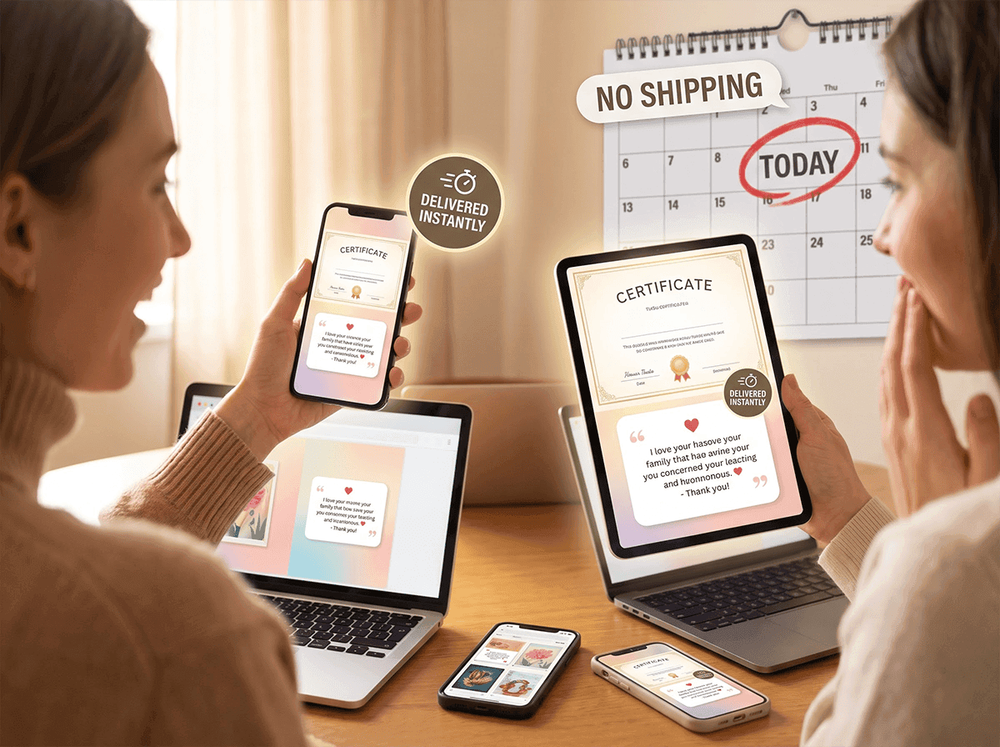
The fastest way to give a great surprise gift right now is to send something digital and personal that arrives the moment you hit send: a private photo puzzle, an animated love letter, a scannable QR-code gift, or a countdown page built around an inside joke. Instant surprise gifts skip shipping entirely, which means there is no tracking number to refresh, no "delivery delayed" email, and no risk of a box landing two days after the moment has passed. This guide walks through dozens of last-minute gift ideas you can create and deliver online in minutes, how to make each one feel expensive even when it is free or nearly free, and the small psychological details that turn a rushed gift into one your person actually remembers.
If you only take one idea away, take this: the gifts people remember are rarely the ones that cost the most or shipped the fastest. They are the ones that prove you were paying attention. A 2026 OnePoll survey reported by Songful found that 62% of Americans prefer gifts that feel personal and come "from the heart" over expensive items, and research from Stanford Graduate School of Business has repeatedly shown that recipients value modest, thoughtful gifts about as highly as costly ones, even though givers assume price drives appreciation. An instant digital surprise lets you spend your effort where it counts, on meaning, and removes the one variable you cannot control at the last minute, which is logistics.
What Counts as an "Instant Surprise Gift"?
An instant surprise gift is anything you can plan, personalize, and deliver without physical shipping, so the recipient experiences it within seconds or minutes of you finishing it. The category is broader than a plain e-gift card. It includes interactive digital keepsakes, scheduled reveals, shared experiences, and small acts you arrange remotely. What unites them is a simple promise: the gift exists the instant you are ready, and the only thing standing between you and the surprise is your own creativity, not a courier.
It helps to separate three things people often lump together:
- Instant delivery means the gift reaches the recipient immediately. A digital keepsake you send by link, an e-gift card, or a scheduled message all qualify.
- Personalization means the gift is shaped around this specific person: their name, your shared memories, a photo only the two of you would recognize, an inside joke. Personalization is what separates a forgettable voucher from a keepsake.
- Surprise means timing and concealment: the recipient does not see it coming, or does not expect it from you, or does not expect it today.
The best instant surprise gifts hit all three at once. A generic gift card is instant but rarely personal and almost never surprising. A handwritten letter is personal but slow to deliver across distance. A digital love letter or a private photo puzzle can be all three, which is why this guide leans heavily on personalized digital formats rather than off-the-shelf vouchers.
Instant does not mean impersonal
There is a stubborn assumption that anything you can send in two minutes must feel cheap. That assumption is wrong, and the research says so. A study in the Journal of Consumer Psychology found that recipients are more sensitive to behavioral cost, meaning the time and mental effort visible behind a choice, than to monetary cost. In plain terms: a gift that obviously took thought beats a gift that obviously took money. When you build a digital surprise around a real memory, the effort is legible. The recipient can see that you chose a particular photo, wrote a particular sentence, and set it up for them specifically. That visible care is what registers, not the speed of delivery.
Why Last-Minute Gifts Get a Bad Reputation (and Why It's Undeserved)
"Last-minute" carries baggage. It suggests you forgot, scrambled, and grabbed whatever was nearest the register. But a huge share of perfectly loving people end up last-minute through no fault of character. Life is busy, dates sneak up, and even careful planners get caught. Talker Research reported in 2022 that 63% of online shoppers have completely forgotten they ordered something until it appeared at their door, and that the average person had eight forgotten orders in a single year. If our memories are that leaky about things we already bought, it is no wonder birthdays and anniversaries occasionally ambush us.
The bad reputation comes almost entirely from one failure mode: the obviously generic, last-second purchase that signals "I did not think about you until just now." The gift itself broadcasts the lack of thought. Gas-station chocolate, a random gift card with no note, a bouquet ordered in a panic. The problem was never the timing. It was the absence of personalization. Remove that, and a last-minute gift can land exactly as warmly as one planned for weeks, because the recipient has no way to time-stamp your effort. They only see the result.
Digital surprise gifts are uniquely good at hiding the clock. A photo puzzle built from a trip you took together, or a letter that recalls the night you met, reads as deeply considered whether you made it three weeks early or eleven minutes before midnight. The medium does the work of disguising the deadline. This is the core advantage of going instant and personal: you reclaim the warmth of a thoughtful gift while keeping the speed you actually need.
The hidden cost of "I'll just order something"
Physical last-minute gifts come with a stress tax that most people underestimate until they are mid-panic. You pay for expedited shipping. You refresh the tracking page. You read the fine print about cutoff times and realize the "next-day" promise had an asterisk. And then you wait, helpless, hoping a stranger in a van honors a window you cannot influence. The emotional labor of that waiting is the part nobody advertises. Instant gifts delete it. The moment you finish, you are done, and the surprise is in your control from start to finish.
The Shipping Problem: Why Physical Gifts Fail at the Last Minute
Shipping is the single biggest reason last-minute physical gifts go wrong, and the data is not reassuring. A Supply Chain Xchange survey found that 70% of e-commerce shoppers said their orders were shipped late, with 35% receiving no explanation at all. Chain Store Age reporting on common delivery problems put late deliveries at 39%, lost or stolen orders at 36%, and damaged products at 27%. When you are ordering ahead of a holiday, those odds get worse, not better, because every carrier in the country is moving more volume than usual.
The downstream effect on gift-givers is measurable. Reporting on holiday shopping behavior found that concern about lateness pushed nearly 70% of shoppers to choose a cheaper, faster option over the gift they actually wanted to give. Read that again: the fear of a gift arriving late is strong enough to change what people buy, steering them toward something lesser just to beat the clock. That is shipping anxiety quietly degrading the quality of gifts across the board.
Instant digital gifts sidestep every link in that broken chain. There is no warehouse, no carrier handoff, no porch, no weather delay, no signature required. The "delivery network" is a link or a scheduled message, and it does not take snow days. For anyone who has watched a tracking page stall on "out for delivery" while a birthday dinner started without the present, the appeal is obvious.
Time zones, holidays, and the cutoff trap
Cross-border and long-distance gifting makes shipping even more fragile. Customs can hold a package for days. A "two-day" service quoted in one country may mean a week to another. And the shipping cutoffs before major holidays are earlier than most people expect, sometimes a full week or more ahead of the date. Miss the cutoff and your options collapse to whatever can be rushed at brutal cost. A digital surprise has no cutoff. You can send it from any time zone to any time zone, on the holiday itself, at the exact minute that matters, and schedule it to land at midnight in their local time rather than yours.
The Psychology of Surprise: Why It Hits So Hard
Surprise is not a garnish on a gift. It is an active ingredient that changes how the gift is felt and remembered. When something unexpected and pleasant happens, the brain releases dopamine, the neurochemical tied to reward and pleasure, and that spike both intensifies the emotional response in the moment and strengthens how firmly the memory is stored. Psychologs Magazine, summarizing the research on surprise gifts in 2025, described how the unexpected element layers joy, excitement, and gratitude on top of the gift itself, producing a stronger reaction than the same item handed over predictably.
This is why a small surprise can outperform a large expected gift. The anticipation gap, the distance between what someone expected and what actually happened, is where the emotional charge lives. If your partner knows a gift is coming and roughly what it is, you have spent the surprise before they open anything. If it genuinely catches them off guard, even a modest gesture detonates. Instant digital gifts are perfectly suited to this, because you control the timing precisely. You can drop a surprise on an ordinary Tuesday with no occasion at all, which is often when it lands hardest, since there is zero expectation to dull it.
Experiences beat objects, and memories beat both
A widely cited 2016 paper by Cindy Chan and Cassie Mogilner in the Journal of Consumer Research found that experiential gifts strengthen the relationship between giver and recipient more than material gifts of equal value. The leading explanation is memory: we remember experiences more vividly than possessions, so an experience-shaped gift doubles as a stored memory the person can revisit. Many digital surprises behave like experiences even though they cost almost nothing. Solving a photo puzzle of your first vacation, scrolling a countdown to a reunion, reading a letter that walks through a shared year. These are small experiences with a memory baked in, not static objects that fade into the background of a shelf.
The giver-recipient gap
One of the most useful findings for anyone choosing a gift is that givers and recipients systematically disagree about what matters. Research covered by ScienceDaily in 2018 showed that givers tend to optimize for the "big reveal," choosing whatever will wow in the moment, even when a different option would bring more lasting satisfaction. A Frontiers in Psychology study went further, finding recipients sometimes rated less expensive gifts higher than expensive ones, while givers assumed the opposite. The practical lesson: stop trying to impress with scale, and start trying to resonate with specificity. A digital gift that references something only your person would recognize will almost always beat a pricier gift that anyone could have given to anyone.
Why Instant Digital Gifting Is Having a Moment
This is not a niche workaround anymore. Instant, personalized gifting has become a mainstream behavior, and the market data shows it accelerating. The digital gift card segment alone was projected to grow from $581.38 billion in 2025 to roughly $680.35 billion in 2026, a 17% annual clip, according to market reporting compiled by The Business Research Company. E-gifting is the fastest-growing slice of the broader gift-card market, expanding at around 20% a year, driven specifically by instant delivery, mobile wallets, and digital personalization.
Personalization is no longer a premium add-on either; it is the baseline expectation. Industry analysis in 2026 found that over 60% of customers now expect personalized gifting solutions, and a meaningful share of providers have responded with custom messages, themed designs, animations, and scheduling. When even large retailers roll out customizable gift cards with images and personal messages, the signal is clear: people want gifts that feel made for someone, delivered the instant they are ready. The instant-and-personal approach this guide describes is exactly where the whole category is heading.
Younger givers are leading the shift. More than 70% of millennials now prefer digital gift cards over physical ones, and convenience and flexibility rank among the top reasons people choose digital formats at all. The takeaway for you is reassurance: sending a thoughtful instant gift is not a sign you cut corners. It is increasingly the default, and the people most fluent in modern gifting reach for it first.
Instant Surprise Gift Ideas by Relationship
The right surprise depends a lot on who is receiving it. What delights a long-distance partner is different from what moves a parent or lands with a best friend. Below are tailored instant ideas for each relationship, all deliverable online with no shipping. You can build most of them with HeartCraft's personalized digital gifts at myheartcraft.com, and the sections that follow explain the specific formats in detail.
For a partner or spouse
Partners reward specificity more than anyone, because they have the context to catch every reference. Strong instant surprises here include a digital love letter that walks through your relationship in small, concrete moments rather than grand abstractions; a photo puzzle of an image they have never seen you keep, like a candid from early on; or a "reasons" page that lists oddly specific things you love, the way they reorganize the dishwasher, the voice they use with the dog. The specificity is the gift. For an anniversary, a dedicated anniversary gift page can collect a year of memories into one reveal that takes you minutes to assemble and them a long, happy while to take in.
For a long-distance partner
Long-distance relationships are common enough that there is real data on them. Estimates put 14 to 15 million U.S. couples in long-distance relationships at any time, and roughly 3.75 million married couples living apart according to Census Bureau figures cited in 2026 relationship reporting. Those couples lean hard on digital connection: one analysis found long-distance partners send about 343 texts a week versus 216 for nearby couples, and that those who video chat at least three times weekly report meaningfully higher relationship satisfaction. A digital surprise meets them exactly where their relationship already lives, on a screen, and it crosses any distance at the speed of a link. A scheduled midnight reveal in their time zone, a QR-code gift they scan to unlock a private video message, or a countdown to your next visit all turn the distance into part of the gift rather than an obstacle to it.
For a best friend
Friendship gifts thrive on humor and shared history. A photo puzzle of the most unflattering, beloved picture from a night out. A mock "certificate" celebrating an absurd inside achievement. A letter that is 80% roast and 20% sincerity, which is the exact ratio close friends prefer. Because there is no romantic pressure, you can be playful, and playfulness photographs well in screenshots, which means your friend is more likely to share it, extending the surprise into a small public celebration of the friendship.
For a parent or grandparent
Older recipients sometimes get written off as "not into digital," but the format that works for them is simply gentler: large, clear photos, a slower reveal, and warmth over cleverness. A digital album set to unlock with a personal note, or a personalized keepsake built from old family photos, tends to move parents and grandparents deeply, because the gift is the attention itself. For a mother specifically, a surprise that gathers messages or photos from several family members into one page carries enormous weight, and it can be assembled by one person in an afternoon while feeling like it came from everyone.
For a sibling or adult child
Siblings occupy a sweet spot between friend and family, so you can blend the roast and the heart. A countdown to a shared trip, a puzzle of a childhood photo, or a letter that finally says the sincere thing you usually communicate through sarcasm. For a parent surprising an adult child far from home, the instant format solves the logistics that distance usually imposes, and a scheduled birthday reveal that lands at midnight feels like you reached across the miles to be first.
For a coworker or acquaintance
Lower-intimacy relationships call for lighter, less personal surprises, and instant digital formats handle the boundary gracefully. A tasteful congratulations page, a small e-gift toward something they mentioned wanting, or a group-signed digital card for a departing colleague keeps the gesture kind without overstepping. The key is matching warmth to the relationship, and digital formats let you dial intimacy up or down with a few word choices.
Instant Surprise Gift Ideas by Occasion
Occasions come with expectations, and a good instant gift either meets the expectation beautifully or subverts it on purpose. Here is how to approach the common ones when you need something online and fast.
Birthdays
The birthday surprise that consistently overdelivers is the midnight reveal. Schedule a personalized page or message to unlock at 12:00 a.m. in the recipient's time zone, so you are the first thing they see on their day. A photo puzzle of birthdays past, a countdown that ran for the week leading up, or a letter listing a memory for every year of their age all work. For a dedicated birthday experience, a birthday gift page can hold photos, a message, and a small interactive element in one link. The instant format also rescues the gift you forgot until the morning of, with no one the wiser.
Anniversaries
Anniversaries are a memory occasion, which makes them ideal for digital surprises. The whole point is to honor accumulated time together, and a digital format can literally lay that time out: a timeline of your relationship, a puzzle of the first photo you ever took as a couple, a letter organized around "this year I learned." An anniversary gift page lets you compile all of it in one place. Because anniversaries are private between two people, you can be as sentimental as you like without an audience.
Valentine's Day
Valentine's Day is the highest-pressure last-minute holiday, because the date is fixed, the expectation is universal, and the stores sell out of the obvious options. It is also the holiday where shipping fails most spectacularly, since everyone ordered flowers the same week. A digital valentine sidesteps all of it. A romantic photo puzzle, a scannable QR-code gift hiding a video, or a love letter delivered at midnight beats wilted roses that arrived a day late. The instant format means you can wait until Valentine's morning and still deliver something that took genuine thought.
Apologies and "I'm sorry"
Some gifts need to arrive now, and an apology is the clearest case. Waiting three days for shipping while someone stays hurt is the opposite of what you want. A sincere, personal "sorry" delivered instantly, a letter that names what you got wrong without excuses, or a small gesture that shows you were thinking specifically about repairing things, carries far more weight than a generic peace offering that shows up later. Speed is part of the sincerity here. The fact that you did not wait communicates that the relationship was urgent to you.
Just because (no occasion)
The no-occasion surprise is the secret weapon of instant gifting, and it may be the highest-impact use of the whole category. Because there is no expectation, the anticipation gap is at its widest, so even a tiny gesture lands hard. A random Tuesday "thinking of you" puzzle, an unprompted letter, a midday message scheduled to surprise them at work. These cost almost nothing and outperform many occasion gifts precisely because nobody saw them coming. If you want a single habit that improves a relationship, it is sending small, unannounced digital surprises a few times a year.
Milestones and good news
New job, graduation, a clean bill of health, a finished marathon. Milestones are time-sensitive by nature, and the celebration loses force if it shows up a week late. An instant congratulations page, a puzzle of a photo from the moment, or a collaborative message board where friends pile on praise all capture the feeling while it is still fresh. SheKnows in 2026 highlighted instant, send-online options specifically for graduation, noting how the immediacy keeps the gift tied to the achievement rather than trailing behind it.
Holidays and family gatherings
For distributed families, a shared digital surprise can knit everyone together across the map. One person builds a page collecting photos and notes from the whole family, then reveals it during a video call. It becomes a group gift without the impossible logistics of coordinating physical presents across cities and countries, and it arrives the instant the call begins.
Instant Surprise Gifts for Every Budget
Cost and impact are barely correlated for surprise gifts, which is liberating. You can match almost any budget, including zero, and still produce something memorable. The market has noticed this shift: the global gifting market was valued at $96.42 billion in 2025 and projected to reach $122.44 billion by 2031 according to GiftAFeeling, with digital and instant formats among the fastest-growing segments because they decouple meaning from spend.
Free instant surprises
A heartfelt, well-written digital letter costs nothing and routinely outperforms purchased gifts, because it is pure personalization. A homemade photo puzzle from pictures you already have, a "reasons I appreciate you" list, a curated playlist with a note explaining each song's meaning to the two of you. Free does not have to feel cheap when the content is specific and clearly took real effort. The cost lives in your attention, and attention is exactly what recipients say they value most.
Under $25
This is the sweet spot for instant gifts, and it covers most personalized digital keepsakes, premium templates, small e-gifts, and short subscriptions. At this level you can add polish, a designed page, a printable component they can keep, an unlock animation, without crossing into expense. Research consistently shows recipients do not value sub-$25 thoughtful gifts much below pricier ones, so this range gives you nearly all of the emotional payoff at a fraction of the cost.
The splurge that still arrives instantly
If you do want to spend more, instant formats still apply. A larger e-gift toward an experience they have mentioned, a premium subscription to something they love, or a digital keepsake combined with a promise of an in-person experience to follow. Subscription gifting has grown sharply: 43% of Father's Day shoppers in 2025 planned to buy a subscription box, up from 34% in 2019 per gifting industry reporting. You can deliver the announcement instantly and let the recurring delight unfold over months.
Digital Surprise Gift Formats, Explained
This section is the toolkit. Each format below is instant, personalizable, and shipping-free, and each suits a slightly different intent. Mix and match based on the person and the moment.
Personalized photo puzzles
A photo puzzle turns a single meaningful image into a small interactive experience. Instead of just showing a picture, you make the recipient assemble it, which slows the reveal and builds a moment of discovery as the image resolves. The format works for almost any relationship and occasion, because the emotion lives in the photo and the playfulness lives in the solving. Choose an image with a story, the worse the camera quality and the better the memory, the more it tends to land, and let the act of completing it become the surprise. A photo puzzle can be built in minutes and sent as a link with no app to install.
Digital love letters
The written word remains the most underrated instant gift, partly because so few people send real letters anymore that receiving one feels rare and deliberate. A digital love letter keeps the intimacy of writing while removing the delay of the mail. The trick is specificity over sentiment: instead of "you mean everything to me," write "I think about the way you laughed when the waiter dropped the tray in Lisbon." Concrete memories prove you were present for them. A well-built love letter page can be styled, scheduled, and delivered the instant you finish writing.
QR-code gifts
A QR-code gift hides a digital surprise behind a scannable code, which adds a layer of mystery and a touch of physicality you can use however you like. Set the code as someone's phone background, slip it into a text, or print it onto something small. When they scan it, it unlocks a video message, a photo gallery, a letter, or a playlist. The scanning ritual itself is part of the fun, a small "what is this?" moment that primes the surprise. QR-code gifts also bridge digital and physical: you can put the code anywhere while keeping the contents instant and shipping-free. Explore the format with HeartCraft's QR-code gifts.
Countdown pages
A countdown builds anticipation on purpose, stretching the surprise across days instead of a single moment. Count down to a birthday, a reunion, an anniversary, or a planned visit. Long-distance couples love countdowns because they make an abstract future date feel real and shared, and the daily tick becomes its own small ritual. You can pair a countdown with a daily unlocked message or photo, turning one gift into a week of tiny surprises that all cost nothing extra to deliver.
Proposal and big-question pages
For the largest moments, a dedicated digital page can hold the story leading up to a question and the question itself. A proposal page is not a replacement for the in-person moment, but it can set it up, document it, or carry it across distance when you cannot be there in person. The same format scales down to any big ask or big announcement where you want the buildup to be part of the gift.
"Sorry" and reconciliation gifts
A purpose-built apology gift gives structure to something hard to say. A page or letter that names the mistake, owns it plainly, and offers a specific path forward reads as far more sincere than a generic gesture. The instant delivery matters here more than anywhere, since a fast, sincere apology does repair work that a delayed one cannot. HeartCraft's 'sorry' gifts are designed for exactly this moment.
E-gift cards and digital vouchers
E-gift cards are the most basic instant gift, and they have a place, but they are also the easiest to make feel thoughtless. The fix is to wrap them in personalization: pair the card with a note explaining why you chose that specific shop, or attach it to a small digital keepsake so the money is the practical layer and the keepsake is the emotional one. The format is enormously popular and growing fast, with over 70% of millennials preferring digital gift cards and more than 60% of gift-card sales now digital according to 2026 market reporting, but popularity is exactly why a bare card feels generic. Personalize it or pair it.
Subscriptions and experiences
A subscription or experience announced instantly gives you immediacy now and recurring delight later. The announcement is the surprise; the gift unfolds over time. This works beautifully for someone who "has everything," because you are giving an ongoing experience rather than another object to store. Pair the announcement with a personalized note so the recurring gift always traces back to a specific, thoughtful moment.
How to Make a Digital Gift Feel Premium, Not Cheap
The most common worry about instant digital gifts is that they will read as low-effort. They will, if you treat them carelessly. They will not, if you apply a few principles that signal care. Here is how to make a free or inexpensive digital surprise feel considered and premium.
Lead with a specific memory, not a generic sentiment
Specificity is the single strongest signal of effort. "Happy birthday, hope it's great" could be sent to anyone. "Happy birthday to the only person who would drive two hours for the right tacos" could only be sent to one person. Every layer of specificity tells the recipient you built this for them and no one else. Open with a concrete detail, and the whole gift inherits its warmth.
Choose the right photo, not the prettiest one
For any photo-based gift, emotional resonance beats image quality every time. A slightly blurry candid from a meaningful day will outperform a crisp but generic stock-feeling shot. Pick the picture with a story attached. The recipient is not judging your photography; they are reliving the moment.
Mind the writing
Take an extra two minutes on the words. Read your message out loud before sending. Cut anything that sounds like a greeting-card cliché, and replace it with something true and specific. The difference between a gift that feels phoned-in and one that feels heartfelt is often three or four sentences of genuine writing, which is the cheapest upgrade available.
Time the delivery deliberately
Do not just send the instant you finish. Schedule for maximum impact: midnight on their birthday in their time zone, the morning of the anniversary, the exact minute they land from a flight. Deliberate timing turns "I sent this when I got around to it" into "I planned this for you," and instant formats give you that control for free.
Add one interactive layer
A small interaction, assembling a puzzle, scanning a code, watching a counter reach zero, unlocking a page, transforms passive reception into active discovery. That moment of participation is what makes a digital gift feel like an experience rather than a file. One interactive layer is usually enough; more can clutter the moment.
Make it keepable
A premium gift outlives its first viewing. Choose formats the recipient can save, revisit, or return to: a page that stays live, a keepsake they can screenshot, a letter they can reread. Research on personalized gifts found that recipients keep and care for them longer than generic ones, so building in keepability extends the gift's emotional life well past the surprise.
Step-by-Step: Create and Send an Instant Surprise in Under 10 Minutes
Here is a repeatable process you can run start to finish in well under ten minutes, even from your phone, even at the last second.
- Pick the person and the feeling (30 seconds). Decide on one emotion you want them to feel: loved, celebrated, missed, forgiven, seen. A single clear feeling keeps the gift focused.
- Choose a format that matches the feeling (1 minute). Loved or missed leans toward a letter or QR video. Celebrated leans toward a birthday or countdown page. Forgiven calls for a sincere "sorry" page. Match the tool to the intent.
- Find one strong asset (2 minutes). Dig up the one photo, the one memory, or the one line that anchors the gift. You only need one great element, not a perfect collection.
- Write three real sentences (2 minutes). One specific memory, one thing you appreciate, one wish or invitation for the future. Specific, true, and short beats long and vague.
- Assemble it (2 minutes). Drop your photo and words into your chosen format. Personalized digital gift tools handle the design so you only supply the meaning.
- Schedule or send (1 minute). Set the delivery for the most meaningful moment, or send immediately if the surprise is the point right now.
- Be available for the reaction (ongoing). The best part of an instant gift is that you are present when it lands. Stay reachable for the call, text, or screenshot that follows.
That is the entire workflow. The reason it stays fast is that you are not shopping, comparing, or waiting. You are translating one genuine feeling into one personal format and pressing send.
Timing Your Surprise for Maximum Emotional Impact
Timing is a lever most people ignore, and it is free. The same gift can land softly or detonate depending entirely on when it arrives. A few principles:
- Earlier in the day beats later. A surprise that greets someone first thing colors their whole day. A midnight or early-morning reveal sets the tone before anyone else has reached them.
- Off-peak beats on-peak for "just because." A random Wednesday surprise outperforms a Saturday one, because the contrast with an ordinary day is sharper.
- Match their time zone, not yours. For long-distance or cross-border gifts, schedule to their local clock so the moment matters to them, not just to you.
- Mind the emotional weather. A surprise that lands during a hard week can mean more than one on a happy occasion, because it shows attentiveness when it counts. Instant delivery lets you respond to the moment as it happens.
The midnight reveal
The single most reliable timing move is the scheduled midnight reveal. Setting a gift to unlock at 12:00 a.m. in the recipient's time zone makes you the first voice on their special day, which carries outsized symbolic weight. It signals that they were on your mind before the day even started. Only digital, instant formats make this trivially easy, and it is one of the clearest advantages over physical gifts, which cannot be timed to the minute.
The Personalization Playbook
Personalization is the engine of every memorable instant gift, so it is worth a deliberate method. Here is how to gather and use the raw material.
Mine your shared history for specifics
Before you build anything, list five concrete things only you and the recipient share: an inside joke, a place, a recurring phrase, a moment that went wrong and became funny, a habit of theirs you secretly love. These specifics are the difference between a gift that could go to anyone and one that could only go to them. You will use two or three of them; gathering five gives you the best to choose from.
Use the senses
Specific sensory details land harder than abstract praise. Reference a sound, a smell, a taste, a texture tied to a memory. "The way the cabin smelled like woodsmoke" beats "our nice trip." Sensory specifics pull the recipient back into the actual moment, which is where the emotion lives.
Name what you usually leave unsaid
The highest-impact line in any personal gift is often the thing you feel but rarely say out loud. The quiet appreciation, the admiration you assume they already know about. Saying it explicitly, in writing, is a gift in itself, and a digital format gives you the courage of a little distance to say it plainly.
Tailor the tone to the relationship
Calibrate intimacy and humor to the bond. A best friend wants more roast; a parent wants more warmth; a new partner wants sincerity without overwhelming intensity. The same format flexes across all of these through word choice alone, so the tool stays the same while the voice adapts.
Common Mistakes That Ruin an Instant Surprise
Instant gifts are forgiving, but a few avoidable errors can undercut them. Watch for these.
- Defaulting to generic. The cardinal sin. A bare e-gift card or a "happy birthday" with no personalization wastes the format's potential. Always add at least one specific, personal element.
- Over-explaining the gift. Telling the recipient how hard you worked, or apologizing for it being "just" digital, deflates the surprise. Let the gift speak. Confidence in the format is part of the gift.
- Spoiling the timing. Hinting that something is coming spends the surprise before it arrives. Keep it sealed until the reveal.
- Choosing the wrong photo. A technically nice but emotionally empty image underperforms a meaningful candid. Prioritize story over polish.
- Writing too much. A wall of text dilutes impact. Three to five genuine sentences usually beat ten paragraphs. Edit ruthlessly.
- Sending at a random moment. Skipping deliberate timing throws away a free upgrade. Schedule for a moment that means something.
- Mismatching intimacy. Too intense for the relationship reads as awkward; too distant reads as cold. Calibrate to the actual bond.
Instant Surprises for Long-Distance Relationships
Long-distance relationships deserve their own deep treatment, because instant digital gifts are arguably more valuable to them than to anyone else. When you cannot share physical space, you share screens, and a thoughtful digital surprise is one of the few ways to create a genuine shared moment across miles in real time.
The numbers underline how real and common this is. With an estimated 14 to 15 million U.S. couples in long-distance relationships, and reporting indicating that 66% of people in long-distance relationships feel lonely often or very often compared to 23% of nearby couples, the emotional stakes of staying connected are high. Care matters more here, and it has to travel further. Roughly 74% of long-distance couples send each other care packages or thoughtful gifts to maintain closeness, but physical care packages face the exact shipping problems this guide keeps returning to: delays, customs, cost, and the heartbreak of a gift arriving after the moment it was meant for. Instant digital surprises remove all of that.
Bridge the time zones, do not fight them
Time-zone gaps are the daily friction of long distance, and instant gifts can turn that friction into intimacy. Schedule a good-morning surprise that lands when they wake, even while you sleep, so the distance becomes a relay of care rather than a wall. A message timed to their clock says "I arranged my gift around your day," which is the opposite of how distance usually feels.
Create shared rituals
Countdowns to the next visit are the signature long-distance gift, because they convert an abstract, painful wait into a shared, hopeful ritual. Each day the number drops, both partners feel the same small lift. Pair the countdown with a daily unlocked memory or message and you have built a week or month of connection out of a single gift.
Make the screen feel personal
Long-distance partners spend hours on screens together, so meet them there with something richer than another text. A QR-code gift they scan to unlock a private video, a photo puzzle of the last time you were together, or a letter scheduled for a hard day. These transform the same device they use for routine messages into the source of a real surprise, which keeps the relationship from flattening into logistics.
Reunion and visit surprises
When a visit is finally close, an instant gift can build the anticipation into an event. A countdown that ends the morning of arrival, a page revealing the itinerary you planned, or a letter scheduled to land the moment they board the plane. The gift becomes part of the reunion rather than a placeholder for it.
How to Surprise the Person Who "Has Everything"
Some people are genuinely hard to shop for, usually because they buy what they want when they want it, so any object you give risks being redundant. The solution is to stop giving objects. A person who has everything cannot buy your specific memories, your particular words, or a keepsake built around your shared history. Those are the only things truly out of stock for them.
Instant personalized formats are tailor-made for this challenge. A letter that recalls a year of your friendship, a puzzle of a photo they have never seen framed, a page collecting messages from people who love them. None of these can be purchased, because they are made of relationship, not retail. The "has everything" person almost never has a beautifully assembled record of why they matter to you, and that is precisely the gift to give.
Give an experience or a contribution, not a thing
If you do want to spend, route it toward an experience or a cause they care about rather than another possession. An instantly announced experience, a donation in their name to something they champion, or a subscription to something they love adds to their life without adding to their clutter. Announce it instantly with a personal note, and the gesture lands the moment you decide to give it.
Group and Collaborative Instant Surprises
Some surprises are better as a chorus. Collaborative digital gifts let many people contribute to one surprise, and they solve a coordination problem that physical group gifts rarely manage well across distance.
The collaborative message page
One organizer creates a page, shares a link with friends or family, and everyone adds a photo, a memory, or a note. The result is a single rich surprise that arrives instantly and represents an entire circle. This is ideal for milestone birthdays, retirements, farewells, and any moment where the message is "look how many people you matter to." No one has to be in the same place, and the whole thing assembles in a day.
Coordinating across distance
Because everything is digital, contributors can be anywhere on earth, which is exactly when physical group gifts collapse. There is no passing a card around an office, no mailing delays, no one left out because they live too far away. A shared link reaches everyone, and the gift is complete the moment the organizer reveals it.
The reveal moment
Plan how the collaborative gift is unveiled. Revealing it live during a video call lets contributors witness the reaction together, turning the gift into a shared event. The synchronized reveal multiplies the emotional payoff, because the recipient feels surrounded even when everyone is scattered.
The Quiet Advantages: Cost, Waste, and Stress
Beyond speed and personalization, instant digital surprises carry a few quieter benefits worth naming.
No waste
Physical gifts come with packaging, padding, and a real chance of becoming clutter the recipient quietly discards. A digital gift has none of that. There is no box to recycle, no wrapping to throw away, and no object destined for a drawer. For anyone trying to give more thoughtfully and waste less, the instant format aligns the gesture with the value.
No stress tax
The mental load of last-minute physical gifting, the tracking, the cutoff anxiety, the helpless waiting, simply disappears. You trade logistics stress for creative effort, and creative effort is the part that actually produces a better gift. The energy you would have spent refreshing a tracking page goes into writing one more genuine sentence.
Honest about cost without being cheap
Instant digital gifts let you be deliberate about money. You can give something free that still feels rich, or spend exactly where it adds meaning rather than where convention demands. Since recipients consistently report that thoughtfulness outweighs price, spending less on logistics and more on personalization is not a compromise. It is an upgrade.
A Reader's Checklist Before You Hit Send
Run through this quick mental list before delivering any instant surprise, to make sure the gift lands the way you intend:
- Does it contain at least one detail that could only apply to this person?
- Did you choose the photo or asset for its meaning, not just its looks?
- Are the words specific and true, with the clichés cut?
- Is the delivery scheduled for a meaningful moment in their time zone?
- Is there one interactive or memorable layer, like a puzzle, a scan, or an unlock?
- Can they keep or revisit it after the first reveal?
- Did you resist hinting at it, so the surprise stays sealed?
- Will you be reachable when it lands, to share the reaction?
If you can answer yes to most of these, your instant gift will outperform almost anything you could have rushed through the mail.
How Instant Digital Gifts Compare to Other Last-Minute Options
When the clock is running, most people consider a handful of last-minute routes. It helps to see how instant digital surprises stack up against each, so you can choose with open eyes rather than panic.
Versus same-day local delivery
Same-day flower or gift delivery exists in many cities, but it is geographically limited, often expensive, and still depends on a driver hitting a window. It collapses entirely for long-distance and cross-border gifts. A digital surprise has no geography and no driver, so it works the same whether the recipient is across town or across an ocean, and it costs a fraction of a rush-delivery fee.
Versus a plain gift card
A gift card is instant and useful, but on its own it signals minimal thought, which is the exact failure mode that gives last-minute gifts a bad name. The fix is not to abandon the card but to wrap it in personalization or pair it with a digital keepsake. A card plus a heartfelt page reads as generous and thoughtful; a card alone reads as a placeholder. Given that over 60% of gift-card sales are now digital, the format is everywhere, which is precisely why a bare one no longer surprises anyone.
Versus rush-shipped physical gifts
Paying for overnight or two-day shipping feels like a solution, but it inherits every risk in the delivery chain: the 70% late-shipment rate, weather, lost packages, and cutoff windows that are earlier than they appear. You pay a premium for the privilege of still not being in control. A digital gift removes the gamble entirely. The only deadline is your own willingness to finish writing.
Versus "I'll give it to them later"
Deferring the gift until you can hand over something physical is tempting, but it sacrifices the moment, and moments do not wait. A milestone celebrated a week late has lost its charge. The better move is often to deliver an instant digital surprise on the day, then follow with a physical gift later if you want. You get the timely emotional hit and the lasting object, instead of trading one for the other.
What to Actually Write: A Practical Guide With Examples
The writing is where most people freeze, so here is a concrete framework with example phrasing you can adapt. The goal is specific, true, and short. You are not writing a speech. You are leaving evidence that you pay attention.
The three-beat structure
Almost any heartfelt message can follow three beats: a memory, an appreciation, and a forward look. One sentence each is enough.
- The memory: anchor in a specific shared moment. "I still think about the time we got hopelessly lost looking for that lighthouse and ended up finding the best diner of our lives."
- The appreciation: name something true about who they are. "You have this way of making strangers feel like old friends within five minutes, and it still amazes me."
- The forward look: a wish or invitation. "Here is to many more wrong turns that lead somewhere good. Save a seat for me."
Three honest sentences in that shape will outperform a long, vague message every time, because each beat carries proof of attention.
Swap the cliché for the concrete
Train yourself to catch greeting-card language and replace it with a detail only you would know. "You mean the world to me" becomes "You are the person I want to tell things to first, good or bad." "Happy birthday, hope it's special" becomes "Happy birthday to the person who taught me that pancakes count as dinner." Each swap trades a phrase anyone could write for one only you could.
Match length to format
A QR-code video caption wants one punchy line. A digital love letter can run several short paragraphs. A puzzle reveal wants a single warm sentence as the payoff. Let the format set the length, and resist the urge to fill space. White space and brevity read as confident; padding reads as filler.
Read it aloud before you send
The single best editing trick is to read the message out loud. Anything that sounds stiff, performative, or like a card you would buy gets cut or rewritten. If it sounds like how you actually talk to them, it is ready. This thirty-second step is the difference between a message that sounds like you and one that sounds like everyone.
Instant Surprise Scenarios: Putting It All Together
Principles are easier to use when you can see them in motion. Here are several common situations and how to handle each with an instant, shipping-free surprise. Treat them as templates to adapt, not scripts to copy.
You forgot until the morning of their birthday
No store will save you, and shipping is hopeless, but you are in better shape than you think. Pull one photo from a shared memory, build it into a photo puzzle, and write a three-beat message as the reveal. Send it before they leave the house so it greets their morning. Total time: under ten minutes. They will never know it came together over coffee, because the gift carries no timestamp, only thought.
Your long-distance partner is having a brutal week
Distance makes you feel powerless when they are struggling, but a well-timed digital surprise closes the gap. Schedule a letter or a QR-code video to arrive when they wake, naming the specific thing they are facing and reminding them you are in it with them. The fact that it lands at the right hour in their time zone, while you may be asleep, tells them you arranged your care around their day.
You need to apologize and it cannot wait
Shipping a peace offering means days of someone staying hurt, which is the opposite of repair. Send an instant "sorry" page that names what you got wrong plainly, without excuses, and offers a specific next step. The speed itself communicates urgency and respect. Follow up in person, but do not let the gap stay open while a box crawls through the mail.
It is a milestone and friends are scattered everywhere
For a big birthday or a graduation where everyone lives in different cities, set up a collaborative message page, share the link, and let friends add photos and notes over a day or two. Reveal it live on a video call so contributors witness the reaction together. One organizer turns a logistically impossible group gift into a single instant surprise that represents an entire circle.
You want to celebrate good news the moment it breaks
When someone lands the job or finishes the marathon, the celebration is freshest immediately. A quick congratulations page or a puzzle of a photo from the moment captures the feeling while it still glows, instead of trailing a week behind. Instant delivery keeps the gift tied to the achievement, which is exactly where its meaning lives.
It is your anniversary and you are traveling apart
Being in different places on an anniversary stings, but a digital surprise can make the day feel shared anyway. Build an anniversary page with a timeline of your relationship, schedule it for the morning in their time zone, and plan to walk through it together on a call. The distance becomes a footnote rather than the headline.
Beyond Romance: Instant Surprises for Every Bond
Most gift guides over-index on romantic gifting, but instant digital surprises shine across every kind of relationship. Widening the lens gives you more chances to use them well.
For new parents
New parents are exhausted, overwhelmed with stuff, and short on time, which makes a no-clutter digital surprise especially kind. A page collecting warm messages from friends, or a simple keepsake celebrating the new arrival, gives them something to keep without adding to the mountain of physical gifts. Skip anything that needs assembly or shelf space.
For someone grieving or going through a hard time
Sympathy and support are time-sensitive, and presence matters more than presents. A quiet, sincere digital note that does not try to fix anything, just says "I am here and thinking of you," can land at the exact moment it is needed. Instant delivery means you can respond to the news the day it breaks rather than waiting for a card to arrive after the worst has passed.
For a mentor or someone who shaped you
Gratitude often goes unspoken with the people who influenced us most. An instant letter that names a specific lesson they taught you, and the difference it made, is a gift few people ever receive and almost everyone treasures. It costs nothing but the courage to say the thing plainly.
For a friend moving away
A farewell is a deadline you cannot extend, so a same-day digital surprise fits perfectly. A collaborative page from the friend group, or a puzzle of a photo from your best shared day, gives them something to carry that weighs nothing in a moving box. They can revisit it from the new place whenever the distance feels heavy.
Frequently Asked Questions
What is the best last-minute gift you can send online instantly?
The best instant last-minute gift is a personalized digital keepsake built around a real memory, such as a photo puzzle, a digital love letter, or a QR-code gift hiding a video message. These deliver in seconds, cost little or nothing, and feel deeply thoughtful because they are specific to the recipient. They beat generic e-gift cards because they show effort rather than just spending, and they beat physical gifts at the last minute because there is no shipping to fail.
Do instant digital gifts feel cheap or low-effort?
They feel cheap only if you make them generic. A bare gift card with no note feels thoughtless. A digital gift built around a specific photo, a real memory, and a few genuine sentences feels considered, because recipients respond to visible effort more than to price. Research in the Journal of Consumer Psychology found people are more sensitive to the behavioral cost behind a gift, the time and thought, than to its monetary cost. Personalize it and it will not feel cheap.
How fast can I actually create and send one?
Most personalized digital surprises take under ten minutes from start to send, and a simple one can take two or three. The time goes into choosing a meaningful photo and writing a few true sentences, not into shopping or shipping. Because there is no delivery step, "sent" and "delivered" happen at the same moment, so you can create something at the last second and have it arrive immediately.
Are instant gifts good for long-distance relationships?
They are especially good for long distance, because they cross any distance instantly and meet partners where their relationship already lives, on a screen. With roughly 14 to 15 million U.S. couples in long-distance relationships and many reporting frequent loneliness, a well-timed digital surprise creates a genuine shared moment without the shipping delays, customs issues, and cost that make physical care packages fragile across distance. Countdowns, scheduled midnight reveals, and QR-code video gifts work particularly well.
What makes a surprise gift more memorable than a regular one?
Surprise triggers a dopamine response that intensifies the emotion in the moment and strengthens the memory afterward, which is why an unexpected gift outperforms a predictable one of similar value. The key is the anticipation gap: the more genuinely the recipient is caught off guard, the bigger the emotional payoff. Instant digital gifts let you control timing precisely, including no-occasion surprises that land hardest because nobody saw them coming.
Are digital gifts appropriate for older relatives like parents or grandparents?
Yes, with a gentler approach. Use large, clear photos, a slower reveal, and warmth over cleverness. Older recipients are often moved most by the attention itself, so a digital album or a personalized keepsake built from old family photos can land deeply. A collaborative page gathering messages from several family members is a particularly strong choice for a parent or grandparent.
Can a free gift really compete with something I pay for?
Often it wins. A heartfelt digital letter or a homemade photo puzzle costs nothing and routinely outperforms purchased gifts, because it is pure personalization. Multiple studies, including OnePoll survey data, show most people prefer gifts that feel personal over expensive ones, and Stanford research found recipients value modest thoughtful gifts nearly as much as costly ones. The effort and specificity carry the gift, not the price.
What is a good instant gift for an apology?
A sincere, immediately delivered "sorry" message or page that names what you got wrong without excuses and offers a specific way forward. Speed is part of sincerity for an apology, because waiting days for shipping while someone stays hurt undercuts the gesture. A personal, instant apology shows the relationship was urgent to you, which is exactly the signal an apology needs to send.
How do I make sure the surprise stays a surprise?
Do not hint that anything is coming, and schedule the delivery rather than mentioning it. The anticipation gap is where the emotional charge lives, so any preview spends the surprise early. Build it quietly, set it to arrive at a meaningful moment, and let the reveal do the work.
What if the person "has everything"?
Give them something that cannot be bought: your specific memories, your words, or a keepsake built from your shared history. A person who buys what they want still does not own a beautifully assembled record of why they matter to you. A personalized letter, a puzzle of a private photo, or a collaborative message page gives them the one thing genuinely out of stock for them.
When is the best time to send a surprise gift?
Earlier in the day usually beats later, and a scheduled midnight reveal in the recipient's time zone is the most reliable high-impact choice, since it makes you the first voice on their day. For no-occasion surprises, an ordinary weekday outperforms a weekend because the contrast is sharper. Always match their time zone rather than yours, especially across distance.
Are instant digital gifts better for the environment?
They generate no packaging, no shipping emissions, and no physical object that risks becoming clutter, so they align well with giving more thoughtfully and wasting less. For anyone who wants the gesture to match their values, the instant format removes the waste that physical last-minute gifts tend to produce.
Can I schedule a digital gift to arrive at a specific time?
Yes, and scheduling is one of the format's biggest advantages. You can set a gift to unlock at a precise moment, such as midnight on a birthday in the recipient's time zone, the morning of an anniversary, or the hour a flight lands. Physical gifts cannot be timed to the minute, but digital ones can, which lets you turn "I sent this whenever" into "I planned this exact moment for you." Scheduling is a free upgrade that meaningfully increases impact.
What if the recipient is not very tech-savvy?
Choose a format with the lowest friction. A link that opens in any browser, with no app to download and no account to create, works for almost everyone. Use large, clear visuals and a simple reveal. If they can open a text message and tap a link, they can receive a digital gift. For older or less technical recipients, keep the interaction to a single step and let the warmth carry it.
Is it strange to give a digital gift instead of a physical one?
Not anymore. Digital and instant gifting has become a mainstream behavior, with the e-gifting segment growing around 20% a year and most younger givers preferring digital formats. What matters is thoughtfulness, not material form. A specific, well-timed digital surprise reads as more considered than a generic physical gift, and recipients consistently report that personalization and effort move them more than the object itself.
Can I combine a digital surprise with a physical gift later?
Absolutely, and it is often the ideal play when you are caught short. Deliver an instant digital surprise on the day to capture the moment, then follow with a physical gift whenever it can arrive. You get the timely emotional hit without the shipping gamble, plus a lasting object later. This pairing gives you the strengths of both formats and the weaknesses of neither.
The Bottom Line
Last-minute does not have to mean low-effort, and instant does not have to mean impersonal. The gifts people actually remember are the ones that prove attention was paid, and you can prove that in minutes with a personalized digital surprise that arrives the moment you finish it. Skip the shipping anxiety, the cutoff dates, and the tracking-page dread. Choose one real feeling, wrap it in one specific memory, pick a format that fits the person, and time the delivery for a moment that matters. That is the entire recipe, and it works whether you have three weeks or three minutes.
Whenever you are ready to build one, HeartCraft's personalized digital gifts, from photo puzzles and love letters to QR-code surprises and countdown pages, are made to be created fast and felt deeply. Start at myheartcraft.com, pick the format that matches your moment, and send something they will not see coming and will not forget.