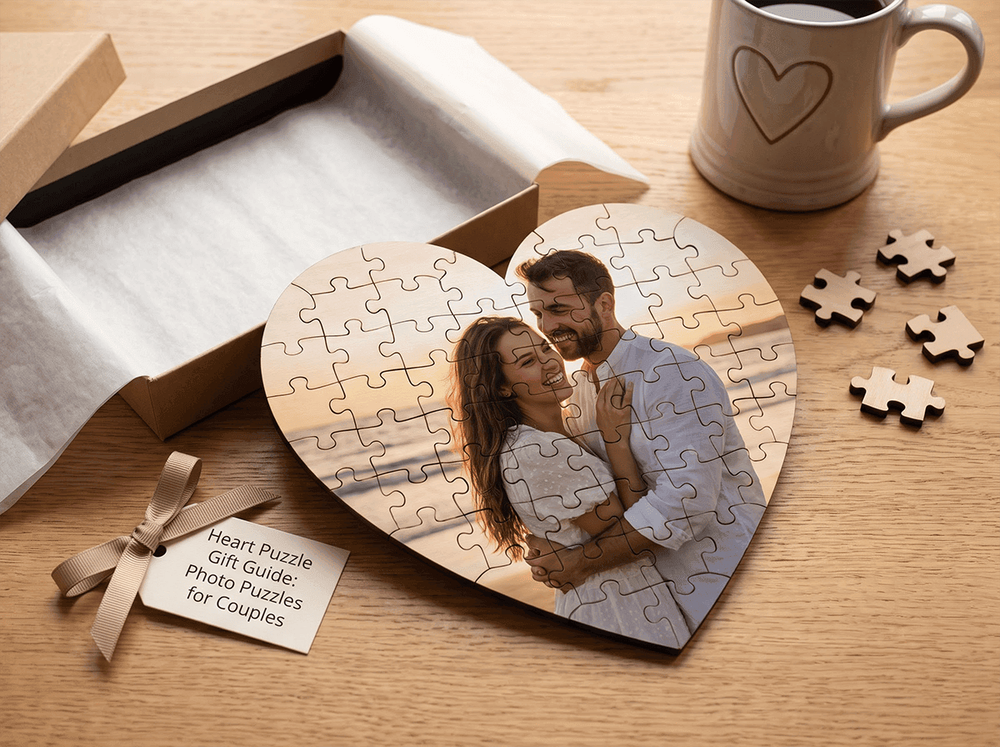
A heart puzzle gift is a personalized jigsaw or photo puzzle that turns a meaningful picture into something a couple solves together, usually shaped like a heart or built around a romantic memory. The reason it works so well as a gift is simple: it combines a personal photo, a shared activity, and a small reveal at the end, so the recipient does not just look at your gift, they earn it piece by piece. This guide covers everything you need to choose, design, and deliver a heart puzzle gift that lands, whether you want a physical box on the table or a digital photo puzzle you can send across the world in seconds.
Below you will find what a heart puzzle gift actually is, the psychology that makes it feel personal, how digital and physical versions compare, how to pick a photo that prints or renders beautifully, a step-by-step design walkthrough, more than thirty gift ideas sorted by occasion and relationship stage, presentation tricks, common mistakes, and a long FAQ. If you already know you want to build one and skip the shopping, you can start a custom photo puzzle for couples and come back to the rest of the guide for ideas.
What Is a Heart Puzzle Gift?
The phrase covers a few related things, and people use it loosely, so it helps to separate them before you buy or build anything.
The heart-shaped puzzle
This is a physical jigsaw cut into the outline of a heart rather than the usual rectangle. The pieces themselves are often standard, but the finished assembly forms a heart, which makes the shape part of the message. Heart-shaped custom puzzles are most often bought for engagements, anniversaries, and Valentine's Day, because the form itself signals romance before the recipient even reads the image. According to product listings tracked across Etsy and specialty puzzle makers in 2025, the heart outline is the single most requested non-rectangular cut for couples.
The photo puzzle for couples
This is any puzzle, heart-shaped or rectangular, printed from a personal photo of the two of you. The photo is the point. The shape is secondary. Most personalized puzzle services let you upload your own image and pick a piece count, and many add the option to lay out a collage of several photos for extra difficulty and extra memories in one box.
The digital heart puzzle
This is the newer category, and it is the one that has changed what a heart puzzle gift can be. Instead of a printed box, you upload a photo to an online tool, it becomes an interactive puzzle the recipient solves on their phone or laptop through a private link, and a hidden message or question is revealed once the last piece clicks into place. There is no shipping, no waiting, and no risk of a lost package. A platform like the HeartCraft photo puzzle builder, for example, lets you upload an image, choose a small grid, add a question and a personal note, preview exactly what your partner will see, and then send a single link.
Throughout this guide, "heart puzzle gift" refers to all three, and where the advice differs for physical versus digital, that difference is called out plainly. The symbolism is the thread that ties them together: a puzzle says two people fit together, that each partner completes the other, and that the picture only makes sense when every piece is in place. That meaning is exactly why the format keeps showing up at weddings, reunions, and anniversaries, as romantic-gift writers have noted for years.
Why Photo Puzzles Work So Well as Gifts for Couples
A heart puzzle gift is not just a cute object. It taps into several well-documented effects in psychology research, and understanding them helps you build a better one, because you can lean into the parts that actually create the feeling.
Shared focus creates a small flow state
Solving a puzzle pulls attention into a narrow, absorbing task. Puzzle researchers describe this as a "flow" state, a condition of full engagement where self-consciousness and anxiety temporarily fade. Writers covering the science of puzzling in 2025 connect this absorption to lower cortisol, the body's main stress hormone, and to improved mood. A 2018 German study frequently cited in this space found that jigsaw puzzling helped people regulate distressing emotions and step back from stressors through the focused attention the activity demands.
When two people share that focus, something extra happens. You are quiet together, working toward the same small goal, and the conversation that comes out of it tends to be relaxed rather than performed. That is very different from handing over a wrapped object and watching a face for a reaction. The puzzle buys you twenty unhurried minutes side by side, which for many couples is the real gift.
The reveal is a built-in emotional payoff
Every puzzle ends with a moment: the last piece, the completed image, the thing snapping into focus. A heart puzzle gift turns that built-in climax into your message. With a physical puzzle, the reveal is the photo itself coming together. With a digital one, the reveal can be a question or note that appears only after the final piece lands. That structure matters. The recipient works toward a payoff they cannot see in advance, so the surprise is sequenced rather than instant, and sequenced surprises tend to feel larger.
Personalization raises the felt value
Research summarized by ScienceDaily in December 2024 found that personalized gifts create stronger emotional connections and can raise a recipient's self-esteem, making them feel more cherished. The same body of work describes a reaction researchers called "vicarious pride," a unique emotional response that personalized gift-giving can trigger in the person receiving it. A puzzle printed from a stranger's stock photo is a toy. A puzzle printed from the photo of your first trip together is a memory you have to rebuild with your hands. The personalization is what moves it from object to experience.
Experiences beat possessions
A consistent finding in gift-giving research, including work covered by the University of Delaware's Lerner College and a 2022 paper in Humanities and Social Sciences Communications, is that people draw more lasting satisfaction from experiences than from things, and that experiential gifts tend to produce more gratitude and a stronger sense of connection. A heart puzzle gift is a clever hybrid. It is a physical or digital object, so it feels like a "real" present, but the act of solving it is an experience. You get the tangibility of a thing and the staying power of an experience in one package.
The neurochemistry of giving and receiving
Both giving and receiving gifts activate the brain's reward circuitry, releasing dopamine and oxytocin, the chemicals tied to pleasure, empathy, and trust, as gift-giving explainers in Psychology Today have described. A collaborative gift that you build and your partner solves stretches that reward across two people and across time: the planning, the sending, the solving, and the conversation afterward. Few gift formats keep paying out for that long.
Digital vs Physical Heart Puzzles: How to Choose
This is the first real decision, and it shapes everything after it. Neither option is better in the abstract. They fit different situations.
When a physical heart puzzle is the right call
Choose a printed puzzle when the two of you are in the same place, when the recipient genuinely enjoys sitting down with a jigsaw, and when you want something that can be framed or kept on a shelf afterward. A finished physical puzzle can be glued and hung, which turns a one-evening activity into wall art. The market supports this: the global jigsaw puzzle market was valued around USD 2.0 billion in 2025 and is forecast to reach roughly USD 2.8 billion by 2035, growing at about 3.6 percent a year, according to Market Research Future. Adults make up the dominant share of buyers, holding about 71 percent of the market in 2025 by end-user analysis, with relaxation, mindfulness, and gifting cited as the main drivers. Custom-photo puzzle purchases specifically rose around 18 percent over two years, concentrated in holiday gift seasons, per the same industry tracking.
The trade-offs are practical. A physical puzzle has to be shipped, which means lead time and the small chance of damage or delay. It only works if the recipient is willing to spend the time assembling it, and very large piece counts can become a chore rather than a treat for someone who is not a dedicated puzzler.
When a digital heart puzzle is the right call
Choose a digital puzzle when distance, timing, or surprise is the constraint. If your partner is in another city or another country, a link arrives instantly. If you forgot the date until this morning, a digital puzzle can be built and sent in minutes. If you want to control the reveal, a digital tool can hide a question or note behind the final piece in a way a printed box cannot. Digital puzzles also remove the entire shipping problem, which is the single most common point of failure for last-minute physical gifts.
The trade-off is tangibility. There is no box to unwrap and nothing to frame, though many people screenshot the finished image or the revealed message and keep it. For long-distance relationships, surprise sends, and anyone who wants the gift to be an interaction rather than an object, the digital format usually wins. HeartCraft's digital photo puzzle was built around exactly these cases: a quick build, a private link, and a message that surfaces once your partner finishes.
A quick decision guide
- Same home, loves jigsaws, wants keepsake: physical heart-shaped or photo puzzle, framed afterward.
- Long distance: digital puzzle with a link, every time.
- Last minute (today): digital puzzle, built and sent in minutes.
- Wants a hidden question or proposal-style reveal: digital puzzle, because the reveal is programmable.
- Older relative or someone who dislikes screens: physical puzzle with large, easy-to-handle pieces.
- Tight budget, no shipping: digital puzzle.
You can also do both. Send a digital puzzle today as the surprise, then follow up with a framed physical version of the same photo for the keepsake. The two formats complement each other rather than compete.
Where Heart Puzzle Gifts Fit: Occasions and Relationship Stages
One of the strengths of this format is range. The same idea works for a brand-new couple and for a fortieth anniversary, as long as you match the photo, the tone, and the message to the moment.
Anniversaries
Anniversaries are the natural home for a heart puzzle gift. The photo can mark the relationship itself: a picture from the wedding, the first date spot, or the trip that turned a casual thing into a serious one. For a milestone year, a collage puzzle that layers several photos from across the years tells a longer story in one box. If you want a dedicated anniversary angle with more ideas, HeartCraft keeps a separate guide and product set for anniversary gifts that pairs well with a puzzle as the centerpiece.
Valentine's Day
Valentine's Day is the peak season for heart-shaped puzzles specifically, since the shape and the holiday reinforce each other. Demand for personal gifts spikes in this window, which is also when shipping gets slowest, so it is the occasion where a digital puzzle most often saves the day. A digital build dodges the Valentine's delivery crush entirely. For more seasonal ideas, the HeartCraft Valentine gifts collection runs alongside the puzzle builder.
Birthdays
A birthday heart puzzle does not have to be romantic. The photo can be a favorite shared memory, a running joke captured in an image, or a montage of the year. Pairing the puzzle with a hidden birthday message at the reveal makes it feel like a card and a gift at once. HeartCraft's birthday gifts range is a good place to look if you want to build a small theme around the puzzle.
Proposals and engagements
This is where the digital reveal becomes genuinely clever. A puzzle that ends with the question "Will you marry me?" turns the act of solving into the buildup to the proposal. The recipient does the work, the image of the two of you comes together, and the question lands at the exact moment the picture completes. Even for couples already engaged, a heart-shaped puzzle of the proposal photo makes a lasting keepsake.
Long-distance relationships
Distance is the constraint that digital heart puzzles were practically invented for. A link crosses any distance instantly, you can both look at the same finished image, and the solving gives you something to do together over a video call. There is a full section on long-distance use further down, because it is one of the strongest fits for the format.
Apologies and making up
A sincere apology gift is hard to get right, and a heart puzzle can carry one well because it asks for the recipient's time and attention before the message arrives. The reveal can hold a genuine, specific apology rather than a generic "sorry." The effort of building something personal communicates more than a store-bought card. If you want a format built specifically for this, HeartCraft also offers other digital gift formats aimed at saying sorry and writing love letters, which pair naturally with a puzzle.
Just because
The most underrated occasion is no occasion. A heart puzzle sent on an ordinary Tuesday, with a photo your partner forgot you had and a note they were not expecting, carries more weight than the same gift on a date they were already braced for. Unprompted gifts read as thoughtful precisely because nothing required them.
For parents and family
Heart puzzle gifts are not only for romantic partners. A photo puzzle of the whole family makes a strong present for a parent, and the collaborative solving works as a group activity. If you are shopping for a mother specifically, a family-photo puzzle slots neatly alongside HeartCraft's range of gifts for mothers and other relationships.
How to Choose the Perfect Photo for a Heart Puzzle
The photo is ninety percent of the gift, and it is also where most people go wrong. A weak image makes a weak puzzle no matter how nice the box or how clever the reveal. These rules apply to both physical prints and digital puzzles, with a couple of notes where they differ.
Start with resolution
For physical puzzles, especially larger sizes, image quality is the make-or-break factor. Custom-puzzle printers generally recommend at least 200 to 300 DPI, and for the biggest puzzles an image of roughly 3000 by 2000 pixels or more, with 150 DPI treated as the practical floor for an acceptable print, according to printing guides from specialty puzzle companies. Below that, the print looks soft, and every flaw is magnified once the image is sliced into pieces and enlarged.
For digital puzzles the bar is lower, since screens are forgiving and the grid is usually small, but a sharp original still looks better than a fuzzy one. Either way, the rule is the same: use the highest-quality version of the photo you can find.
Use the original file, never a screenshot
This is the single most common mistake. Do not use a screenshot, a photo saved from social media, or an image forwarded through a messaging app. All of those are compressed, sometimes heavily, and the lost detail cannot be recovered. Go to the original file in your camera roll or cloud backup and use that. A screenshot of a photo is a copy of a copy, and it shows.
Favor bright, high-contrast images
Photos with clear contrast and varied color make the best puzzles, physical or digital, because they give the eye distinct regions to work with. Avoid images dominated by a single texture or color, like a wide expanse of blue sky, plain sand, or grass. Those areas are visually boring and, in a physical puzzle, genuinely frustrating to assemble because every piece looks the same. A picture of the two of you with a detailed background beats a beautiful but uniform landscape.
Mind the lighting
Well-lit photos, particularly those shot in natural light, reproduce more vibrantly. Images taken outdoors near sunrise or sunset, the so-called golden hour, tend to carry warm, rich tones that print and render well. Harsh midday shadows or dim indoor shots with heavy noise are harder to work with.
Think about composition and the cut
Keep the most important content, usually faces, away from the extreme edges, because edges get trimmed slightly and, in a heart-shaped puzzle, the outline cuts into the corners of the image. Center the subject. If you are using a collage, make sure no single face lands on a seam between photos. For digital puzzles with a small grid, simple compositions read better than busy ones, since each tile holds a recognizable chunk of the picture.
Save in the right format
JPEG is the standard and recommended format for most custom-puzzle services. If your tool accepts PNG or HEIC, those work too, but a high-quality JPEG of the original is a safe default. Whatever you do, export from the source rather than re-saving a compressed copy.
A simple photo checklist
- Is it the original file, not a screenshot or a download from social media?
- Is it sharp at full size, with no blur when you zoom in?
- Does it have clear contrast and varied color, not a single flat texture?
- Are the faces and key details away from the edges?
- Is the lighting good, ideally natural?
- Does the photo actually mean something to the recipient, not just look nice?
That last point overrides all the technical ones. A slightly imperfect photo of a moment that matters beats a flawless photo of nothing in particular.
How to Design a Heart Photo Puzzle, Step by Step
Here is the full build process. The digital path is faster and is covered first, then the physical path, then the parts that apply to both.
Building a digital heart puzzle
The flow on a tool like the HeartCraft photo puzzle builder is short and deliberately so. It runs roughly like this:
- Upload your image. Pick the photo using the selection rules above. The tool turns it into the puzzle the recipient will solve.
- Choose the puzzle size. Digital builders usually keep the grid small, for example a 3 by 3 or 4 by 4 layout, so it is satisfying to solve on a phone without becoming tedious. Smaller grids suit a quick, emotional reveal; larger grids stretch the activity.
- Add your question and follow-ups. This is the heart of a digital build. You can pose a primary question, such as a date invitation, an anniversary prompt, or a proposal, and optionally chain follow-up questions for a longer interaction.
- Write the message that appears at the end. Compose the personal note that surfaces once the last piece is placed. This is your reveal, so make it specific.
- Preview the recipient's experience. A good builder lets you see exactly what your partner will see before you commit. Use it. Check the photo, the question wording, and the note.
- Pay and share the link. A unique link is generated. Send it however you like, and that is the whole gift delivered.
The entire process takes minutes, which is why digital puzzles are the go-to for surprises and last-minute saves.
Ordering a physical heart puzzle
The physical path takes longer because of production and shipping, so plan backward from the date.
- Pick your photo and your cut. Decide between a heart-shaped outline and a rectangular photo puzzle. Heart shapes lean romantic; rectangles maximize image area.
- Choose a piece count that matches the person. For a casual puzzler, smaller counts in the dozens to a few hundred pieces keep it fun. Dedicated puzzlers can handle 500 to 1,000 pieces or more. Common custom sizes run from around 48 pieces up through 500 and 1,000, with some makers offering many sizes in between.
- Decide single photo or collage. A collage packs in more memories but raises the difficulty and can muddy a small puzzle. For a heart shape, a single strong image usually reads better.
- Proof the layout. Check how the photo sits inside the cut, especially where the heart outline trims the corners. Confirm faces are not cropped.
- Order with buffer time. Build in extra days for production and delivery, and more during holiday seasons when custom-puzzle demand peaks.
The parts that matter for both
Whatever format you choose, three things separate a memorable heart puzzle from a forgettable one: the photo carries real meaning, the message at the end is specific rather than generic, and the presentation matches the moment. The next sections cover the message and the presentation in depth, because those are where good gifts become great ones.
Adding Meaning: Questions, Notes, and the Reveal
A puzzle without a message is a nice activity. A puzzle with the right message is a gift people remember for years. This is the part most buyers underthink, so it is worth slowing down on.
Write the reveal like it is the whole gift
Because the reveal is the climax, it deserves the most effort. Skip generic lines like "I love you" on their own. Instead, anchor the message to something only the two of you share: the in-joke from the photo, the thing your partner said on the day it was taken, the reason you chose that particular picture. Specificity is what makes a recipient feel seen. "I picked this one because it is the moment I stopped pretending I was not already in love with you" outperforms any greeting-card line.
Use questions to create interaction
Digital puzzles let you pose questions, and a well-chosen question turns a passive gift into a back-and-forth. A few patterns that work:
- The invitation: "Dinner, Friday, just us. Yes?" The puzzle becomes the ask.
- The memory prompt: "Do you remember where this was taken?" It invites a reply and reopens the memory.
- The milestone: "Three years today. Same answer as last time?"
- The big one: a proposal, with the photo of the two of you completing just as the question appears.
Match the tone to the relationship stage
A six-week-old relationship and a twenty-year marriage call for different registers. Early on, keep it light and low-pressure; a heavy declaration can land as too much, too soon. Later, you have the shared history to make a deeper message feel earned. Read the stage honestly and write to it.
Length and restraint
Short and specific beats long and vague. A few honest sentences carry more than a wall of text. If you have a lot to say, a puzzle reveal may not be the right container for all of it, and a dedicated love letter format might serve the longer message better, with the puzzle as the opener.
More Than Thirty Heart Puzzle Gift Ideas
Use these as starting points. Each pairs a photo idea with a message angle, so you can adapt rather than copy.
For new couples
- The photo from your first date, with the reveal asking for a second, third, or hundredth.
- A screenshot-free picture from the trip or event where you met, captioned with what you thought of them that day.
- A candid shot they do not know you took, revealing that you have been paying attention since the start.
- A small 3 by 3 digital puzzle of a selfie, ending with "Be my Valentine?" for a low-pressure ask.
- A picture of the place you want to take them next, with the reveal as the invitation.
For long-term couples and marriages
- A collage spanning every year you have been together, solved on the anniversary.
- The wedding photo as a heart-shaped keepsake puzzle, framed afterward.
- A then-and-now pairing: an early photo and a recent one in the same puzzle.
- A picture of the home you built together, with a note about the life inside it.
- A photo of the kids or pets, for an anniversary that is really about the family you made.
For long-distance
- A digital puzzle of the last photo you took together, sent to solve on a call.
- A map or photo of the city where you will next meet, revealing the date you booked.
- A puzzle of a photo from each of your current cities, side by side.
- A countdown reveal: the message shows how many days until you are together again.
- A morning surprise link timed to their wake-up across time zones.
For proposals and engagements
- A digital puzzle of your favorite photo together, ending with the proposal question.
- A heart-shaped physical puzzle of the spot where you plan to propose, given the night before.
- A puzzle of the ring, revealed before you ask in person.
- A multi-question digital build that walks back through your relationship and ends with the big one.
For birthdays
- A montage of the past year, ending with a birthday message.
- A puzzle of an inside joke captured in a photo, for someone who values a laugh over a flourish.
- A picture from their last birthday, revealing the plan for this one.
For apologies
- A photo from a genuinely happy moment, with a specific, honest apology at the reveal.
- A picture of something you know they love, paired with a concrete plan to make things right.
For family and parents
- A family photo puzzle for a parent, solved together at a gathering.
- A childhood photo recreated and turned into a puzzle for a milestone birthday.
- A collage of grandchildren for a grandparent who is far away, sent digitally.
- A picture from a family trip, with each person's note revealed at the end.
For "just because"
- A random favorite photo sent on an ordinary day, with no occasion attached.
- A puzzle of a meal you cooked, a view you shared, or a quiet moment most people would not photograph.
- A weekly or monthly tradition: one small digital puzzle, every so often, of something from the week.
The ideas are deliberately broad, because the magic is in the specific photo and message you bring to them, not in the template.
Presentation and Delivery: Making the Moment
How the puzzle reaches the recipient shapes how the gift feels. A great puzzle handed over carelessly loses half its effect, and a simple one delivered with care gains it back.
Physical presentation
For a printed puzzle, the unboxing is part of the gift. Consider these touches:
- Hide the image. Remove or cover the box photo so the picture is a surprise that only emerges as they assemble it.
- Set the scene. Clear a table, pour drinks, and make the assembly an evening rather than a chore squeezed between other things.
- Hold back one piece. Keep the final piece in your pocket and place it yourself, or hand it over with the message attached.
- Plan the keepsake. If the puzzle is a milestone gift, have a frame ready so the finished image goes straight onto the wall.
Digital presentation
For a digital puzzle, the link is the delivery, but timing and framing still matter:
- Time it. Send the link when they can actually sit with it, not in the middle of a workday. First thing in the morning or last thing at night often works best.
- Say little. Resist explaining the gift in the message. "Open this when you have five minutes" builds more anticipation than a paragraph.
- Be there for the reveal. If you can, get on a call so you witness the moment the message appears. For long-distance couples, this is the closest thing to handing it over in person.
- Capture it. Encourage a screenshot of the finished image and message, so the digital gift leaves a keepsake behind.
Combining formats
The strongest version, for a major occasion, uses both. Send the digital puzzle as the live surprise, then give a framed physical print of the same photo as the lasting object. The digital piece carries the moment; the physical piece carries the memory.
Common Mistakes to Avoid
Most heart puzzle gifts that fall flat fail for predictable reasons. Avoid these and you are most of the way to a good one.
Using a low-quality or wrong photo
The number one error. A blurry screenshot, a compressed download, or a photo dominated by flat sky ruins a physical puzzle and weakens a digital one. Spend the extra two minutes finding the original, sharp file.
Writing a generic message
A reveal that says only "I love you" wastes the format's biggest advantage. The whole point of the buildup is to land something specific. If you would not be embarrassed to put the message on a mass-produced card, it is not personal enough.
Mismatching difficulty to the person
A 1,000-piece puzzle given to someone who does not enjoy jigsaws is a burden disguised as a gift. Match the piece count, physical or digital, to how much the recipient actually likes solving things. For most people, smaller is better.
Forgetting lead time on physical orders
Custom puzzles take time to produce and ship, and demand peaks in gift seasons when delivery slows further. If the date is close, switch to a digital build rather than risk a late or damaged box.
Over-explaining the gift
Telling the recipient exactly what is coming drains the surprise. Let the puzzle do the reveal. Your job is to deliver it and step back.
Choosing the shape over the photo
A heart outline is charming, but the photo carries the meaning. Do not pick a worse picture just because it fits a heart shape better. The image comes first.
What a Heart Puzzle Gift Costs, and How to Think About Budget
Prices vary widely by format, size, and maker, so think in ranges and in value rather than chasing the lowest number.
Physical custom puzzles scale with piece count and quality. Small photo puzzles are inexpensive, while large premium pieces, heart-shaped cuts, and gift packaging push the price up. Add shipping, and factor in faster delivery if the date is tight. The advantage you are paying for is a tangible keepsake you can frame.
Digital puzzles are generally lower cost because there is no material or shipping, and the price is for the build and the shareable experience rather than a physical object. For long-distance gifts, last-minute saves, and anyone on a tight budget, the digital route delivers most of the emotional payoff at a fraction of the logistics. The free and low-cost end of the digital gift world has grown specifically because people want something that feels personal without the expense or the wait.
The honest way to weigh cost is per memory, not per object. A puzzle that produces an unforgettable evening and a framed photo on the wall, or a long-distance reveal that gets screenshotted and kept, returns far more than its price suggests. Spending research consistently shows experiences outlast possessions, and a heart puzzle gift is mostly experience.
Heart Puzzle Gifts for Long-Distance Relationships
This deserves its own section because it is the situation where the digital format is not just convenient but genuinely better than the alternatives.
Why distance changes the math
When you cannot hand someone a gift, most physical presents become a logistics problem: shipping costs, customs, delays, and the deflating gap between the occasion and the arrival. A digital heart puzzle erases all of that. The link arrives the moment you send it, anywhere, with no border to cross. For couples separated by cities, countries, or time zones, that immediacy is the whole point.
Solving together across the distance
The best long-distance use is shared. Get on a video call, send the link, and solve it together, or watch your partner solve it while you talk. The activity gives the call a focus beyond the usual catch-up, and the reveal at the end becomes a moment you experience at the same time even though you are far apart. Puzzle research on social solving notes that shared puzzling reduces feelings of isolation and creates a sense of joint accomplishment, which is exactly what distance erodes.
Working with time zones
Timing is the one thing to get right. Send the link when it is a good moment for them, not for you. A puzzle that lands as they wake up, or as they wind down at night, gets the attention it deserves. A morning-surprise link, timed across the time difference, is a small logistical effort that reads as a big thoughtful one.
Building anticipation between visits
A heart puzzle can also carry practical romance: reveal the date of your next visit, a countdown to it, or a photo of where you will meet. It turns the gift into a marker of the next time you will be in the same room, which is the thing long-distance couples care about most. For more ideas built around distance and everyday love, the broader HeartCraft digital gifts hub collects formats designed for exactly this.
Accessibility and Inclusivity Considerations
A gift only works if the recipient can actually enjoy it, so adjust for the person.
For older relatives or anyone with limited dexterity or vision, a physical puzzle with large, easy-to-handle pieces and a small count is far kinder than a fiddly 1,000-piece set. For someone who finds screens hard or tiring, the physical format is the better choice outright. For a recipient who is rarely without their phone and lives at a distance, the digital format meets them where they already are. Keep digital reveals readable: clear, reasonably sized text and a simple grid serve everyone, not only those with perfect eyesight. The goal is to remove friction between the recipient and the moment, never to add a test.
Turning a Heart Puzzle Gift Into a Tradition
The single best way to multiply the value of this format is to repeat it. A one-off puzzle is lovely. A puzzle that shows up every anniversary, or on the same date each year, becomes a ritual the relationship is built around.
Pick an anchor: your anniversary, the date you met, a birthday, or even a monthly cadence for long-distance couples. Each year or month, build a small puzzle from a photo of the time that has passed since the last one. Over the years, the series becomes a visual diary of the relationship, and the recipient starts looking forward to it before the date arrives. Anticipation is itself a gift, and a tradition manufactures it for free. Because digital puzzles are quick and inexpensive to make, the cadence is easy to sustain, and you can always mark the bigger years with a framed physical version to punctuate the series.
Heart Puzzle Ideas for Milestone Anniversaries
Anniversaries reward a photo and message tuned to the specific year, and the traditional anniversary themes give you a ready-made angle. You do not have to follow them literally, but they are a useful prompt when inspiration runs dry.
First anniversary
The first year is about proof that the leap worked. Use a photo from the wedding or from the first big trip you took as a married couple, and let the reveal name one thing you learned about your partner in the year. The traditional theme is paper, which pairs neatly with a printed puzzle as the modern twist on a paper gift.
Fifth anniversary
Five years is long enough to show change. A then-and-now puzzle, an early photo beside a recent one in a single collage, makes the passage of time the subject. The reveal can simply note what has stayed the same underneath everything that changed.
Tenth anniversary
A decade earns a bigger gesture. A collage puzzle drawing one photo from each year tells the whole story in a single box, and solving it becomes a guided walk back through the relationship. For a tenth, many couples choose a heart-shaped physical version to frame, marking the milestone with something permanent on the wall.
Twentieth, twenty-fifth, and beyond
The longer milestones are about the life you built, not just the romance. Photos of the home, the children, the trips, and the ordinary days all belong here. A digital puzzle lets distant family take part, useful when grown children live far away, and the reveal can hand the floor to the whole family rather than only the couple. For a deeper set of year-by-year ideas, HeartCraft keeps a dedicated guide to anniversary gifts that works well with a puzzle as the centerpiece.
How to Photograph Now for a Better Puzzle Later
The best heart puzzle gifts often start months before the occasion, with a photo taken on purpose. If you know a future anniversary or birthday is coming, a little intention behind the camera pays off when it is time to build.
Shoot in good light. Natural light near sunrise or sunset gives the warm, rich tones that print and render best, while harsh midday sun and dim indoor scenes are harder to work with later. Get close enough that faces are large in the frame, since faces are what make a personal puzzle land, and keep them away from the very edges where a heart-shaped cut trims the corners. Choose backgrounds with some detail and contrast rather than a flat wall or open sky, because varied texture makes a physical puzzle far more pleasant to assemble and a digital one more readable tile by tile.
Most importantly, save the original. Keep the full-resolution file in a cloud backup rather than relying on a version that has passed through a messaging app, which compresses images and strips the detail you will want at print size. When the occasion arrives, you will reach for the original, sharp file and have exactly what a great puzzle needs. Taking one deliberate photo at a meaningful moment, knowing it may become a gift later, is a small habit that quietly upgrades every puzzle you make afterward.
A Short History of Puzzles as Gifts
The jigsaw puzzle started life as a teaching tool, not a romantic one. In the 1760s, mapmakers in Europe mounted maps on wood and cut them along borders so children could learn geography by reassembling countries. These "dissected maps" were the first puzzles, and they were given to the young as educational presents. The leap from classroom aid to popular pastime took roughly a century, helped by cheaper cardboard and die-cutting, which made puzzles affordable enough to hand out widely.
Puzzles became a genuine gift culture during the early twentieth century, peaking as an inexpensive entertainment during hard economic times when people wanted hours of activity for very little money. That value proposition, lots of engagement for a small price, is still part of why puzzles make good gifts today. The personalization era arrived much later, once home photography and on-demand printing let anyone turn a private photo into a one-off puzzle. That shift is what made the heart puzzle gift possible: the puzzle stopped being a picture of a generic landscape or painting and became a picture of your life.
The most recent chapter is digital. As screens became the place where long-distance relationships actually live, the puzzle followed, moving from a printed box to an interactive link that can hold a hidden message. Each step in this history kept the same core idea and changed the delivery. A puzzle has always been a gift that asks the recipient to participate, and participation is exactly what makes it stick.
How a Heart Puzzle Compares to Other Romantic Gifts
It helps to see where a heart puzzle sits against the usual options, because the comparison shows what it does that they do not.
Versus flowers
Flowers are beautiful and immediate, and they are also gone within a week. They carry no personalization beyond the choice of bloom, and they ask nothing of the recipient except to put them in water. A heart puzzle costs a similar amount, lasts far longer, and turns the recipient into a participant. Flowers say "I thought of you today." A photo puzzle says "I remember this specific moment we shared, and I want you to relive it." For some occasions flowers are perfect, but they cannot carry a message the way a puzzle reveal can.
Versus jewelry
Jewelry is the heavyweight romantic gift, and it has staying power, but it is expensive and impersonal unless engraved. A ring or necklace says commitment; it does not say anything about a particular memory. A heart puzzle is the opposite: lighter on the wallet, heavier on personalization. The two are not rivals so much as different tools. A puzzle can even introduce jewelry, by revealing where to look for the real gift once the last piece lands.
Versus a generic e-card
E-cards were the first attempt at a digital romantic gift, and they have aged badly. A static animated card with a stock template asks for nothing and reveals nothing. A digital heart puzzle is what the e-card should have grown into: interactive, personalized with your own photo, and built around a reveal the recipient has to work toward. The difference is participation. An e-card is watched; a puzzle is solved. Coverage of the shift away from e-cards toward interactive digital gifts has made exactly this point.
Versus a photo book or framed print
A photo book or framed print shares the puzzle's strength, a personal image, but skips the activity. It is something to look at, not something to do. A puzzle adds the solving, the shared focus, and the reveal, and a finished physical puzzle can be framed afterward, so it becomes the print as well. If the recipient values the doing as much as the having, the puzzle wins. If they only want a polished object on the wall, a print may be simpler.
Versus an experience day
Experience gifts, a dinner, a trip, a class, score highly in research on lasting satisfaction, but they require scheduling and presence. A heart puzzle is a small experience that needs neither, which is why it works across distance and at the last minute. For couples who cannot be together, the puzzle delivers a slice of the experiential benefit without the logistics.
Pairing a Heart Puzzle With Other Digital Gifts
A heart puzzle does not have to stand alone. Some of the most memorable gifts use the puzzle as the opening act and pair it with a second format that carries a longer or different message. Because digital gifts are quick and inexpensive to build, stacking two of them is realistic even on a small budget.
A few combinations that work well:
- Puzzle plus a long letter. The puzzle reveal is the wrong place for a paragraph, so keep it short and point the recipient toward a separate love letter for the full message. The puzzle sets the mood; the letter delivers the depth.
- Puzzle plus a proposal page. For an engagement, the puzzle can build to the question while a dedicated proposal page holds the full story of the relationship for the recipient to read afterward, keeping the moment itself simple and the keepsake rich.
- Puzzle plus a QR-code gift. A printed heart puzzle can hide a QR code among its pieces, or arrive alongside one, so that completing the physical puzzle unlocks a digital surprise. A QR-code gift bridges the physical and digital versions in one experience.
- Puzzle plus a "sorry" gift. An apology benefits from both effort and honesty. A puzzle of a happy shared moment, paired with a dedicated sorry gift format that carries the real apology, shows you put thought in rather than reaching for the nearest card.
The principle behind every pairing is the same: let the puzzle do what it does best, which is the photo and the reveal, and hand off anything longer or more serious to a format built for it. Stacking gives the recipient a small sequence of moments instead of a single one, and sequences feel more generous than their cost suggests.
A Writing Workshop for the Reveal Message
Because the message is where most heart puzzles are won or lost, here is a fuller workshop with patterns and worked examples. Adapt the structure, never copy the words, since the entire value is in specificity.
The three-part structure
A strong reveal usually has three beats: a hook that names the moment, a turn that says why it matters, and a close that points forward. You do not need all three every time, but the shape keeps a message from drifting into vague sentiment.
- Hook: name the photo. "This is the night we missed the last train."
- Turn: say what it meant. "I have never laughed that hard with anyone, before or since."
- Close: point forward. "Three years later, I would miss every train with you."
Patterns by occasion
Anniversary. Anchor to time passing. "Year five. Same photo on my phone, same answer in my chest." Reference the specific year and a detail only the two of you would catch.
Valentine's Day. Keep it warm and low on pressure. "I did not need a holiday to send this, but I will take the excuse. Dinner, Friday, you and me?"
Birthday. Celebrate the person, not just the date. "A whole year of you, and this was my favorite minute of it. Here is to the next one."
Proposal. Short, certain, and unmistakable. Let the photo complete and ask the question plainly. The buildup has already done the emotional work; the words just need to be clear.
Apology. Be specific about what and concrete about next. "I was wrong about Tuesday, and I have been sitting with it. This is me starting to make it right, and here is how." Avoid "if I hurt you" phrasing, which dodges responsibility.
Long-distance. Make the distance the subject and shrink it. "Forty-one days. I counted. Solve this on Sunday's call and I will tell you where I booked us."
Words and phrases to avoid
Generic openers like "words cannot describe" describe nothing and waste the reveal. Greeting-card abstractions, "you mean the world to me," carry less weight than one concrete detail. And anything you could send to more than one person is, by definition, not personal enough for this format. The test is simple: read the message and ask whether it could only have been written about this exact person and this exact photo. If the answer is no, rewrite it.
Matching length to the moment
For a quick "just because" send, a single sentence is plenty. For an anniversary, three or four sentences. For anything that wants to be longer, move the bulk into a paired letter and keep the reveal itself tight, because a screen full of text at the end of a puzzle deflates the very momentum the puzzle built.
Design Details That Make a Puzzle Feel Premium
Small choices separate a gift that feels considered from one that feels rushed. None of these cost much, and together they change the impression.
For physical puzzles, the box and finish matter more than people expect. A glossy, sturdy box and clean printing read as premium, while flimsy packaging undercuts even a great photo. Recent production improvements in the custom-puzzle space, including domestic manufacturing in some markets for faster shipping and tidier, more compact boxes, have raised the baseline, so it is worth choosing a maker whose finish you have seen. Piece feel counts too: thicker pieces with a satisfying snap make assembly pleasant, while thin, flimsy pieces frustrate.
For digital puzzles, the equivalent details are the photo crop, the grid choice, and the wording. A clean crop that centers the subject, a grid sized so the solve feels rewarding rather than trivial or tedious, and a message free of typos all signal care. Use the preview step to catch the things that quietly cheapen a digital gift: a face split awkwardly across tiles, a question with a typo, a note that runs too long. The preview exists so the recipient sees the polished version and never the rough one.
Across both formats, restraint is the premium signal. One strong photo beats a cluttered collage. A few honest words beat a paragraph. A single well-timed delivery beats a flurry of hype messages. The most expensive-feeling gifts are usually the most edited ones.
Caring For and Displaying a Finished Physical Puzzle
If you go the physical route and want the puzzle to outlive the evening, plan for what happens after the last piece.
To keep a completed puzzle intact, use puzzle glue or a peel-and-stick adhesive sheet. Glue is brushed across the assembled front and seeps between the pieces to lock them; adhesive sheets are applied to the back and avoid a shiny coat on the image. Either way, let it dry fully on a flat surface before moving it. Work on a hard backing or a dedicated puzzle mat so you can slide the finished piece without flexing and popping it apart.
Once it is sealed, framing turns the puzzle into wall art. Measure the finished dimensions before buying a frame, since custom and heart-shaped puzzles rarely match standard frame sizes, and a deep frame or shadow box accommodates the thickness of the pieces. Mounting it on foam board first keeps it rigid inside the frame. Hung this way, an anniversary or wedding-photo puzzle becomes a permanent fixture, which is the physical format's main advantage over digital: it leaves something on the wall.
If you would rather keep it as a reusable puzzle, store it flat in its box with the pieces in a sealed bag, away from humidity and direct sun, which can warp pieces and fade the print over time. A puzzle kept well can be reassembled on future anniversaries, becoming its own small tradition.
Heart Puzzles for Friends and Platonic Love
Romance gets most of the attention, but the format works just as well for the people you love who are not partners. Close friendships rarely get marked the way romantic relationships do, which is exactly why a thoughtful friendship gift stands out. A photo puzzle of a trip you took together, an inside joke frozen in an image, or a picture from the day you met carries the same collaborative warmth without the romantic charge.
The message is where you set the tone. Keep it affectionate and specific without tipping into language that would read as romantic if that is not the intent. "Ten years of being insufferable together, and I would not trade a single one" lands as friendship, not flirtation. For a friend going through a hard stretch, a small digital puzzle of a happy shared memory, sent with no occasion attached, can do more than a long message, because it asks them to spend a few absorbed minutes somewhere good before they read your note. The same research on shared puzzling reducing isolation applies to friends as much as partners.
Long-distance friendships benefit from the digital format for the same reasons romantic ones do. A link crosses any distance, and solving it together on a call gives the conversation a shared focus. Friendship is a relationship people forget to celebrate, and a heart puzzle is a low-key way to do it without making it awkward.
The Practical and Environmental Footprint
Worth a brief, honest word, since it can tip a close decision. A physical puzzle is a manufactured object: cardboard, printing, packaging, and a shipped parcel, all of which carry a small material and transport cost. For a keepsake you will frame and keep for years, that footprint is easy to justify, since the object earns its existence. For a one-evening novelty that ends up in a drawer, it is harder to justify.
A digital puzzle has effectively no material footprint and nothing to ship, which is part of why the lower-cost, no-shipping end of the digital gift world has grown so quickly. If the occasion does not call for a physical keepsake, the digital route is the lighter choice on every practical axis: cost, waste, and time. The cleanest approach is to match the format to whether you genuinely want a lasting object. Buy the physical puzzle when you will keep it, send the digital one when the moment is the point. That single question resolves most of the trade-off honestly.
Frequently Asked Questions
What is a heart puzzle gift exactly?
It is a personalized puzzle made for a romantic or family relationship, either a physical jigsaw cut into a heart shape or printed from a personal photo, or a digital puzzle solved through a link that reveals a hidden message at the end. The common thread is that the recipient assembles something meaningful rather than just receiving it, which fits the symbolism of two people who complete each other.
Are digital or physical heart puzzles better?
Neither is universally better. Physical puzzles suit same-home couples who want a keepsake to frame and who enjoy assembling jigsaws. Digital puzzles suit long-distance relationships, last-minute surprises, and anyone who wants a programmable reveal like a hidden question or proposal. Many people use both: a digital puzzle for the live moment and a framed print for the keepsake.
How many pieces should a photo puzzle for couples have?
Match the count to the recipient. Casual puzzlers do well with smaller counts, from a few dozen up to a couple hundred pieces. Dedicated puzzlers can enjoy 500 to 1,000 or more. Digital puzzles usually keep the grid small, such as 3 by 3 or 4 by 4, so the reveal stays satisfying rather than tedious on a phone.
What photo works best for a custom puzzle?
Use the original, high-resolution file, never a screenshot or a social-media download, because those are compressed and lose detail. Choose a sharp, well-lit image with clear contrast and varied color, keep faces away from the edges, and avoid large flat areas like plain sky or sand. Most importantly, pick a photo that actually means something to the recipient.
What resolution do I need for a printed heart puzzle?
Printing guides generally recommend 200 to 300 DPI, with 150 DPI as the practical minimum, and for large puzzles an image around 3000 by 2000 pixels or more. Higher resolution prevents the blur and pixelation that get magnified when an image is sliced into pieces and enlarged.
Can I make a heart puzzle for a proposal?
Yes, and the digital format is especially good for it. You can build a puzzle of your favorite photo together and set the final reveal to the proposal question, so it appears the instant the picture completes. Some people also give a heart-shaped physical puzzle of the proposal spot as a keepsake afterward.
How do heart puzzle gifts work for long-distance couples?
A digital puzzle is sent as a link, so it arrives instantly anywhere with no shipping. The best approach is to solve it together over a video call, timed to a good moment in the recipient's time zone. The reveal can carry a countdown to your next visit or the date you will next meet, which is what long-distance couples value most.
How long does it take to make one?
A digital heart puzzle takes only a few minutes to build and send, which is why it works for last-minute gifts. A physical custom puzzle needs production and shipping time, so order well ahead of the date, with extra buffer during busy gift seasons when delivery slows.
What should the hidden message say?
Make it specific to the two of you, not a generic line. Reference the moment in the photo, an inside joke, or the reason you chose that picture. A few honest, particular sentences outperform a long or generic message. If you would not be embarrassed to see the same words on a mass-produced card, rewrite them.
Are heart puzzle gifts only for romantic partners?
No. They work for parents, grandparents, close friends, and family. A family-photo puzzle solved together at a gathering, or a digital collage of grandchildren sent to a grandparent far away, carries the same collaborative warmth without being romantic.
Can I reuse a digital puzzle or send it to more than one person?
Digital puzzles are usually built around a single recipient and a single message, since the personalization is the point. If you want to surprise more than one person, building a separate puzzle for each, with its own photo and note, keeps the gift personal rather than mass-produced.
What occasions suit a heart puzzle gift best?
Anniversaries and Valentine's Day are the most natural fits, followed by birthdays, proposals, and apologies. The format also shines for long-distance relationships and for unprompted "just because" gifts, which often land hardest precisely because nothing required them.
How do I keep a finished physical puzzle together?
Use puzzle glue brushed across the front or a peel-and-stick adhesive sheet applied to the back, then let it dry flat before moving it. Once sealed, mount it on foam board and frame it, measuring the finished size first since custom and heart-shaped puzzles rarely fit standard frames. A deep frame or shadow box leaves room for the thickness of the pieces.
Can a heart puzzle hold a surprise beyond the photo?
Yes. Digital puzzles can hide a question or note behind the final piece, and physical puzzles can conceal or arrive with a QR code that unlocks a digital surprise once assembled. Pairing a puzzle with a separate letter, proposal page, or apology format extends the gift into a short sequence of moments rather than a single reveal.
Is a heart puzzle a good gift for someone who is not into puzzles?
It can be, if you keep it small. Someone who dislikes long jigsaws will still enjoy a quick digital puzzle or a small physical one, because the activity is short and the payoff is personal. Avoid large piece counts for reluctant puzzlers; the goal is a pleasant few minutes, not a weekend project they feel obligated to finish.
How far in advance should I order a physical heart puzzle?
Order with several days of buffer for production and shipping, and add more during holiday gift seasons when custom-puzzle demand peaks and delivery slows. If the occasion is within a day or two, choose a digital puzzle instead, since it is built and delivered in minutes with no shipping risk.
Putting It All Together
A heart puzzle gift earns its place because it does three things at once: it carries a personal photo, it turns receiving into an activity, and it ends on a reveal you control. Get the photo right, write a message that only the two of you would understand, and match the format to your situation, physical for a same-home keepsake or digital for distance, speed, and a programmable surprise. Do those three things and the gift will outlast almost anything you could buy off a shelf, because most of what you are giving is an experience, and experiences are what people remember.
Keep the decision simple when it comes time to act. Ask whether you want a lasting object or a shared moment, and let that choose your format. Ask which single photo only the two of you would understand, and use the original, sharp file of it. Then write a few honest sentences that could not have been written about anyone else. Those three answers are the entire recipe, and everything else in this guide is detail in service of them. A heart puzzle gift does not ask you to spend the most; it asks you to pay attention, which is the part recipients actually feel.
If you are ready to build one now, you can create a custom heart photo puzzle in a few minutes, add your question and a hidden note, preview exactly what your partner will see, and send it as a single link. Whether it is for an anniversary, a proposal, a birthday across an ocean, or an ordinary day you decide to make special, the format bends to the moment. The only piece that has to be perfect is the one you bring to it: the photo, and the reason you chose it.